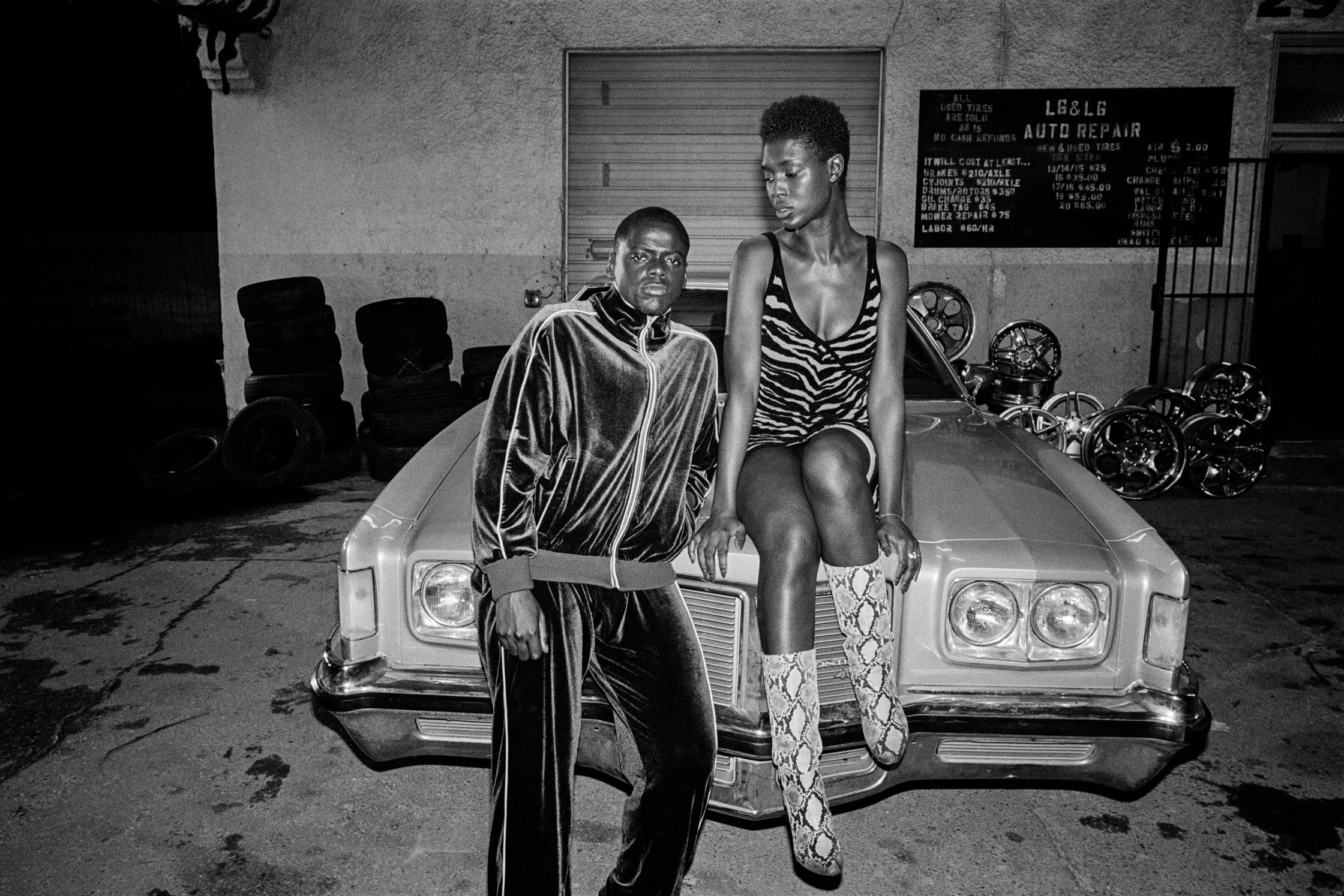
Queen & Slim is not based on a true story. The 2019 film, written by Lena Waithe and directed by Melina Matsoukas, tells an original story about a Black couple who kill a police officer in self-defense during a traffic stop and go on the run. But calling it fiction doesn’t quite capture it either, because the world the film lives in is painfully real. Waithe built the screenplay from the same headlines, the same dashcam footage, and the same fear that shapes how Black people interact with law enforcement every single day.
The better answer: it’s not one true story. It’s all of them.
Where Did the Idea for Queen and Slim Come From?
The concept started with someone who knew he couldn’t write it. Author James Frey, best known for A Million Little Pieces, pitched the idea to Waithe at a Hollywood Reporter party. His pitch was simple: a Black couple gets pulled over, the encounter goes sideways, and instead of dying, they kill the officer in self-defense and run.
Waithe’s response, as she told Andscape: “You can’t write that. But I think I can.”
Frey had an outline and a title. Waithe threw both out. She kept the premise—the traffic stop, the self-defense shooting, the decision to flee—and rebuilt everything else around what she called a “meditation on blackness.” Frey received story credit. Waithe wrote the screenplay.
That distinction matters. The idea of a Black couple on the run from a cop killing is a Hollywood pitch. What Waithe turned it into, a road trip through the American South that’s equal parts love story, protest, and funeral, is something else entirely.
What Real Events Inspired the Film?
Waithe has been direct about what fed the screenplay. In interviews around the film’s release, she pointed to Trayvon Martin, Mike Brown, Eric Garner, Sandra Bland, and Tamir Rice—not as direct source material, but as the atmosphere she was writing inside. “I think being a Black person in America can be quite traumatizing,” she told ABC News. “And for me, my weapon of choice is a laptop.”
Director Matsoukas took the real-world foundation even further. Her primary visual references weren’t other films, they were YouTube videos of Black people being pulled over by police. “I watched a lot of YouTube videos of Black people being pulled over by the police or encountering law enforcement, and it not necessarily ending well,” she said. “Unfortunately, there are so many of those videos.”
The film’s opening scene, set in Cleveland, the same city where twelve-year-old Tamir Rice was killed by police in 2014, doesn’t feel like a coincidence because it isn’t one.
Who Are Angela Johnson and Ernest Hines?
One of the film’s sharpest choices: you don’t learn the main characters’ real names until the very end. Throughout the entire movie, they’re just Queen and Slim—nicknames that Matsoukas has said were meant to represent all of us. Queen for Black women. Slim as a name Black men get called all the time.
Their legal names, Angela Johnson and Ernest Hines, only surface in the final minutes, through news broadcasts reporting their deaths. By that point, the couple has already become something bigger than two individuals. They’re symbols. The names arrive too late to make them people again in the public eye, which is exactly the point.
Angela Johnson and Ernest Hines are fictional characters, not based on any specific real people. But the way the film withholds their humanity until after it’s been taken from them says everything about how the media processes Black death.
Why Do People Compare Queen and Slim to Bonnie and Clyde?
The “Black Bonnie and Clyde” comparison followed the film from its first trailer, and Matsoukas was never happy about it. She called it “a really simplistic and diminishing way to talk about our film.” Her argument: Bonnie and Clyde were criminals who chose that life. Queen and Slim were ordinary people who had a traffic stop turn into a death sentence.
Waithe drew a clearer line. If she was going to compare the film to anything, she said it was Set It Off—the 1996 crime drama with Jada Pinkett Smith, Queen Latifah, and Vivica A. Fox. Not a white archetype. A Black one.
The Bonnie and Clyde framing reveals a habit the industry hasn’t kicked: needing a white reference point to explain a Black story. Waithe understood that. “It’s a natural thing for the industry when there is a Black story to ask, ‘but what’s a white story that this is like,’” she said. “I really think they should look at it as something new.”
Who Made Queen and Slim?
The film was the feature debut for both Waithe (as screenwriter) and Matsoukas (as director), though neither was remotely unknown.
Waithe had already made history in 2017 as the first Black woman to win an Emmy for Outstanding Writing for a Comedy Series, shared with Aziz Ansari for the “Thanksgiving” episode of Master of None. That episode, which Matsoukas directed, was based on Waithe’s own experience coming out to her family. It’s part of why their collaboration on Queen & Slim felt like a natural progression: they’d already built trust on deeply personal material.
Matsoukas came from music videos, Beyoncé’s “Formation,” Rihanna’s “We Found Love,” Lady Gaga, plus television work on Insecure and Master of None. Her visual instincts shaped the film’s look: warm, saturated, built on Black beauty even in the most desperate scenes.
The cast was anchored by Daniel Kaluuya, two years removed from his Oscar-nominated performance in Get Out, and Jodie Turner-Smith in what became her breakout role. Bokeem Woodbine, Chloë Sevigny, Flea, and Indya Moore rounded out the supporting cast.
On a reported budget of $18 million, the film grossed $47.7 million worldwide, a solid return that confirmed the audience for original Black stories with teeth.
What Was the Film Really About?
Queen & Slim works on two levels at once. On the surface, it’s a fugitive thriller, a couple running from the law through the American South, picking up allies and enemies, falling in love on borrowed time.
Underneath that, it’s asking something harder: what does it take for a Black life to matter? Queen and Slim don’t become national figures because they lived full, rich lives. They become symbols because they died. The dashcam footage goes viral not because the system failed them, but the system worked exactly as it was designed to. The virality is the only justice they get.
Waithe structured the film as a “reverse Underground Railroad,” moving south instead of north, which inverts the traditional escape narrative. Queen starts the film as a Malcolm X figure: cynical, sharp, ready to fight the system on its own terms. Slim is the MLK: faithful, gentle, hoping for the best in people. By the end, they’ve swapped positions. That character arc wasn’t accidental. It was the spine of the script.
The film also forced a conversation about who gets to be a hero and who gets to be a martyr. The couple inspires a teenager named Junior to shoot a police officer at a protest, and Junior dies for it. The film doesn’t celebrate that moment or condemn it. It just shows what happens when people who feel powerless finally see someone fight back. The consequences ripple outward in ways no one can control.
The Story Behind the Story
Queen & Slim premiered at AFI Fest on November 14, 2019, and opened wide on November 27, Thanksgiving. The timing felt right for a film about what Waithe called “what we celebrate when it comes to Blackness: our lives versus our deaths.”
The film sits in a specific moment in Black cinema. It arrived the same year as Just Mercy, two years after Get Out, and one year after BlacKkKlansman. But where those films worked within recognizable genres—legal drama, horror, comedy—Queen & Slim refused to settle into one lane. It’s a romance that becomes a thriller that becomes a political statement that ends as an elegy. Matsoukas put it this way: “I hadn’t seen two dark-skinned people fall in love on screen, or be represented in this way, in such layers.”
That’s the thing about Queen & Slim. The plot is fictional. The world it takes place in isn’t. And the question it leaves you with, whether survival and love are possible when the system is built against you, doesn’t have a comfortable answer. The film doesn’t pretend it does.