QUICK FACTS
- Pop Smoke’s real name: Bashar Barakah Jackson
- Mother: Audrey Jackson, Jamaican
- Father: Greg Jackson, Panamanian
- Born: July 20, 1999, Brooklyn, New York
- Raised in: Canarsie, Brooklyn
- Siblings: Older brother Obasi Jackson
Who Are Pop Smoke’s Parents?
Pop Smoke’s mother is Audrey Jackson, who is Jamaican. His father is Greg Jackson, who is Panamanian. He said so himself. In a recorded interview, Bashar put it plainly: “My pops is Panamanian and my mom is Jamaican. I never really grew up with my Jamaican side. I grew up with my Panamanians.”
That’s the answer. Both parents are Caribbean immigrants who settled in Brooklyn, and that combination of Jamaican and Panamanian heritage, dropped into Canarsie, Brooklyn, shaped everything about who Bashar Jackson became.
Per Wikipedia, Pop Smoke was born on July 20, 1999, to Audrey and Greg Jackson. His older brother, Obasi Jackson, is also a music artist. The family lived in Canarsie, a neighborhood in southeast Brooklyn that has been home to generations of West Indian and Caribbean families.
His father’s side gave him one of the most recognizable pieces of his identity. Pop Smoke’s stage name was partly built from a nickname, “Poppa”, given to him by his Panamanian grandmother. The “Smoke” came from “Smocco Guwop,” a street name his Canarsie friends gave him. Put them together, and you have Pop Smoke. One name from the family. One name from the block.
His mother, Audrey, was always present. She once said she knew he had a voice for rap. Long before the deal with Republic Records, before Paris Fashion Week, before “Welcome to the Party” had millions of plays, she was watching her son play African drums and sing in the church choir in Canarsie.
Why So Many Sites Have This Wrong
Here’s where the record needs to be straightened out.
A number of websites, including some that rank well for Pop Smoke searches, have his parents’ backgrounds flipped. Several sites describe Audrey Jackson as Panamanian and Greg Jackson as Jamaican. That’s backward.
Pop Smoke’s own words make this clear. He said his father is Panamanian, his mother is Jamaican. Reporting from LatinTrends, which notes specifically that his mother is Jamaican and his father is Panamanian. The detail that his Panamanian grandmother gave him the nickname “Poppa”, which became half his stage name, further confirms which parent is which.
The confusion likely stems from copy-paste errors that compounded as more sites covered him after his death in February 2020. None of it changes who his parents are. Audrey Jackson is Jamaican. Greg Jackson is Panamanian.
What Canarsie, Brooklyn Actually Meant
You can’t talk about Pop Smoke’s parents without talking about where they raised him, because Canarsie is its own answer to half the questions people have about who he was.
Canarsie sits at the southeastern edge of Brooklyn, and for decades it has been one of the most Caribbean-concentrated pockets in New York City. Trinidadian, Jamaican, Haitian, Guyanese, Panamanian, the neighborhood carries that cultural current in its cookouts, its stoops, its churches, and its language. When Audrey and Greg Jackson planted their family there, they were not outsiders. They were exactly where they were supposed to be.
The Fader magazine reported that Pop Smoke grew up “in a Panamanian household with a strong female presence.” That female presence runs through every account of his early life, his mother, his grandmother, his sister, the women around him who held things together while he navigated a path that went from church choir to house arrest to a Philadelphia prep school basketball program to the streets of Canarsie, and finally to a recording studio.
He told the New York Times that his teenage years ran “high-risk, high-reward.” At 16, he was driving a BMW 5 Series. He’d also been expelled from eighth grade for bringing a gun to school and spent two years under house arrest with an ankle bracelet. He said the house arrest was the only reason he got his diploma, because it was the only place he was allowed to go.
At 15, he got a basketball scholarship to Rocktop Academy, a prep school in Philadelphia. Six months in, a heart murmur ended his competitive basketball career. He came back to Canarsie and turned to street life, said in a LA Leakers interview that coming from the hood left three options: rap, play ball, or sell drugs. He did all three.
His parents didn’t manufacture a sheltered childhood for him. What they gave him was roots. Caribbean roots. A mother who heard his voice and knew before he did. A father whose heritage became literally embedded in his name.
How His Heritage Shaped the Music
Brooklyn drill, the sound Pop Smoke helped define, didn’t come from nowhere. It came from a specific pocket of New York shaped by exactly the kind of Caribbean diaspora his parents represented.
The drill sound he gravitated toward, with its UK-rooted production from 808Melo, connected naturally to someone raised in a West Indian neighborhood that had more in common culturally with London’s Afro-Caribbean communities than it did with, say, Chicago. Canarsie and its musical DNA, reggae at the barbecues, soca at the parties, patois in the hallways, ran parallel to the UK’s Afro-Caribbean communities that had developed their own drill sound. When Pop Smoke found 808Melo’s beats on YouTube and started rapping over them, it wasn’t a random discovery. It was a cultural recognition.
His voice, that deep, gravelly, uncommon-for-20-years-old baritone, carried something older than him. Whether that was genetics or environment or both, it sounded like someone who had absorbed a lifetime of sound before he ever touched a microphone.
He started making music almost by accident in 2018, in a Brooklyn studio session where his friend Jay Gwuapo fell asleep. He grabbed the mic just to see if he could do it. Within a year, he was at Nicki Minaj’s level of co-sign. Within two years, he was dead at 20.
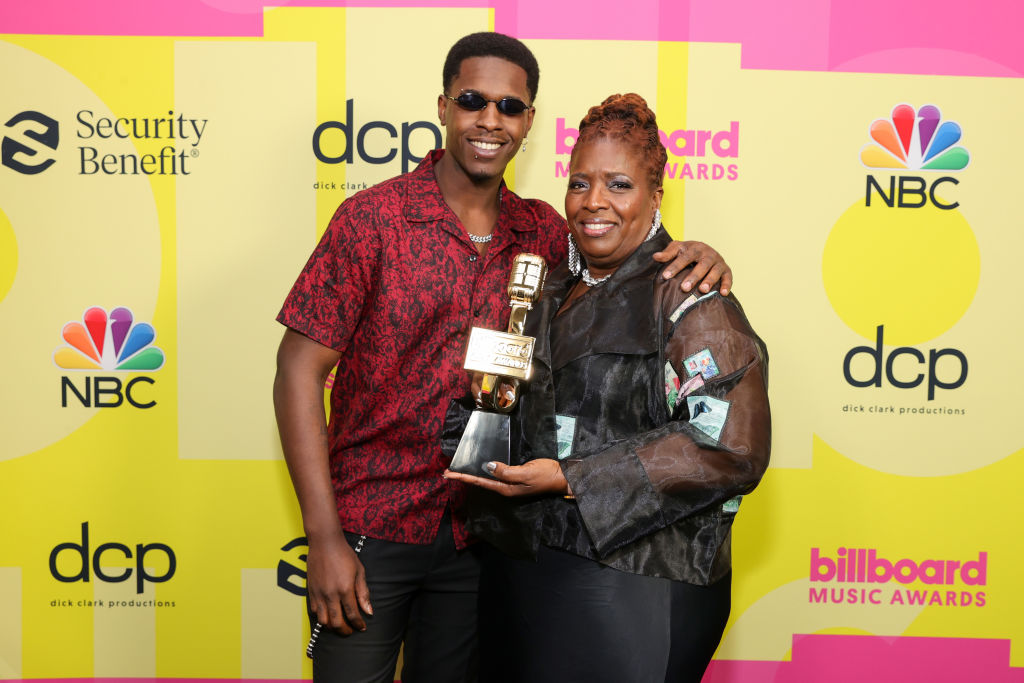
The five Billboard Music Awards he won posthumously in 2021, Top New Artist, Top Rap Artist, Top Rap Male Artist, Top Rap Album, and more, were won by a kid from Canarsie raised between two Caribbean immigrant households and nine Brooklyn schools.
Audrey Jackson After Bashar’s Death
The person who has done the most to carry Pop Smoke’s name forward is his mother.
Audrey Jackson chose the final cover art for his posthumous debut album, Shoot for the Stars, Aim for the Moon. The original artwork, created by Virgil Abloh, drew criticism from fans who called it lazy and disrespectful. A Change.org petition demanding a new cover attracted tens of thousands of signatures. Ryder Ripps designed a replacement: a chrome rose against a black background. Audrey chose it. Hours before the album was released commercially.
The album debuted at number one on the Billboard 200. All 19 tracks charted on the Billboard Hot 100. His mother’s instinct, down to the art.
She also appeared in an anti-gun violence PSA alongside Greg Jackson. Her statement was direct. She said: “On February 19th, at 4:00 AM, a gun was used to take my son from me. You know him as Pop Smoke, we called him ‘Shar’. Because of gun violence, I’ll never see my son run up the front of our steps, taking them two at a time; he won’t ever take my hands again and dance with me; he won’t come into my room and muscle pose in the mirror. Gun violence destroys families. It must stop.”
The Shoot for the Stars Foundation, which Pop Smoke had begun setting up before his death, in collaboration with his mother, continues to run. It’s focused on helping inner-city youth access resources and opportunities. It was his idea. She’s kept it alive.
She never asked anyone to separate her son’s light from the circumstances that took him. She just showed up. Every time.
The Parents Behind the Name
Pop Smoke is buried at Green-Wood Cemetery in Brooklyn. His funeral was in Canarsie, the neighborhood where Audrey and Greg Jackson raised him. A horse-drawn carriage carried his casket through the blocks he grew up on.
His name was half his grandmother’s, his music was built on sounds his neighborhood already knew, and his foundation carries the title of the album his mother helped deliver to the world.
Bashar Barakah Jackson was the product of two Caribbean immigrant families who came to Brooklyn and planted something. What grew from that was one of the most distinct voices New York rap has ever produced. It lasted two years publicly, and it’s still playing.