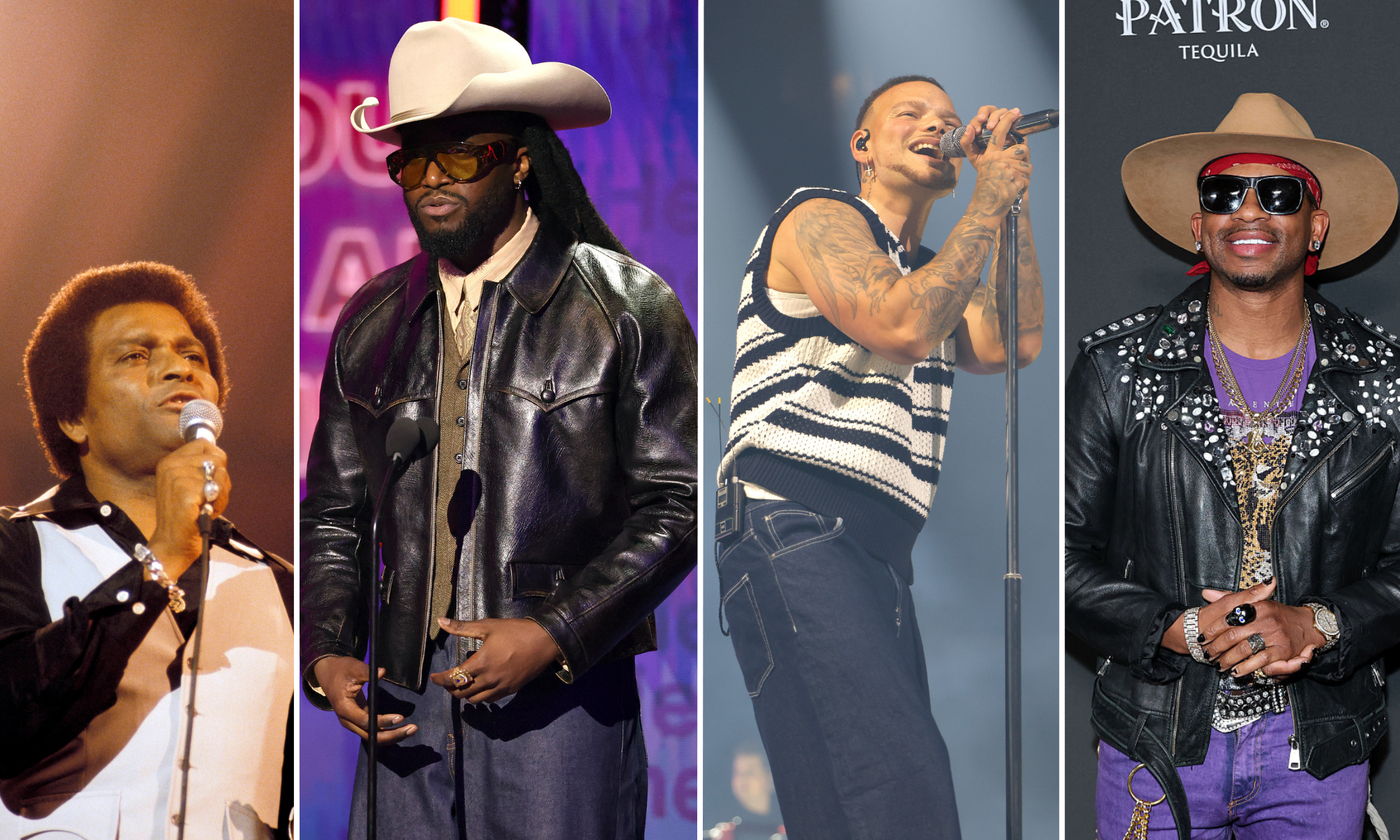
Black men didn’t just contribute to country music. They helped build it. The banjo, the instrument most associated with country and Appalachian folk, has West African origins, brought to America by enslaved people. DeFord Bailey, a Black harmonica player from Tennessee, was the performer whose song inspired the name “Grand Ole Opry” in 1927. And yet, for most of the genre’s history, Black male country singers have been treated like guests in a house their ancestors helped frame.
That’s changing now. Shaboozey’s “A Bar Song (Tipsy)” tied the all-time Billboard Hot 100 record with 19 weeks at number one in 2024. Kane Brown is one of the biggest acts in the format. But this isn’t a new wave, it’s a correction that’s been building for a century.
Here are the black male country singers who shaped the genre, from the ones Nashville tried to forget to the ones who are impossible to ignore.
Who Was the First Black Male Country Singer?
DeFord Bailey is the answer most historians land on, and the story behind it says everything about how this genre works.
Bailey was born in Smith County, Tennessee, in 1899. He contracted polio at age three, which stunted his growth and left him standing just four feet ten inches tall. While bedridden, his family gave him a harmonica. He never put it down.
On December 10, 1927, WSM station manager George D. Hay introduced Bailey’s train-imitating harmonica piece “Pan American Blues” on the radio, and in doing so, spontaneously renamed the show. “For the past hour, we have been listening to music largely from Grand Opera,” Hay said on air. “But from now on, we will present the Grand Ole Opry.”
A Black man performing a harmonica blues piece gave America’s most famous country music show its name.
Bailey was one of the Opry’s most popular performers for 14 years. He toured with Bill Monroe and Roy Acuff, Acuff later said Bailey was the draw, not him. But in 1941, a licensing dispute between ASCAP and BMI meant Bailey couldn’t perform his best-known songs on air. WSM fired him. He spent the rest of his life shining shoes in Nashville.
He was inducted into the Country Music Hall of Fame in 2005, 23 years after his death.
Charley Pride Changed What Country Music Looked Like
If Bailey opened the door and had it shut behind him, Charley Pride kicked it back open and refused to leave.
Pride was born into a sharecropping family in Sledge, Mississippi, in 1934. He dreamed of becoming a baseball player and spent time in the Negro American League before music took over. Chet Atkins signed him to RCA Records in 1966, and the label sent his first singles to radio stations without a photograph, unsure how DJs would respond to a Black country singer.
The music spoke. Between 1967 and 1988, Pride posted 29 number-one hits and 52 top-10 singles on Billboard’s Hot Country Songs chart. “Kiss an Angel Good Mornin’” crossed over to pop in 1971, the same year the CMA named him Entertainer of the Year and Male Vocalist of the Year. He won both Male Vocalist awards in ’71 and ’72, back to back, a first.
He sold over 70 million records. He became RCA’s best-selling artist since Elvis Presley.
And the whole time, he navigated the racism that came with being the only Black face in the room. Well-documented stories place him on tours where he couldn’t eat at the same restaurants as his bandmates. Fellow performers George Jones and Willie Nelson made “jokes” that, per Rissi Palmer’s account, included slurs and KKK references scrawled on his car. He absorbed it, performed through it, and outlasted nearly everyone who tried to make him uncomfortable.
Pride died in December 2020 at 86. The Country Music Hall of Fame had inducted him in 2000. After his death, a bronze statue was erected at the Ryman Auditorium. It was a long time coming.
Who Are the New Black Male Country Singers Making Noise Right Now?
The current generation isn’t asking for permission the way previous generations had to. They’re just making the music, and the numbers are following.
Shaboozey
The Virginia-born artist (real name Collins Chibueze) came up through hip-hop and R&B before landing in country. He appeared on Beyoncé’s Cowboy Carter in 2024, then released “A Bar Song (Tipsy),” which spent 19 weeks at number one on the Billboard Hot 100, per Billboard, tying Lil Nas X’s “Old Town Road” for the longest reign in chart history, tying Lil Nas X’s “Old Town Road” for the longest reign in chart history. He was also the first Black male artist to simultaneously top the Hot 100 and Hot Country Songs charts. The song earned Grammy nominations for Song of the Year, Best Country Song, and Best Country Solo Performance.
Shaboozey isn’t code-switching between genres. He’s proving they were never as separate as Nashville pretended.
Kane Brown
Brown grew up in Chattanooga, Tennessee, and built his initial audience on social media before labels paid attention. His self-titled debut album hit number one on Top Country Albums in 2016. Since then, he’s become one of country’s biggest streaming artists, blending the genre with R&B and pop on tracks like “What Ifs” and “Heaven.” He launched his own label, 1021 Entertainment, through Sony, a move that signals he’s thinking beyond just making records.
Brown doesn’t fit neatly into the traditional country mold, and that’s the point. His audience doesn’t care about genre walls, and neither does he.
Jimmie Allen
Allen, from Milton, Delaware, became the first Black artist to launch a career with a number-one debut single on Billboard’s Country Airplay chart with “Best Shot” in 2018. He won New Artist of the Year at the CMA Awards in 2021. His music leans pop-country with personal storytelling, songs about growing up, faith, and family.
Allen’s career hit turbulence in 2023 after sexual assault allegations led to his label parting ways with him. His story is complicated, and it’s still unfolding.
Willie Jones
The Shreveport, Louisiana, native first got national attention on The X Factor as a teenager, singing Josh Turner’s “Your Man” in a deep baritone that caught everyone off guard. His debut album, Right Now, came out in 2021 and sits at the intersection of country, hip-hop, and Southern soul. His single “American Dream” confronts race directly: “When you’re livin’ as a Black man / It’s a different kinda American dream.”
Jones isn’t softening anything for mainstream comfort. He’s making country music that’s honest about what it means to be Black and Southern.
Darius Rucker Proved Country Could Be a Second Act, and a Real One
Most people know Rucker as the frontman of Hootie & the Blowfish, the band that dominated the ’90s with Cracked Rear View. What’s more impressive is what happened after.
In 2008, Rucker released Learn to Live, his first country album. “Don’t Think I Don’t Think About It” became his first country number one. He followed it with “Wagon Wheel” in 2013, a cover of the Old Crow Medicine Show track built on a Bob Dylan sketch, which went five-times platinum and became one of the decade’s defining country anthems.
Rucker has scored multiple number-one singles and is one of only five Black artists to win a Grammy in the country field. He was inducted into the Grand Ole Opry in 2012.
What made Rucker’s transition work wasn’t novelty; it was that the music was actually good, and he committed to it fully. He didn’t dip into the country. He moved there.
What About the Black Male Country Singers Nashville Overlooked?
For every Charley Pride who broke through, there were others the industry didn’t support.
- Stoney Edwards was a country singer from Oklahoma who landed multiple charting singles in the 1970s, including “She’s My Rock” and “Mississippi You’re on My Mind.” He never got the label push that would’ve taken him further. He died in 1997, largely forgotten by the mainstream.
- O.B. McClinton, from Senatobia, Mississippi, released five albums between 1972 and 1976 and charted singles on the country chart. He called himself “the Chocolate Cowboy” and earned a devoted following in the Southeast, but Nashville’s infrastructure wasn’t built to sustain more than one Black male country star at a time. He died of cancer in 1987 at 47.
- Cleve Francis was a cardiologist who pursued country music as a second career in the early ’90s, signing to Capitol Nashville and releasing two albums. The music was solid, the label support wasn’t, and he returned to medicine.
This is a pattern: Black men making genuine country music and running into a system that couldn’t, or wouldn’t, make room for more than one at a time.
Why Does Country Music Still Have a Race Problem?
The genre’s relationship with Black artists has always been contradictory. Country music draws from traditions that Black musicians helped create, the banjo, blues structures, call-and-response patterns rooted in gospel. Ray Charles recorded Modern Sounds in Country and Western Music in 1962, and it became one of the best-selling albums of the year, but country radio wouldn’t touch it.
When Lil Nas X’s “Old Town Road” was removed from Billboard’s Hot Country Songs chart in 2019, citing insufficient country elements, the controversy exposed what a lot of people already knew: the gatekeeping isn’t always about the music. The song went on to spend 19 weeks at number one on the Hot 100, the same record Shaboozey later tied.
Beyoncé’s Cowboy Carter in 2024 brought the conversation to its biggest stage yet. She won Best Country Album and Album of the Year at the Grammys, the first Black woman to win a country music Grammy as a solo artist. But she also said the album was born from feeling unwelcome at the CMA Awards in 2016 when she performed “Daddy Lessons” with The Chicks.
The doors are opening wider than they ever have. But the history of who built them, and who tried to keep them shut, isn’t something the genre should get to skip past.
The Through Line From 1927 to Now
DeFord Bailey gave the Grand Ole Opry its name in 1927. Charley Pride became the genre’s biggest star while navigating racism that his peers didn’t have to think about. Darius Rucker proved a Black man could thrive in Nashville on talent alone. Kane Brown and Shaboozey are making country music that sounds like what the genre has always drawn from, Black culture, Southern stories, and songs that don’t stay in one lane.
The list of black male country singers isn’t short. It’s just been made to look that way. What’s happening now isn’t a new trend. It’s the genre finally catching up to what’s always been true: this music belongs to them too. It always did.