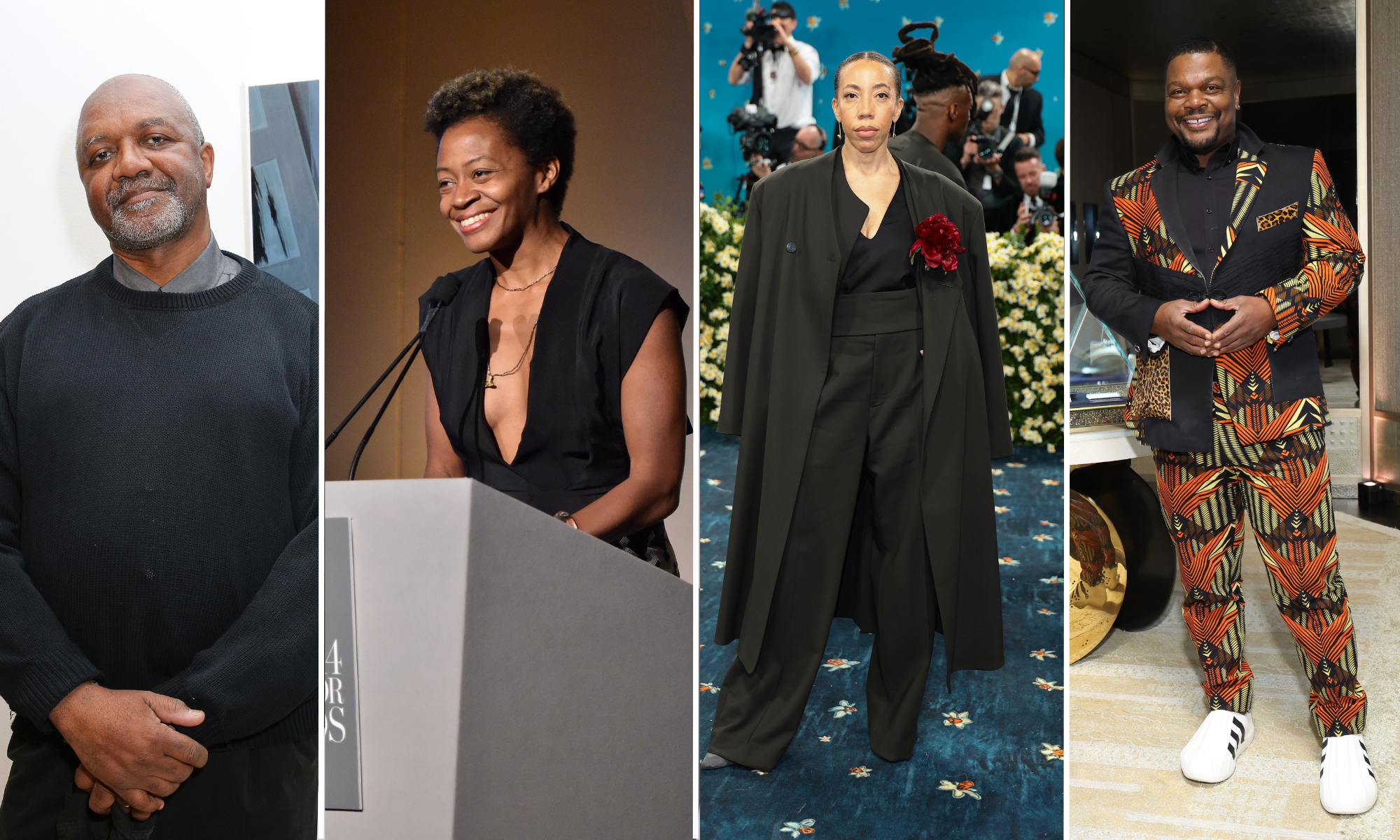
The most famous Black artists working today aren’t just occupying space in the art world. They’re rewriting what that world is allowed to look like, who gets to be portrayed, who gets to be heroic, whose history gets to hang in the permanent collection.
That shift didn’t happen by accident. It happened because artists like Kerry James Marshall spent decades making paintings that the institution had no framework for, until the institution finally caught up. It happened because Kehinde Wiley turned the commission that once excluded Black people into the biggest art news moment of 2018. It happened because Amy Sherald painted Michelle Obama in grayscale and made half the country stop and actually think about what portraiture means.
This list covers the artists doing that work right now: painters, sculptors, quilters, photographers, and conceptual artists. Some of them you know. Some of them you need to know. All of them have changed what’s possible.
Kerry James Marshall
If there’s one name that anchors this list, it’s Marshall. He’s spent his entire career doing one thing: putting Black people, real, full, present Black people, at the center of paintings made in the grand tradition of Western art history.
His 1997 work Past Times, which shows a Black family spending a leisurely afternoon at a lakefront park, composed in the style of Seurat or Manet, sold at Sotheby’s in May 2018 for $21.1 million, setting the record at that time for the highest auction price ever achieved for a work by a living African American artist. The painting had been purchased in 1997 for $25,000.
That jump, 844 percent in two decades, isn’t just about the art market. It’s about an institution finally pricing what Marshall always knew: Black subjects deserve grand paintings. He grew up in Watts and South Central Los Angeles, wandered the halls of museums as a teenager, and noticed that the people he saw every day were nowhere in the canvases. He decided to put them there. He’s been doing it ever since, and the market caught up.
Kehinde Wiley
Wiley has been doing something similar, pulling Black people into the visual rhetoric of power, but his method is different. He takes the poses, the scale, the ornate backgrounds of Renaissance and Baroque portraiture, the visual language historically reserved for kings and generals and saints, and applies all of it to Black men and women he finds on the street.
The result is immediately legible to anyone who knows those old paintings and striking to anyone who doesn’t. His subjects become monumental. They belong.
That approach landed him the commission that mattered: Wiley and Amy Sherald became the first Black artists commissioned by the Smithsonian’s National Portrait Gallery to create official presidential portraits. His portrait of Barack Obama, unveiled in February 2018, shows the 44th president seated against a lush backdrop of chrysanthemums (Chicago’s official flower), jasmine (Hawaii), and African blue lilies (Kenya). The flowers tell the story of where Obama came from. The scale tells the story of where he arrived.
The painting has toured five cities and drawn record-breaking crowds that the Portrait Gallery hadn’t seen in years.
Amy Sherald
Sherald paints Black Americans in grayscale, their skin rendered in shades of gray rather than the pigments you’d expect, against bold, flat, dreamlike backgrounds. It’s a deliberate choice. She wants to shift the viewer’s attention away from racial categorization and toward the individual human being in front of them.
In 2016, she became the first woman and first African American to win the Outwin Boochever Portrait Competition. That win led to the commission that led to the portrait of Michelle Obama. In December 2020, her painting The Bathers fetched $4,265,000, nearly 30 times the presale estimate.
Her mid-career retrospective, American Sublime, opened in 2024 and traveled from the San Francisco Museum of Modern Art to the Whitney Museum of American Art. She pulled it from its final planned stop, the National Portrait Gallery, in 2025 over concerns about institutional censorship of a painting depicting a Black transgender woman as the Statue of Liberty.
That decision tells you exactly who she is. The work says something. She’s not negotiating that.
Kara Walker
Walker has been making art about American racial history since the mid-1990s, and she’s been making it in a form you wouldn’t expect: large-scale silhouettes, cut from black paper, installed on white gallery walls. The silhouettes are beautiful and brutal at the same time. They depict scenes from antebellum slavery with the visual vocabulary of Victorian illustration. The tension between the decorative form and the violent content is the point.
She’s not a new name. She’s been one of the most important artists in contemporary American art for three decades. But she belongs here because she’s still working, still pushing, still finding new ways to make the history of anti-Black violence impossible to look away from. Recent work has expanded far beyond silhouettes into monumental sculpture and large-scale works on paper.
Walker’s work is held by MoMA, the Whitney, the Tate Modern, and institutions across the world. The work doesn’t get easier to look at over time.
That’s the whole idea.
Bisa Butler
Butler’s medium is the quilt. Not as craft, not as folk art, as a full artistic language with as much visual complexity as any oil painting.
Her large-scale quilted portraits take photographs of Black people, often archival images, everyday moments, community celebrations, and render them in vibrant fabric: thousands of pieces of cloth chosen for color, texture, and pattern, assembled into images that carry real weight. She learned to sew from her mother and grandmother, and she’s spoken about the connection between her practice and the quilting traditions of her family and of Black American history.
Her exhibition Bisa Butler: Portraits at the Art Institute of Chicago brought her wide recognition. What made it significant wasn’t just that the work was stunning, it’s that the medium was a deliberate statement. The history of Black American quilting, including the tradition-breaking quilts of Faith Ringgold that Butler has cited as direct inspiration, is part of what she’s working in and extending.
The quilts show Black people as the paintings in major museums don’t: in full color, their specific faces, their particular lives.
Njideka Akunyili Crosby
Akunyili Crosby makes paintings that occupy two places at once. Born in Nigeria and now based in Los Angeles, her large-scale works layer photographic transfers of Nigerian domestic life onto painted surfaces alongside Western art historical references. A Nigerian living room. An American magazine. Aso-oke fabric. A Romare Bearden reproduction on the wall.
The result is work that doesn’t choose between its influences. It holds them all simultaneously. The visual complexity mirrors the actual complexity of a life lived across cultures, and she renders that complexity with specificity most painters can’t match.
She’s represented by David Zwirner and Victoria Miro, two of the most prominent galleries in the world, and her work is held by MoMA, the Tate Modern, the Whitney, and other major institutions. Her auction prices have climbed significantly in recent years as collectors and institutions have caught up to work that was always operating at an exceptional level.
Jordan Casteel
Casteel paints the people she sees around her. Not celebrities, not historical figures. Neighbors, friends, people she encounters in New York City, rendered in large-scale oil paintings with a warmth and directness that makes the viewer feel present with them.
That sounds simple. What makes it radical is context. The history of portraiture in Western art is overwhelmingly a history of powerful men painted to look powerful. Casteel’s subjects are Black people going about their lives, buying produce, sitting on stoops, existing. She gives them the scale and attention the old masters reserved for royalty.
Her work was included in the 2019 Whitney Biennial, and she’s had solo exhibitions at the New Museum in New York. She’s young, and her career is nowhere near its ceiling.
Mickalene Thomas
Thomas’s work is large, loud, and in your face in the best possible way. She makes paintings, photographs, video, and installation, of Black women as reclining nudes, as powerful presences, using rhinestones, glitter, and acrylic to create surfaces that vibrate with energy.
The reference point is art history’s reclining nude, Manet’s Olympia, Titian, the whole tradition, and she puts Black women in those poses and gives them rhinestones and swagger that the original paintings never would have allowed. She’s rewriting the genre from the inside.
Her work is in major museum collections, and she’s had shows at the Brooklyn Museum and institutions across Europe. In December 2020, her market record spiked alongside Sherald and Wiley, a market moment that reflected what the broader art world had been slow to acknowledge.
El Anatsui
Anatsui is Ghanaian, and he belongs on any honest list of the most famous Black artists working today. His sculptures, constructed from thousands of crushed bottle caps and liquor labels connected with copper wire and hung like tapestries from walls and museum facades, are among the most recognized works in contemporary art.
The materials carry the message. The bottle caps are largely from alcohol brands that operated during the colonial period, when the liquor trade functioned as a form of economic control across Africa. Anatsui takes that material and makes it gleam. He turns the remnants of exploitation into something overwhelming and beautiful.
His work has been shown at the Venice Biennale, the Tate Modern, the Brooklyn Museum, and institutions across the world. He is one of the few African artists to achieve the level of institutional recognition that his work has always warranted.
Toyin Ojih Odutola
Odutola makes drawings, large-scale, intensely detailed drawings using pen, charcoal, pastel, and pencil, that depict Black skin with extraordinary specificity. The surface of her subjects’ skin is built up in layers: blue, brown, silver, black, highlights that make the skin look almost architectural. The medium has always been her argument. A drawing tool was originally a writing tool. Her work is also akin to fiction.
She often tells fictional narratives about invented Nigerian aristocratic families, posing questions about class, identity, and the stories we tell about Black people. Her Whitney solo exhibition in 2017, To Wander Determined, brought her wide institutional recognition. Her work is held in the collections of MoMA, the Whitney, the Philadelphia Museum of Art, and the Smithsonian’s National Museum of African Art, among others.
Odutola isn’t making realistic portraits. She’s making arguments about how Black skin has been seen, and how it deserves to be seen.
Hank Willis Thomas
Thomas works across photography, sculpture, and installation, and his consistent subject is the way Black identity gets processed through American popular culture, advertising, and media. He takes images from advertising, often vintage, and strips out the text, leaving just the image: the Black body, the product, the implied transaction. The discomfort of what’s left is the point.
His public work reaches far beyond gallery walls. The For Freedoms project, which he co-founded in 2016, became what TIME named the largest U.S. art initiative in history, a nationwide civic art initiative that placed artist-made billboards in all 50 states during the 2018 midterm elections, working with more than 200 arts organizations. His bronze sculpture, The Embrace, honoring Martin Luther King Jr. and Coretta Scott King, was unveiled on Boston Common in January 2023.
In September 2023, the U.S. Department of State awarded him the Medal of Arts. He said yes, which tells you something, too.
Tschabalala Self
Self paints Black womanhood, specifically the Black female body, with a physicality and urgency that cuts through. Her figures are large, constructed from painted canvas and collage, assembled rather than rendered in the traditional sense. The bodies in her paintings are exaggerated, full, and present in a way that insists on being seen.
The work draws on the history of how the Black female body has been depicted, exoticized, and commodified, and it reclaims that body as its own subject. Self has said her figures are about joy as much as resistance. That combination, pleasure and politics existing at the same time in the same body, is one of the things that makes her work distinct and difficult to look away from.
She’s had solo exhibitions across the US and Europe. She is one of the younger artists on this list, and her trajectory makes her essential.
What This List Adds Up To
The narrative about Black artists in the art world used to center on absence. Those who weren’t in the museums, whose work didn’t hang in the permanent collections, who didn’t get the major grants or the gallery representation.
That story hasn’t ended. The institutions are still working through what they owe. But the artists on this list have moved the terms of the conversation, from absence to presence, from margin to center, from “emerging” to defining what contemporary art is.
Kerry James Marshall didn’t wait for the canon to make room. He painted Black people into it until the canon had no choice. Kehinde Wiley walked into the National Portrait Gallery and put a Black man in the chair where presidents sit. Amy Sherald painted the First Lady in grayscale and made the whole country think about what they were actually looking at.
The art world finally caught up. These artists have been here the whole time.