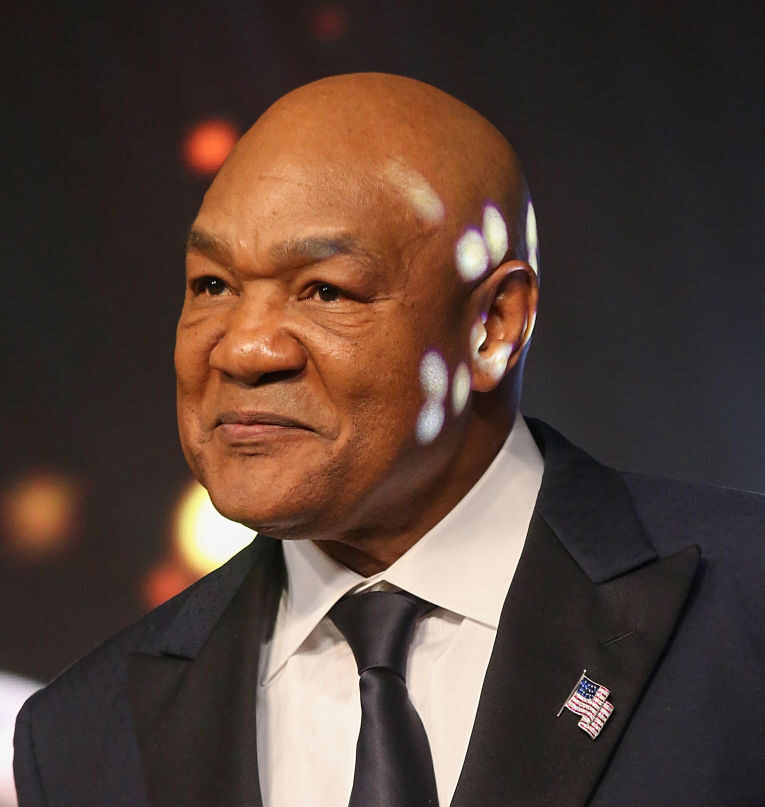
George Foreman’s net worth was estimated at $300 million when he died on March 21, 2025, at age 76. The staggering part isn’t the number, it’s where it came from. The two-time heavyweight champion of the world made more money selling countertop grills than he ever earned throwing punches. His boxing career, which included an Olympic gold medal and one of the greatest comebacks in sports history, brought in roughly $5 million over eight years. The grill brought in over $200 million.
That math tells the real story. George Foreman didn’t just win titles, he figured out how to turn a name into a business at a time when most athletes were watching their money disappear the moment they stopped playing. In an era when Black fighters routinely got exploited by promoters and left the sport with nothing, Foreman rewrote the script.
QUICK FACTS
- Full name: George Edward Foreman
- Born: January 10, 1949, Marshall, Texas
- Died: March 21, 2025, Houston, Texas (age 76)
- Net worth at death: ~$300 million (estimated)
- Boxing record: 76-5 (68 KOs)
- Children: 12 (five sons, all named George)
- Married: Five times; final marriage to Mary Joan Martelly (1985–2025)
How Did George Foreman Make His Money in Boxing?
George Foreman grew up in Houston’s Fifth Ward, one of the toughest neighborhoods in the city. His mother raised him and six siblings alone. He dropped out of school, ran with crews, and by his own telling, only started boxing because the Job Corps program gave him a place to land. “I went into boxing at the age of 17 to lose weight and become a great street fighter,” he told Ringside Report in 2000. “Next thing I know, I was fighting as a Golden Glover.”
By 19, he had Olympic gold from the 1968 Games in Mexico City. By 24, he was heavyweight champion of the world after destroying Joe Frazier in Kingston, Jamaica, the fight that gave Howard Cosell his most famous call. He went 40-0 before losing to Muhammad Ali in the Rumble in the Jungle in October 1974, a fight still considered one of the greatest sporting events of the twentieth century.
But the money from that first run was thin by modern standards—roughly five million dollars saved between 1969 and 1977. Bad investments and overspending wiped it out. By 1987, George Foreman was broke.
That’s not unusual. Evander Holyfield, Mike Tyson, Joe Frazier—the list of heavyweight champions who went broke is longer than it should be. What’s unusual is what Foreman did next.
What Made George Foreman’s Comeback Historic?
After losing to Jimmy Young in 1977, Foreman had what he described as a religious awakening in the locker room. He became a born-again Christian, an ordained minister, and founded the George Foreman Youth and Community Center in Houston. For ten years, boxing was behind him.
At 38, he came back to the ring. He hadn’t fought in a decade. He was overweight, out of shape by boxing standards, and nobody took him seriously. He won anyway, 24 straight fights, including victories over credible opponents. He lost a decision to Evander Holyfield in 1991, which would have ended most comeback stories.
Three years later, at 45 years old, he knocked out Michael Moorer to become the oldest heavyweight champion in boxing history. The November 1994 fight was supposed to be a showcase for Moorer. Foreman was losing on the scorecards when he landed a right hand in the tenth round that ended it.
He retired for good in 1997 with a final record of 76 wins and 5 losses, 68 by knockout. The International Boxing Hall of Fame inducted him in 2003. He was also the executive producer on Big George Foreman, a 2023 film based on his life.
The comeback did more than add titles. It reintroduced Foreman to the public, not as the scowling, menacing fighter who terrified opponents in the 1970s, but as a funny, warm, slightly heavy guy who clearly loved what he was doing. That personality shift is what made everything that came next possible.
How Much Money Did George Foreman Make Off His Grills?
More than boxing. More than endorsements. More than most athletes make from anything.
In 1994, Salton Inc. approached Foreman to endorse a countertop electric grill. The marketing pitch was simple: a former heavyweight champion who “knocks out the fat.” The George Foreman Lean Mean Fat-Reducing Grilling Machine became one of the most successful consumer products in American history, eventually selling over 100 million units.
Foreman’s initial deal gave him roughly 40% of profits. At peak, he was earning eight million dollars a month in royalties. In a 2014 AARP interview, he was asked whether he’d earned more than $200 million from the grill. His answer: “Much more. There were months I was being paid $8 million per month.”
In 1999, Salton paid Foreman $138 million in cash and stock to buy the naming rights outright. Between the monthly royalties and that buyout, his total grill earnings exceeded $250 million—dwarfing what any boxing purse ever paid him.
Here’s a detail that puts the whole story in perspective: the grill almost went to Hulk Hogan. According to Hogan himself, his agent offered him the deal first. Hogan passed because he wanted a different product, a meatball maker. When he declined, the agent gave the grill to his other client: George Foreman. That one phone call is the difference between $250 million and a footnote.
Foreman understood something a lot of athletes missed. He wasn’t selling grills. He was selling trust. The intimidating young fighter people feared in the ’70s had become the friendly guy next door who cooked for his kids. That transformation, which was genuine, not manufactured, made him one of the most effective pitchmen in American advertising history.
Who Inherited George Foreman’s Money?
Foreman was married five times and had 12 children, five sons, all named George Edward Foreman, and seven daughters. His final marriage, to Mary Joan Martelly, lasted from 1985 until his death, 40 years of stability after years of turbulence.
The estate planning for a family that size, across multiple marriages, with adopted children and business assets tied up in brand licensing and intellectual property, is about as complicated as it gets. According to his daughter Georgetta, Foreman treated each child differently based on individual need, “fair but not equal,” as she described it.
His estate includes not just cash and real estate, a sprawling property in Huffman, Texas, with a custom Mediterranean-style mansion and an 11,000-square-foot garage, a 300-acre ranch in Marshall, a Malibu townhouse purchased in 2002, but ongoing brand licensing, intellectual property rights, and residual income from the grill. Specific details of his estate plan have not been made public.
What is known: Foreman insisted all his children get college degrees. George III became a professional boxer who went 16-0 before co-founding the boxing gym chain EveryBodyFights. Freeda Foreman, his daughter, also boxed professionally before her death in 2019 at age 42. The family Foreman built was as much a part of his identity as any title belt.
What George Foreman’s Fortune Really Represents
George Foreman didn’t just build wealth. He built it twice—once in the ring, lost it, and built it back bigger through a business that had nothing to do with fighting. That story hits different for Black athletes, because the list of champions who ended up broke is long and painful, and the system around them, managers, promoters, hangers-on, is often why.
Foreman broke the pattern. He lost everything after his first career and came back with clarity about what money actually was and what it was for. The grill deal wasn’t lucky, it worked because he had become someone people trusted. The kid from Fifth Ward who couldn’t read a contract in his twenties became a man who sold naming rights for $138 million in his fifties.
The $300 million number is impressive. What’s more impressive is that he kept it.