The first Black superhero wasn’t Black Panther. It was Lion Man, a college-educated scientist created by Black journalist Orrin Cromwell Evans for All-Negro Comics #1 in 1947. That’s nineteen years before T’Challa appeared in a single panel of Fantastic Four. And if you’ve never heard of him, that’s not an accident.
Black Panther gets the credit because he debuted in mainstream comics, Fantastic Four #52 in July 1966, created by Jack Kirby and Stan Lee. But the actual history of Black superheroes is longer, messier, and more telling than one character’s origin story. It’s a story about who got to create, who got shut out, and how long it took for Black creators to build something the industry couldn’t ignore.
Who Was Lion Man?
Lion Man was the creation of Orrin Cromwell Evans, a Philadelphia journalist who’d already made history before he ever touched a comic book. Evans was, per his obituary, the first Black writer to cover general assignments for a mainstream white newspaper in the United States, the Philadelphia Record. His reporting on segregation in the armed forces during World War II became part of the congressional record.
When the Record folded in 1947, Evans didn’t look for another newsroom. He looked at comic books. The medium was exploding in popularity, and Evans saw what was missing: Black heroes created by Black people. He teamed up with former colleagues Harry T. Saylor and Bill Driscoll, recruited artists including his brother George J. Evans Jr., and founded All-Negro Comics, Inc. in Philadelphia.
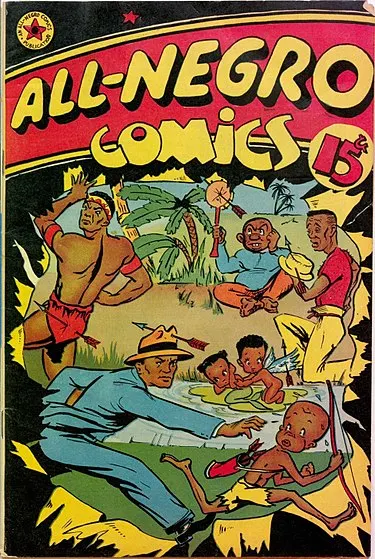
In June 1947, the company published All-Negro Comics #1, a 48-page anthology that sold for 15 cents, five cents more than the standard price. Time magazine covered its release, calling it “the first to be drawn by Negro artists and peopled entirely by Negro characters.” The lead feature: Lion Man, a scientist sent by the United Nations to guard a uranium deposit on Africa’s Gold Coast. He wasn’t wearing a cape. He was knocking out white antagonists in 1947 America.
Evans’ editorial in that first issue said it plainly: this publication would “give Negro artists an opportunity gainfully to use their talents” and “glorify Negro historical achievements.” He wasn’t just making a comic. He was making a declaration.
Why Did All-Negro Comics Only Last One Issue?
There was no second issue. Not because the first one failed, but because Evans couldn’t get the paper to print it on.
When he tried to purchase newsprint for issue #2, distributors refused to sell to him. Comics historians believe he was deliberately blocked by prejudiced suppliers. At the same time, white-owned publishers like Parents Magazine Press and Fawcett Comics started producing their own Black-themed titles, where they controlled the stories, the characters, and the money.
There’s no signed confession proving the sabotage. But a Black publisher in 1947 Philadelphia getting shut out of the supply chain while white publishers moved into his market doesn’t require much imagination to understand. This was seven years before the Comics Code Authority would begin policing content, and the industry already had its own ways of deciding who got to publish and who didn’t.
The timing tells a story on its own. Evans creates a comic by Black artists for Black readers. It gets attention—Time magazine writes about it. Then the supply chain closes. Then white publishers start making their own “Black comics.” The same pattern plays out across every Black-owned industry in the mid-twentieth century: build something, watch it get noticed, lose control of it.
Evans returned to journalism. He worked at the Chester Times and then the Philadelphia Bulletin until his death in 1971. He was 68. He never published another comic. In 2014, he was posthumously inducted into the Will Eisner Award Hall of Fame—the industry’s highest honor. It only took 67 years.
In 2022, writer Chris Robinson launched a Kickstarter to reprint All-Negro Comics #1. That reprint won an Eisner Award for Best Archival Collection in 2024. Lion Man was finally getting recognized — not as a footnote, but as a foundation.
Was Black Panther the First Black Superhero in Marvel Comics?
Black Panther is the first Black superhero in mainstream American comics—that distinction is accurate. T’Challa debuted in Fantastic Four #52 in July 1966, created by Jack Kirby and Stan Lee. Kirby originally conceived the character as “Coal Tiger” before the name was changed.
The significance of Black Panther isn’t just the character. It’s when he showed up and what he represented. This was 1966, two years after the Civil Rights Act, in the middle of the Black Power movement. T’Challa was a king. Ruler of an uncolonized African nation with technology that surpassed anything in the West. He wasn’t a sidekick or a stereotype. He was, from his first appearance, the equal of any hero in the Marvel universe.
The Falcon followed three years later in Captain America #117 in September 1969. Sam Wilson holds a different distinction: he’s the first African-American superhero in mainstream comics. Black Panther is African—Wakandan. The Falcon is from Harlem. That difference matters, and it mattered to readers who wanted to see themselves, not just a fictional African king, in those pages.
Luke Cage came next, debuting in Hero for Hire #1 in June 1972. He was the first Black hero to headline his own mainstream comic book. The series ran 125 issues, real longevity in a market that killed most titles within a year.
Who Were the First Black Superheroes at DC?
DC was slower than Marvel to bring Black heroes into its universe—and when it finally did, the road was rocky. The company’s first Black superhero was John Stewart, an architect who became the backup Green Lantern in Green Lantern #87 in January 1972. Artist Neal Adams pushed back when DC suggested naming the character Lincoln Washington—a stereotypical slave name. Adams won that fight, and it says something about where DC’s head was at the time that the fight had to happen at all.
John Stewart ended up becoming, for many fans, the definitive Green Lantern. The Justice League animated series in the early 2000s used Stewart as its Lantern—meaning a generation of kids grew up thinking of Green Lantern as a Black man. That wasn’t the plan when DC created him as a backup character in 1972. It’s what happened anyway.
DC’s first Black superhero to headline his own series was Black Lightning. Jefferson Pierce — Olympic athlete turned inner-city school teacher, debuted in April 1977. Created by Tony Isabella and artist Trevor Von Eeden, Black Lightning was also notable for who drew him: Von Eeden was one of the first Black artists to work regularly for DC Comics. Isabella later said he created the character specifically because DC’s existing attempts at Black heroes felt shallow and stereotypical.
Between those two, DC introduced Nubia in Wonder Woman #204 in January 1973, the company’s first Black female superhero. Nubia was Wonder Woman’s twin sister, formed from darker clay by Queen Hippolyta and stolen at birth by Ares. The concept had weight. The execution didn’t match—Nubia appeared in a handful of issues, then disappeared for two decades. It took until 2021 for her to finally get her own series.
Who Was the First Black Female Superhero?
This one depends on how you count. Nubia (DC, January 1973) and Storm (Marvel, May 1975) both have claims.
Nubia came first chronologically, but she was barely used—a few issues, then shelved for twenty years. Storm, on the other hand, changed everything. Ororo Munroe debuted in Giant-Size X-Men #1 in May 1975 and immediately became one of the most important characters in the X-Men franchise. She wasn’t a supporting player. She led the team. She married Black Panther in the comics. She became one of the most recognizable superheroes in the world, period.
Storm was also Marvel’s first major African female character. Born to a Kenyan princess and an American photographer, orphaned in Cairo, recruited by Professor Xavier, her backstory alone had more depth than most male heroes got in a decade. In a roster that was getting increasingly diverse in the mid-70s, she stood out—not as a token, but as a character whose power and presence made her the center of every story she was in. Halle Berry played her in the X-Men films. The character became a cultural touchstone for Black women who rarely saw themselves in the genre at all.
The distinction between Nubia and Storm captures something real about how representation works in this industry. Nubia was created, underused, and forgotten. Storm was created, centered, and elevated. The character who got the investment became the icon. The one who didn’t got rediscovered decades later. Both matter, but only one of them shaped what people thought was possible.
What Was the First Black Superhero Movie?
The screen took even longer than the page. The first Black superhero film is generally considered to be Abar, The First Black Superman—a low-budget blaxploitation movie released in 1977. It’s rough. The hero doesn’t even get his powers until the final twenty minutes. But it exists, and it came more than a decade before Hollywood thought the concept was viable.
The first major-studio effort was Robert Townsend’s The Meteor Man in 1993, a superhero comedy about a Washington, D.C., teacher who gains powers after being hit by a meteor. It underperformed at the box office, but it was the first time a Black filmmaker wrote, directed, and starred in a superhero movie for a major studio.
Then came Spawn in 1997, with Michael Jai White in the lead. Then Blade in 1998, with Wesley Snipes. Blade is worth pausing on: that franchise proved Black superhero movies could be commercially successful years before anyone at Marvel Studios greenlit Black Panther. Snipes’ performance as the daywalker is one of the most influential in the genre’s history, and the first Blade film helped save Marvel from bankruptcy.
The Black Panther movie arrived in 2018, directed by Ryan Coogler, starring Chadwick Boseman, and made over a billion dollars worldwide. It was the first superhero film with a Black lead set within the Marvel Cinematic Universe. But it wasn’t the first Black superhero film, and the history that came before it is part of why it resonated the way it did.
What Milestone Media Built
The most important chapter in this story might be the one that doesn’t get enough attention: Milestone Media.
In 1993, four Black creators, Dwayne McDuffie, Denys Cowan, Michael Davis, and Derek T. Dingle, founded Milestone Media because the mainstream industry still wasn’t telling their stories right. McDuffie, who’d written for Marvel and knew the system from the inside, was blunt about the problem: mainstream comics treated Black characters as guests in a white universe. Milestone’s answer was to build a universe where they weren’t guests at all.
They struck a deal with DC Comics for distribution and launched four titles in spring 1993: Hardware, Blood Syndicate, Icon, and Static. The characters lived in Dakota City—a fictional metropolis with the kind of racial, economic, and social complexity that Marvel’s New York and DC’s Gotham never quite managed.
Static became the crown jewel. Virgil Hawkins, a teenager from Dakota City with electromagnetic powers, later got a Saturday morning cartoon, Static Shock, that ran four seasons on Kids’ WB. It connected to the wider DC animated universe, tying in with Batman and Justice League. For a generation of Black kids in the late ’90s and early 2000s, Static was the hero. Not a sidekick to someone else’s story. The main character of his own.
What makes Milestone significant is the same thing that made All-Negro Comics significant 46 years earlier: Black creators building their own characters, controlling their own narratives, owning their own stories. McDuffie and his partners weren’t asking DC to diversify its roster. They built a universe. McDuffie died in 2011 at age 49—too young, and before the full legacy of what he built was recognized.
The Pattern That Runs Through All of It
Here’s what the timeline actually tells you. In 1947, a Black journalist created the first Black superhero, and the industry shut him down. Nineteen years later, two white creators made Black Panther, a milestone, but one owned by Marvel, not by any Black creator. It took another 27 years for Black creators to build Milestone Media and launch their own superhero universe again. And it took until 2018 for a Black director to bring a Black superhero to the screen in a way that broke every record in the genre.
Seventy-one years from Lion Man to the Black Panther movie. The pattern repeats: Black creative vision gets created, gets suppressed or co-opted, then eventually forces its way through anyway. Evans couldn’t buy newsprint. McDuffie had to start his own company. Coogler made a billion-dollar film. The ambition was always there. The access is what took seven decades.
Lion Man didn’t get a sequel. But the door Evans pushed open—even though the industry forced it shut—stayed open just enough for everyone who came after.