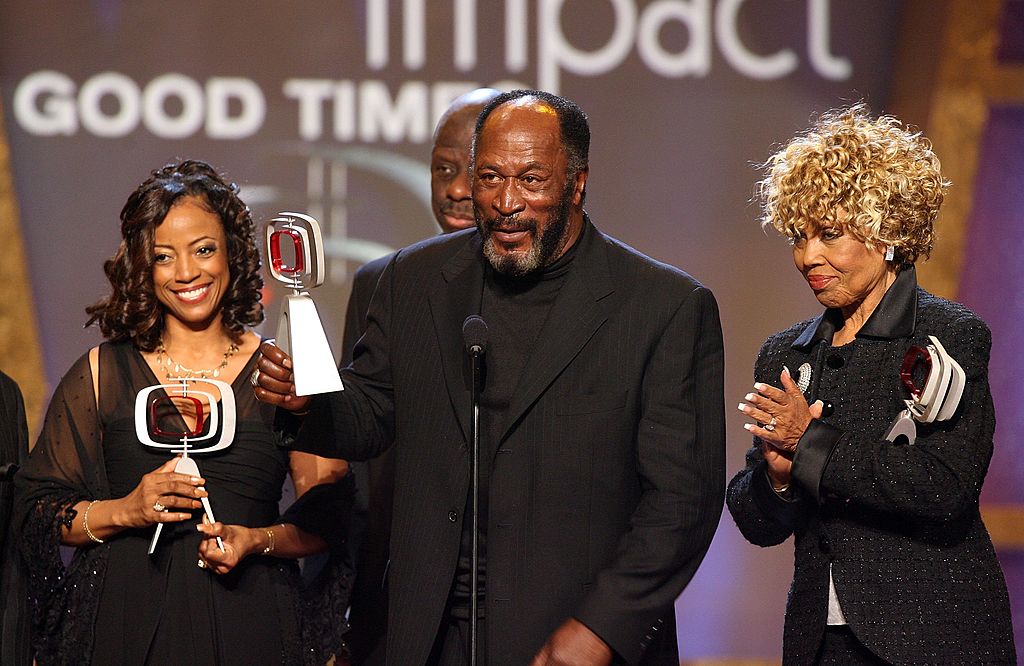
John Amos didn’t leave Good Times. He was fired. After three seasons as James Evans Sr., the hardworking father at the center of television’s first Black two-parent family sitcom, executive producer Norman Lear told Amos his contract option wasn’t being renewed.
The reason: Amos had spent those three seasons fighting the show’s white writing staff over what he saw as inauthentic, stereotypical portrayals of Black characters, and the writers had had enough of him.
That’s the short version. The fuller story is a creative battle over who gets to define Black family life on television, and what happens when the Black actor in the room tells the white writers they’re getting it wrong.
QUICK FACTS
- Full name: John Allen Amos Jr.
- Born: December 27, 1939, Newark, New Jersey
- Died: August 21, 2024, age 84
- Good Times role: James Evans Sr. (1974–1976), 61 episodes
- Reason for departure: Fired by Norman Lear after being labeled a “disruptive element”
- Character’s fate: Killed off in a car accident, Season 4 premiere
Why Was John Amos Fired From Good Times?
It came down to authenticity. When Good Times premiered on CBS on February 8, 1974, there were no African American writers on the show’s staff. The series was created by Eric Monte and Mike Evans, both Black men, but the day-to-day writing room was white. Amos, who had started his career as a writer on The Leslie Uggams Show in 1969 before he was ever a television actor, knew the difference between authentic Black dialogue and what someone imagined it sounded like.
He pushed back. Constantly. In a 2017 interview with Sway in the Morning, Amos described it plainly: the writers would present scripts with attitudes and behaviors that didn’t reflect how Black families actually operated, and he’d tell them so. Their response was to cite their credentials. His response was to ask how long they’d been Black.
The friction built for three seasons. Amos was only 34 when production started—just eight years older than Jimmie Walker, who played his eldest son J.J., and 19 years younger than Esther Rolle, who played his wife Florida. He was a young man with strong convictions, a Newark upbringing, and no interest in diplomacy when the scripts felt wrong.
Norman Lear eventually made the call. In a 1976 Jet Magazine interview, Amos recounted: “Norman Lear called me a month ago and told me my option with Good Times was not being picked up. That’s the same as being fired.”
What Was the J.J. Evans Problem?
The biggest flashpoint was Jimmie Walker’s character, J.J. Evans. Walker had become the show’s breakout star—his catchphrase “Dyn-o-mite!” was a cultural phenomenon, and the writers kept feeding it. More J.J. antics. More chicken hats. More mugging for laughs. The character was pulling the show’s center of gravity away from where Amos and Rolle believed it belonged.
In his 2014 interview with the Archive of American Television, Amos laid it out: he felt too much emphasis was going to J.J.’s buffoonery when the show had two other Evans children with ambitions worth exploring—Michael, who wanted to be a Supreme Court Justice, and Thelma, who wanted to be a surgeon.
Both Amos and Rolle saw J.J.’s portrayal as feeding stereotypes rather than challenging them. The character was getting the biggest laughs and the most screen time, while the writers sidelined the storylines that showed a Black family with serious goals and real complexity. For a show that was supposed to present an honest picture of Black family life, the drift toward comedy at the expense of substance felt like a betrayal.
Lear acknowledged the tension in his 2014 memoir, writing that the attention on J.J. made Amos “glum and dispirited,” which ultimately led to writing the actor out after Season 3.
Even Walker understood the situation. In his 2012 memoir Dyn-O-Mite!, he wrote that he would have preferred Amos stay and the show remain an ensemble.
How Was James Evans Killed Off Good Times?
The producers didn’t just write James Evans out—they killed him. In the two-part Season 4 premiere, “The Big Move,” Florida learns that James died in a car accident in Mississippi while starting a new business, an auto repair shop that was supposed to lift the family out of the projects. The scene that followed became one of the most famous moments in sitcom history: Esther Rolle, as Florida, smashes a punch bowl and screams “Damn! Damn! DAMN!”—a raw, devastating performance that carried real weight because the audience knew something irreplaceable had been lost.
The producers chose not to recast the role. They wanted James Evans gone for good.
The character’s death wasn’t just a plot device. It dismantled the two-parent Black family structure that had made Good Times groundbreaking in the first place. Rolle had originally insisted the family have a father, that was a non-negotiable for her when she signed on. Now that father was dead, and the show that had been built on the foundation of a strong Black marriage was a single-mother story. Not because the creative vision called for it, but because the network and its producer couldn’t work with a Black actor who insisted on getting the representation right.
Did Esther Rolle Leave Good Times for the Same Reason?
Rolle shared Amos’s frustrations—and in some ways was even more vocal about them. She had been outspoken about her problems with J.J.’s characterization even before Amos was fired, telling Ebony magazine in 1975 about her disdain for what the character had become. She saw J.J. as a modern minstrel figure, and she said so publicly. Without Amos on set to push back alongside her, Rolle found it increasingly difficult to steer the show’s direction.
She left after Season 4. Contract negotiations played a role, she’d asked for a raise and was turned dow, but the creative disagreements ran deeper. Rolle didn’t just want more money. She wanted the show to stop reducing its Black characters to punchlines. When the producers wouldn’t budge on either front, she walked.
The show tried to keep going without either parent, leaning hard on Walker’s J.J. to carry the series. They brought in new characters and a new love interest for Florida. None of it stuck.
Rolle returned for the sixth and final season in 1978, but the damage was done. The show’s ratings had dropped significantly, partly because of time slot changes and partly because the core of what made the show work, the Evans family with both parents present, was gone. Good Times ended on August 1, 1979, after 133 episodes and six seasons. The last three seasons were a different show than the first three, and everyone watching could tell.
What Happened to John Amos After Good Times?
The firing turned out to be the door to something bigger. In 1977, just months after James Evans was killed off, Amos played the adult Kunta Kinte in ABC’s landmark miniseries Roots. The show drew over 130 million viewers and earned Amos an Emmy nomination.
There’s a real irony there. The actor who was fired for demanding authentic Black storytelling on a sitcom went straight to the most powerfully authentic portrayal of the Black American experience television had ever produced.
After Roots, Amos built a career that stretched for decades. He played Cleo McDowell in Coming to America alongside Eddie Murphy—a role he famously ad-libbed some of the best lines in, was Admiral Percy Fitzwallace on The West Wing. He appeared in Die Hard 2, The Beastmaster, and dozens of other projects, staying active right up until his death.
And he reconciled with Lear. In a 2019 Entertainment Weekly interview, Amos said they’d settled their differences years earlier. He went on to do three more pilots with Lear, including 704 Hauser. In December 2019, Amos appeared on ABC’s Live in Front of a Studio Audience recreation of a Good Times episode, playing a different character. He and Lear hugged on stage.
The Fight That Mattered More Than the Show
John Amos lost his job on Good Times because he told a room full of white writers that they didn’t understand Black life, and he wasn’t wrong. The show he fought for eventually lost both of its leads over the same creative disagreement, and it was never the same. But the fight itself mattered. A Black actor on one of the biggest shows on television refused to co-sign portrayals he knew were inaccurate, even when it cost him the role that made him famous.
He chose the integrity of the work over the security of the job. The culture remembers that, and it’s the reason his name still carries weight decades later.
Amos died on August 21, 2024, at 84, of congestive heart failure. His death wasn’t publicly announced for over 45 days. But the work—Good Times, Roots, Coming to America, and everything in between—doesn’t need an announcement. It speaks for itself.