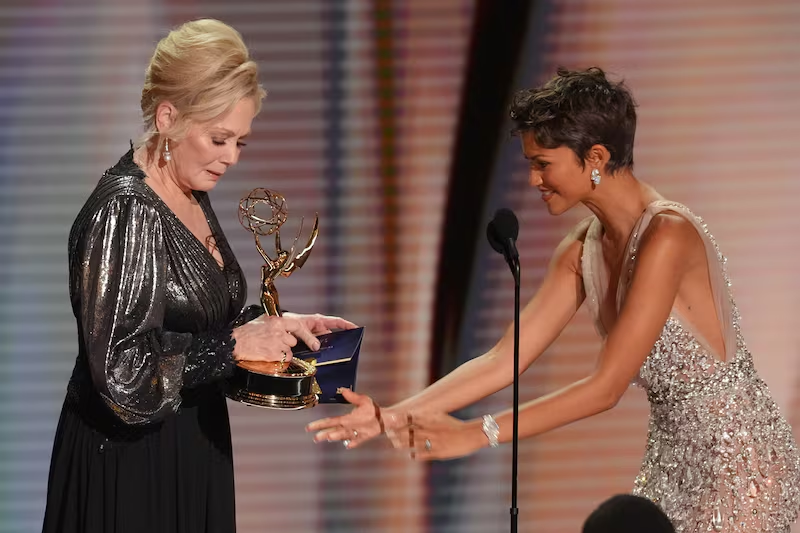
Apple TV+’s “Widow’s Bay” dominated the 78th Primetime Emmy Awards Sunday, Sept. 14, winning six trophies on the main telecast, while the ceremony also honored Michael J. Fox for his Parkinson’s advocacy and mourned Dolly Parton, who died in August. The night unfolded against a backdrop of guild anger over the Television Academy’s decision to cut five categories from the televised broadcast.
The Winners
“Widow’s Bay,” a horror-comedy created by Katie Dippold, won Outstanding Comedy Series along with writing, directing, lead actor (Matthew Rhys), supporting actor (Stephen Root) and supporting actress (Kate O’Flynn) — six wins at the Peacock Theater ceremony in downtown Los Angeles, part of 14 Emmys total once Creative Arts awards are included. HBO Max’s “The Pitt” won Outstanding Drama Series, and its star Noah Wyle won lead drama actor.
“DTF St. Louis” won Outstanding Limited or Anthology Series.
Rhys made Emmy history, becoming the first performer to win in two separate lead-acting categories the same night: comedy lead for “Widow’s Bay” and limited-series lead for “The Beast in Me.” Jean Smart won her fifth lead comedy actress Emmy for “Hacks.” Rhea Seehorn won her first Emmy, for lead drama actress in “Pluribus,” after years of being passed over for “Better Call Saul.”
Accepting the comedy series award, Dippold thanked Apple, saying, “They truly just let us do this weird show, and we can’t thank you enough.”
The Fox Tribute
Fox received the Bob Hope Humanitarian Award for his advocacy through the Michael J. Fox Foundation for Parkinson’s Research, appearing with wife Tracy Pollan for his first Emmys appearance together with her in 13 years. He received a standing ovation. “Initially, I kept my Parkinson’s diagnosis a secret,” Fox said in his acceptance remarks. “I worried that it would affect my work and my relationship with audiences.” He said his foundation is “close” to a cure.
The show also staged a tribute to Dolly Parton, who died Aug. 25 at age 80, three weeks before the ceremony. Sally Field introduced the segment, saying, “If there are truly angels on Earth, we just lost one. She was genuine and humble, supportive and blisteringly funny.” Parton was nominated for four Emmys over her career and won once, for outstanding television movie for “Dolly Parton’s Christmas on the Square.”
The broadcast’s broader In Memoriam segment, set to Noah Kahan’s performance of “Bridge Over Troubled Water,” also marked the deaths of other television figures from the past year.
Host Mariska Hargitay, best known for playing Olivia Benson on “Law & Order: Special Victims Unit,” led the ceremony on NBC and Peacock from the Peacock Theater. “The Pitt” entered the night as the most-nominated series with 25 total nominations, including 12 in major categories, making its eventual loss of the top comedy prize to “Widow’s Bay” one of the night’s closer races even though “The Pitt” still took home the drama series award.
The Guild Fight Over Cut Categories
The ceremony doubled as a flashpoint in an ongoing dispute between the Television Academy and Hollywood’s major guilds. In July, the academy moved five categories — limited-series supporting actor and actress, limited-series writing and directing, and variety writing — off the primetime NBC broadcast and into the untelevised Creative Arts ceremonies, shrinking the main show from 26 categories to 19 to make room for what Television Academy Chairman Cris Abrego told Variety would let the show “flex more creativity” and “create an incredible night of entertainment.”
The Directors Guild of America, SAG-AFTRA and the Writers Guild of America responded with a joint statement condemning the move: “The decision to eliminate these categories from the primetime broadcast devalues the contributions of the talented people the Academy is meant to honor.” Neither side has publicly softened its position since the July announcement, and the dispute was still unresolved as of the Sept. 14 telecast.
The cut categories are not minor by industry standards: limited-series supporting acting and directing awards have in past years gone to prominent performers and filmmakers whose work is central to a given season’s prestige-television slate. Moving those categories off the live broadcast means their winners are announced and honored only at the separate, non-televised Creative Arts Emmys held the weekend before the main show, without the same national audience or acceptance-speech platform as an on-air win.
Why It Matters
The Emmys remain television’s most-watched annual industry honor, and this year’s ceremony became a visible test of how much room a major awards show has for spectacle versus recognition of the writers, directors and supporting performers whose categories were pushed off-camera. The three guilds’ unified public objection signals the dispute is not limited to a single union’s grievance.
What Happens Next
It remains to be seen whether the Television Academy adjusts its category format for the 2027 ceremony given the guilds’ continued objection. “Widow’s Bay” is expected to return for a second season on Apple TV+ following its sweep. Rhys’s dual-category win in comedy and limited series is also expected to prompt renewed industry discussion about how the Television Academy classifies genre-blending shows, a recurring point of friction given how many prestige series now blur the line between comedy, drama and limited-series formats from year to year.
Seehorn’s win for “Pluribus” closed out a yearslong narrative in television awards circles: she had been nominated repeatedly for her supporting role as Kim Wexler on “Better Call Saul” without ever winning, making her first Emmy, in a leading role on a different series entirely, a resolution many television critics had been anticipating for several award cycles.