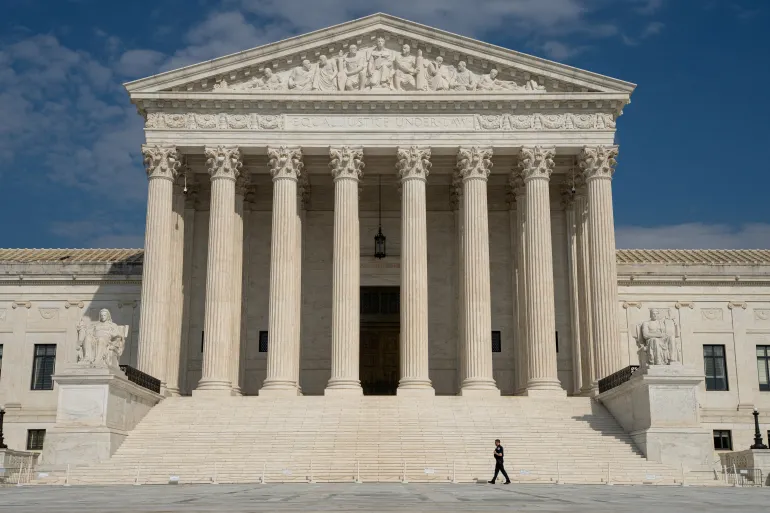
The Supreme Court on Sept. 14, 2026, denied the Trump administration’s request to lift a lower-court order blocking new mail-ballot rules at the U.S. Postal Service, leaving the rules on hold through November’s midterm elections.
What the Supreme Court Decided
The unsigned majority order said the government is “unlikely to succeed on the merits of its challenge” and that “equitable factors … do not favor a stay.” The case, U.S. Postal Service v. California, No. 26A305, reached the court on its emergency docket, a track typically used when a party asks the justices to act quickly, without full briefing or argument, before a lower-court case is finished.
Justice Brett Kavanaugh wrote separately, concurring in the outcome. Kavanaugh, the justice, said the rule “falls within the Postal Service’s statutory authority” but that putting it into effect now would be “arbitrary and capricious … because state and local election officials do not have sufficient time to reasonably implement the rule” before the Nov. 3 election.
Justices Samuel Alito and Clarence Thomas dissented and would have granted the administration’s request. Alito argued the states and voting-rights groups that sued did not have legal standing to bring the challenge.
The rule at issue traces to a March 2026 executive order from President Trump directing the Postal Service to require states to submit voter lists and use specific security barcodes on mail-ballot envelopes, with ballots going undelivered if states did not comply.
How the Case Reached the Supreme Court
The ruling capped a procedural path that moved through three courts in less than two weeks. U.S. District Judge Indira Talwani in Boston issued the first preliminary injunction around Sept. 4-7, 2026, finding the Postal Service lacks the authority to condition ballot delivery on the new requirements. The 1st U.S. Circuit Court of Appeals then unanimously denied the administration’s bid to lift that injunction on Sept. 10, 2026, in a 3-0 decision from a panel made up of Judges Gustavo A.
Gelpí, Julie Rikelman and Seth Aframe, all three appointed by President Biden. A second federal judge, Carl Nichols, separately ruled against the plan on Sept. 13, 2026. Notably, Nichols was nominated to the bench by Trump, meaning a Trump-appointed judge and three Biden-appointed appellate judges reached the same conclusion against the administration’s own policy before it made its third emergency application, this time to the Supreme Court, which ruled on Sept. 14, 2026.
Reactions From Both Sides
Solicitor General D. John Sauer, arguing for the administration, called the injunction “baseless.” President Trump, reacting to the ruling on Sept. 15, 2026, called it “a big loss for Republicans” and said the justices were “a shell of their original selves.” Trump called Alito and Thomas “legends” for their dissent.
Challengers welcomed the decision. Celina Stewart, chief executive of the League of Women Voters, said
“the Postal Service exists to deliver Americans’ mail — not to rewrite election rules.” New York Attorney General Letitia James, one of the state officials who sued, said voters should “never have to wonder whether a ballot they legally cast will be counted.”
Opposition to the rule was not limited to Democratic officials. Republican state election officials, including in Utah, had separately warned the plan “will almost certainly lead to mistakes, delays, and confusion,” putting some Republican officials at odds with the administration’s own policy.
Why It Matters and What Happens Next
The ruling blocks a major change to election procedure roughly seven weeks before the midterms. At least two states had already begun mailing ballots under the existing rules before the dispute reached the Supreme Court.
Litigation over the rule continues at the 1st Circuit, where the underlying legal challenge to the Postal Service’s authority will be argued on the merits. Talwani’s injunction stays in place while that case proceeds, meaning the barcode and voter-list requirements will not take effect before voters cast ballots in November. The Supreme Court’s order applies only to the emergency request to lift the injunction and does not resolve the broader legal question of whether the Postal Service has the statutory authority to impose the requirements at all.
Fed Interest Rate Hike Lifts Rates to 3.75%-4% Range
The Federal Reserve raised its benchmark interest rate by a quarter of a percentage point on Sept. 16, 2026, lifting the federal funds rate target range to 3.75%-4% from 3.5%-3.75%. It is the first increase since July 2023 and reverses a cutting cycle that ran through late 2025, as inflation stayed well above the Fed’s 2% target.
Why the Fed Raised Rates
The Federal Open Market Committee voted 12-0 to approve the increase, according to the Federal Reserve’s statement. Fed Chair Kevin Warsh, a Trump appointee who took over as chair earlier in 2026, told reporters that “the plain fact is that inflation is too high and has been for too long,” and said “this summer’s inflation readings do not tell me that underlying trends have meaningfully improved,” according to Fox Business.
Warsh cited personal consumption expenditures inflation running near 3.6% in August, well above the Fed’s 2% goal, along with core PCE inflation at 3.2% and core Consumer Price Index inflation at 2.4%, according to Fox Business. He also pointed to higher energy prices as a factor. Despite the increase, Warsh said “our decision comes at a time when the American economy appears to be strengthening,” according to the same report.
The Fed’s own projections show one more quarter-point increase likely before the end of 2026, with officials forecasting PCE inflation at 3.7% for the year before it eases to 2.3% in 2027, according to the Federal Reserve.
What the Inflation Numbers Show
The rate decision followed a Consumer Price Index report showing prices rose 0.4% in August and 3.4% over the past year, according to the Bureau of Labor Statistics. Gasoline prices drove much of the increase, rising 3.9% for the month and 27.4% over the year, and alone accounted for more than a third of August’s overall monthly increase, the bureau reported.
The broader energy index climbed 2.1% for the month and 16.3% over the year. Shelter costs, the largest single component of the index, rose a comparatively modest 0.3% for the month and 3.0% over the year, according to the BLS report.
What Higher Gas Prices Are Really Costing Americans
The U.S. Energy Information Administration reported the average U.S. retail price for a gallon of gasoline at $4.192 in August 2026, according to EIA data. Using the BLS’s reported 27.4% year-over-year increase in gasoline prices, a back-of-envelope calculation — not a figure published by either agency — puts the implied August 2025 price at about $3.29 a gallon, arrived at by dividing $4.192 by 1.274. That points to an increase of roughly 90 cents a gallon over the year.
Using the EIA’s most recently published figure for total U.S. finished-motor-gasoline consumption, roughly 137.14 billion gallons a year, against a U.S. population of about 342 million, per-capita consumption works out to roughly 401 gallons a year. Multiplying that by the roughly 90-cent increase suggests higher gas prices alone are costing the average American about $360 a year, or roughly a dollar a day.
That figure is spread across the entire population rather than just drivers, so the actual cost to someone who drives regularly runs higher. This is an original calculation using BLS and EIA figures, not a number either agency published itself, and the consumption figure used is the most recently available one rather than a count specific to 2026.
What It Means for Mortgage Rates
Mortgage rates track the 10-year Treasury yield rather than the Fed funds rate directly, but they climbed alongside the rate decision. Forbes Advisor, citing Zillow-linked data, reported the average 30-year fixed mortgage rate at 7.08% on Sept. 16, up from 6.78% a week earlier and a one-year high. The 15-year fixed rate rose to 6.30%, according to Forbes Advisor.
Separately, marketplace data from Zillow reported by Yahoo Finance put the 30-year fixed rate at 7.02% and the 15-year fixed at 6.32% on Sept. 15, according to Yahoo Finance. The two trackers report slightly different averages for the same week.
On a $100,000 loan, a 30-year mortgage at 7.08% runs about $671 a month in principal and interest and about $142,490 in total interest over the life of the loan, Forbes Advisor calculated. A 15-year loan at 6.30% runs about $860 a month with about $55,555 in total interest, according to Forbes Advisor.
Melissa Cohn, regional vice president at William Raveis Mortgage, said the relationship between Fed moves and mortgage rates does not always run in the same direction. “In 2025, when the Fed was cutting rates, mortgage rates went up. So, who’s to say that in 2026, if the Fed raises rates, that mortgage rates can’t come down?” Cohn said, according to Newsweek.
She also said the increase was necessary for the Fed’s credibility, saying “if Warsh and the Fed did not raise rates, he risked losing credibility.” Cohn added that rising rates narrow the pool of qualified buyers: “Every eighth of a percent higher on a rate is another group of buyers that don’t qualify. People are going to have to downsize their expectations,” she said, per Newsweek.
Eric Orenstein, senior director at Fitch Ratings, said the higher rates will weigh on the housing market. “Elevated rates will certainly slow home purchases and mortgage refinancing through the rest of the year,” Orenstein said, according to Newsweek. Lawrence Yun, chief economist at the National Association of Realtors, said relief depends on factors beyond the Fed’s control.
“Mortgage rates can come down once oil prices retreat and with a credible plan to reduce the budget deficit,” Yun said, but cautioned that “these developments are highly uncertain, at least in the upcoming months,” according to Real Estate News. Bill Banfield, chief business officer at Rocket Mortgage, offered buyers a more optimistic view, saying “for anyone house hunting right now, it’s a buyers’ market in many metros, with inventory at a six-year high and plenty of room to negotiate,” according to Real Estate News.
The Political Fallout
The rate increase sets up a clash between the White House and a Fed chair Trump himself installed earlier in 2026. President Donald Trump wrote on Truth Social that “interest rates in the United States should be 1%, or less,” and demanded the Fed “lower the interest rates for the United States of America, and fast,” according to Yahoo Finance. Trump said the economy was “booming with new investment.”
Asked about pressure from the White House, Warsh declined to comment. “I’ve got nothing for you on a discussion with the president,” he said, adding that the Fed should “stay in our lane,” according to Fox Business.
White House senior deputy press secretary Kush Desai called the Fed’s decision “rather unfortunate” and said it lacked “a particularly compelling economic case,” according to Yahoo Finance. Desai attributed the recent price increases solely to energy supply shocks rather than broader inflation trends, a direct rebuttal to Warsh’s framing that underlying inflation pressures remain elevated.
What Happens Next
The Fed’s own projections point to one more quarter-point increase before the end of 2026, according to the Federal Reserve. Where mortgage rates go from here will depend largely on the direction of the 10-year Treasury yield and oil prices, according to Real Estate News. Yun said any relief for homebuyers hinges on oil prices retreating and a credible federal deficit-reduction plan, though he called that outcome uncertain in the near term.