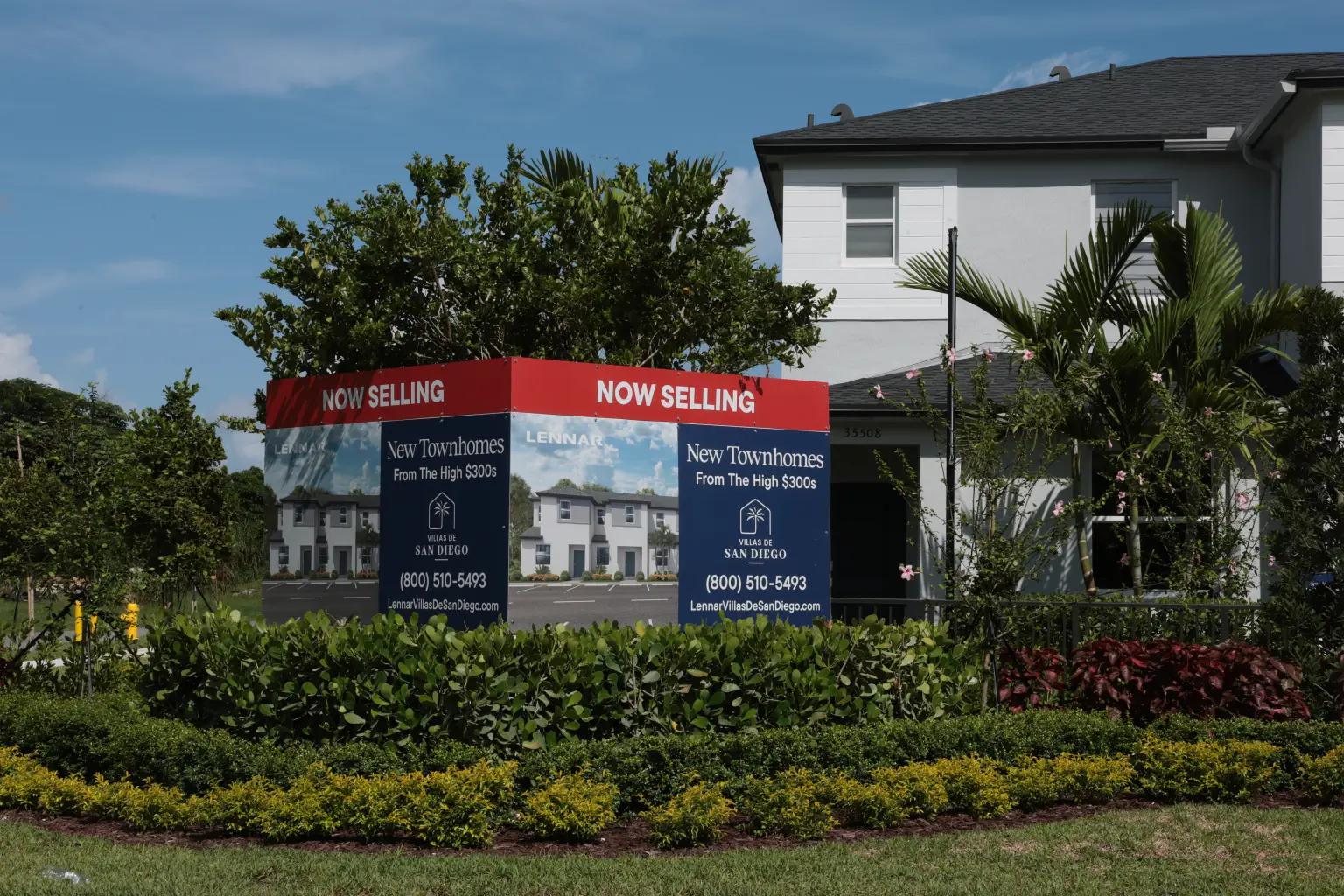
The average rate on a 30-year fixed mortgage climbed to 6.95% this week, the highest level in a year, Freddie Mac reported Sept. 17, two days after the Federal Reserve raised its benchmark interest rate for the first time since 2023. The rate is up from 6.76% the previous week and from 6.26% a year ago.
Forbes Advisor’s competing tracker put the average 30-year rate even higher, at 7.08%, a gap that reflects differences in methodology. Freddie Mac’s survey samples rates quoted early in the week from a mix of lenders, while Forbes Advisor and similar trackers weight more heavily toward rates locked later in the week, capturing moves that happen after new economic data or Fed decisions land.
Mortgage rates do not move in lockstep with the Fed’s benchmark rate, a point Mike Fratantoni of the Mortgage Bankers Association and Ali Wolf of Zonda have both made. Mortgage rates instead track more closely with the yield on the 10-year Treasury note, since lenders and investors who buy mortgage-backed securities price them against that longer-term benchmark rather than the short-term rate the Fed sets.
Lawrence Yun of the National Association of Realtors and Joseph Panebianco pointed to persistent inflation pressure and a resilient labor market as the drivers behind the Fed’s decision to raise rates rather than hold or cut them.
Reaction among builders and real estate professionals has split.
Robert Dietz raised concerns about the effect on new construction, while Yun said the industry should “expect 7% as the new normal” for mortgage rates. Rick Palacios Jr. and Chen Zhao offered more measured views, arguing the market has already adjusted to rates in this range over the past year.
The rate increase carries a real cost for buyers. On a median-priced home of $556,900, the jump from 6.26% a year ago to 6.95% now adds roughly $203 to the monthly payment and about $2,440 a year, a calculation TransUnion’s Michele Raneri said tracks with what the credit bureau is seeing in new mortgage originations.
Home Sales Are Already Slowing
The rate jump is showing up in sales data. Existing-home sales fell 2% in August from July to a seasonally adjusted annual rate of 3.98 million, the slowest pace since June 2025, according to the National Association of Realtors. Sales were down 1.2% from a year earlier. Inventory climbed to 1.62 million homes, up 5.9% from a year ago and the highest level since November 2019, giving buyers 4.9 months of supply, the most in more than a decade.
The median home price still rose 1.6% year-over-year to $429,100, and first-time buyers made up 30% of purchases in August, a share NAR’s chief economist said reflects some improvement in affordability even as rates climb.
Refinancing Activity Pulls Back
Refinancing has cooled sharply as rates rose. Total mortgage applications fell 8.5% in a single week earlier this month, with the refinance index dropping 18% and refinance applications’ share of total activity slipping to 37.5% from 41.9%, according to the Mortgage Bankers Association’s weekly survey. Conventional refinances fell 14%, FHA-backed refinances fell 18% and VA refinances dropped 34% in that same week.
“The 30-year fixed rate has increased 30 basis points over the past five weeks to its highest level since August 2025,” the MBA said in the survey. “With the rate now at 6.65%, many borrowers understandably backed away from refinancing last week.” Purchase applications held up better, down just 0.4% for the week and still up 5% from a year earlier, with the average purchase loan size reaching a survey high of $473,600.
As rates kept climbing toward 7% the following week, the pullback deepened. Joel Kan, the MBA’s deputy chief economist, said “higher mortgage rates caused many buyers to pause their purchase decisions” after adjusting for the Labor Day holiday, and he pointed to “spiking energy prices, persistently high inflation and future monetary policy” as the forces pushing bond yields and mortgage rates higher, according to Scotsman Guide.
Refinance applications fell 65% from a year earlier in that reading, and their share of total mortgage activity dropped to about 39% from nearly 60% a year ago, when borrowers were racing to lock in lower rates.
Rising rates land hardest on first-time buyers, who have already been retreating from the market. First-time buyers made up just 21% of home sales in 2025, an all-time low, down from a historical norm closer to 40%, and their average age climbed to a record 40 years old, according to the National Association of Realtors. Buyers who did purchase put down 10% on average, the largest down payment for first-time buyers in nearly 40 years, even though government-backed loan programs allow as little as 3% to 3.5% down.
NAR research estimates that mortgage rates easing back toward 6% could open homeownership to as many as 1.6 million additional renters who are currently priced out, underscoring how sensitive that segment of the market remains to even small rate movements.
How Today’s Rates Compare Historically
Even at 6.95%, current rates remain far below the levels borrowers faced in the early 1980s, when 30-year fixed rates peaked above 16% during a period of high inflation. They are well above the pandemic-era lows of 2020 and 2021, when rates fell to a record 2.65% in January 2021 and averaged 3.15% across all of 2021, a stretch that fueled a refinancing boom and record home-buying activity.
Rates in the 6% to 7% range are closer to the historical norm for the 1990s and 2000s, when 30-year mortgages generally ran between 6% and 9%, suggesting the current environment reflects a return toward longer-run averages after more than a decade of unusually cheap borrowing following the 2008 financial crisis.