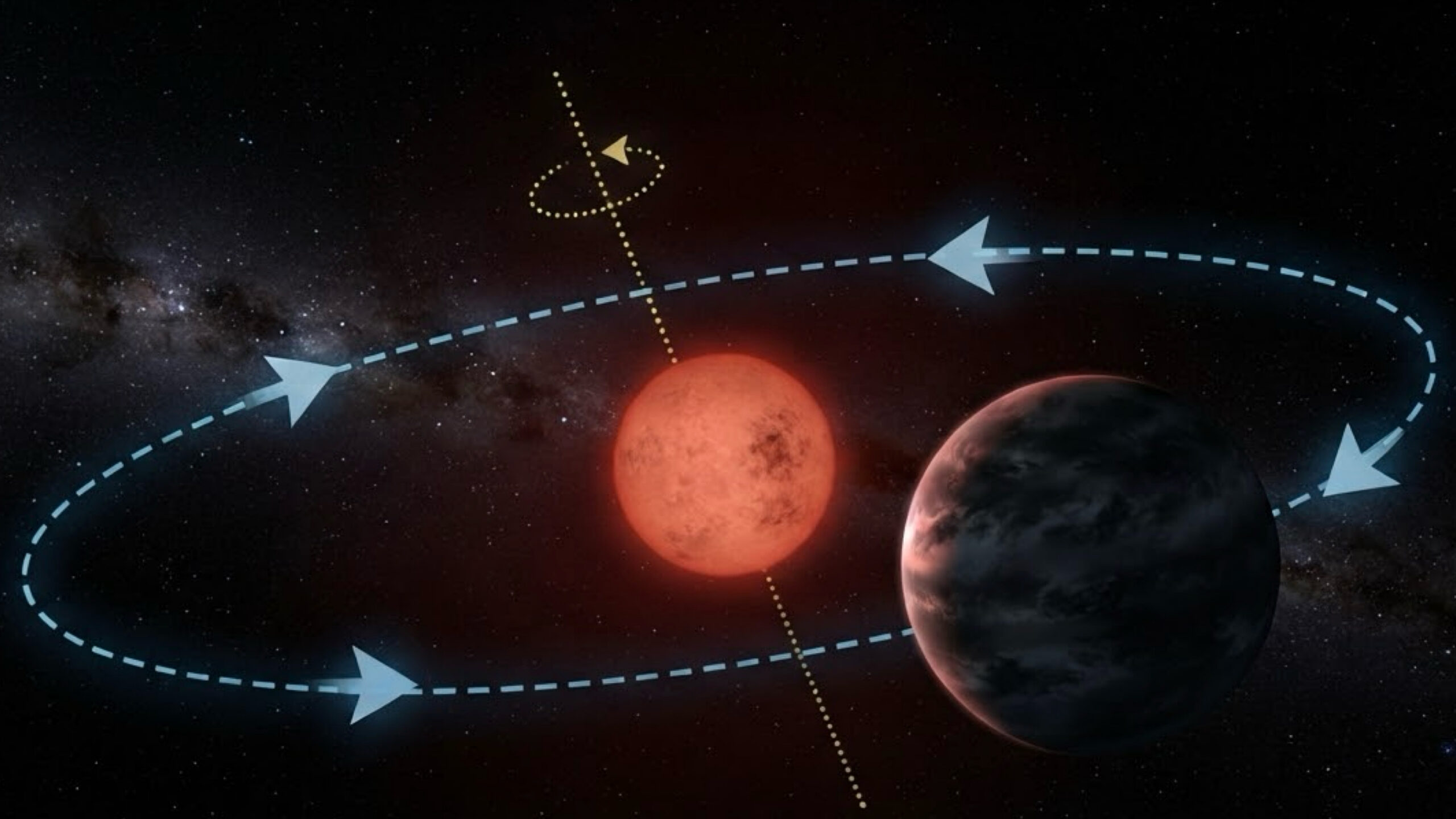
Astronomers have found a retrograde planet around a red dwarf star for the first time. The planet, GJ 3090 b, is a sub-Neptune about 73 light-years away that circles its star in the direction opposite to the star’s spin, according to a study in Astronomy & Astrophysics published Sept. 21. The result matters because every other known planet with a badly tilted orbit has an obvious culprit nearby. This one does not.
How astronomers measured a backward orbit around GJ 3090
The star, GJ 3090, is an M2 dwarf with a radius of about 0.52 times the sun’s and a rotation period of 17.9 days, according to the paper. The planet is a little more than twice Earth’s width at 2.18 Earth radii and has 4.52 times Earth’s mass. It completes an orbit in just under three days. Space.com reported that the planet was first found in 2022.
Queen Mary University of London, which announced the result, called the planet Neptune- sized. The paper classes it as a sub-Neptune, and its 2.18 Earth radii put it well below Neptune’s size. The team, led by Yann Carteret and Vincent Bourrier of the University of Geneva with more than 60 co-authors, used a technique based on the Rossiter-McLaughlin effect.
When a planet crosses the face of a spinning star, it blocks light from the side turning toward Earth or the side turning away, and that slightly distorts the star’s spectrum. The pattern shows which way the planet is moving relative to the spin. The researchers watched six transits with the NIRPS and HARPS spectrographs on the European Southern Observatory’s 3.6-meter telescope at La Silla in Chile.
The paper gives a projected obliquity, the tilt as seen on the sky, of 208 degrees, with a margin of plus 15 and minus 18. The full three-dimensional tilt comes out at 136 degrees, with a margin of plus 24 and minus 18. That range runs from 118 to 160 degrees. Every value in it is past 90 degrees, so the orbit is backward even at the low end of the uncertainty.
QMUL’s Andrew Winter, who worked on the study, said in the university’s release that the planet is not simply tilted but orbits in the opposite direction. The paper was received July 14 and accepted Aug. 15.
Why a backward planet with no giant neighbor is a problem
Planets form from a disk of gas and dust that spins the same way as the young star, so orbits normally line up with the star’s equator. When one is knocked far out of line, astronomers usually find a heavy body nearby that did it.
GJ 3090 stands apart from five other multi-planet systems with tilts above 70 degrees, the paper says. Each of those has either a confirmed wide stellar companion or a massive outer planet. The authors call GJ 3090 the first highly misaligned confirmed multi-planet system without a known massive companion. ZME Science noted that GJ 3090 b is also the first retrograde planet found around a red dwarf at all.
The researchers looked for a culprit. They excluded any companion heavier than one Jupiter within 15 astronomical units and found no wide binary star. Yann Carteret, a doctoral student at the University of Geneva, said in the QMUL release the team looked for such a companion but found no evidence of one.
The standard violent explanations also fail on the system’s own layout. GJ 3090 holds at least two more planets, a candidate near 13 days and a confirmed non-transiting one near 16 days. The paper argues that planet-to-planet scattering or a high-eccentricity migration would have disrupted a tidy inner system like this. It also finds that close stellar encounters are inefficient at transferring angular momentum to a retrograde disk around a star this small.
Tides do not explain it away either. Red dwarfs have deep convective envelopes that can pull planets back into alignment, but the paper puts the planet at roughly 13 stellar radii from its star, far enough that tidal realignment is weak.
The leading explanation is a second disk that spun the other way
The authors favor late disk accretion. In that scenario the young star pulled in a second batch of gas and dust after its first disk had formed, and that material arrived with a random spin direction. Planets built from the second disk would then orbit at whatever angle it happened to carry.
Bourrier told Space.com the star “could have accreted a misaligned, retrograde secondary disc” in which the planets formed. The paper calculates that the star would keep its original spin axis, and the misalignment would survive, if the infalling material totaled less than about 1,500 Earth masses.
The paper says the idea is consistent with long-lived accretion disks seen around other young red dwarfs. Queen Mary’s release lists a second explanation, a massive companion that tilted the orbit over time, but says the team found no sign of one.
What the numbers show about a planet that has gone backward for a billion years
The paper puts the star’s age at 1.07 billion years, with a margin of plus 0.71 and minus 0.16 billion. At an orbital period of about 2.9 days, the planet has made roughly 135 billion trips around its star in that time.
The planet also circles much faster than the star turns. Dividing the star’s 17.9-day rotation by the planet’s period of about 2.9 days gives about six orbits for each turn of the star, each one against the spin.
The orbit is tight. Thirteen stellar radii of a star 0.518 times the sun’s radius works out to about 0.03 astronomical units, roughly one-twelfth the distance from Mercury to the sun.
The authors say the near-infrared technique opens a way to probe the tilts of the smallest planets around red dwarfs, which have mostly been out of reach. The paper says GJ 3090 b is the smallest planet around a red dwarf with a measured three-dimensional obliquity. Red dwarfs are the most common stars in the galaxy, so each new measurement tests whether backward planets are a rare accident or a common outcome of how these systems form.