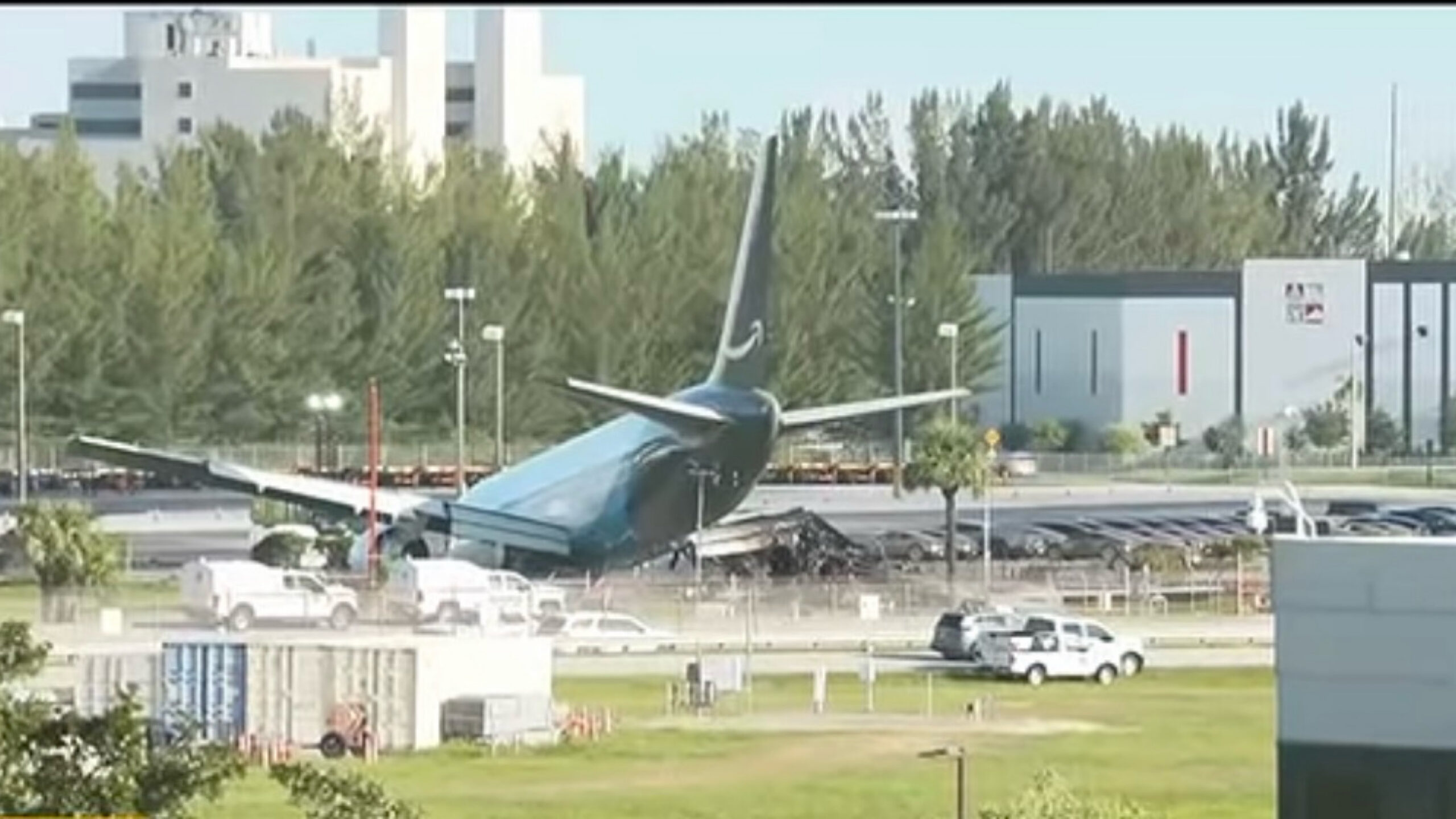
The National Transportation Safety Board’s preliminary report on the Sept. 6 crash of a Boeing 767 cargo jet at Miami International Airport says the air traffic controller cleared the plane to land without giving the crew any wind information. The plane touched down fast, ran off the runway and killed five people in a van on the ground.
What the NTSB Preliminary Report Says About 21 Air Flight 7598
The aircraft was a Boeing 767-33A freighter, registration N1997A, flying as 21 Air Flight 7598 from San Juan, Puerto Rico, to Miami, according to the NTSB’s preliminary report. The report says 21 Air LLC operated the flight for Amazon.com Services LLC. The accident happened about 1:53 p.m. EDT.
The captain had about 7,267 hours of total flight experience, including 150 hours in the 767, and 21 Air hired him in April 2026, the report says. The first officer had about 2,800 total hours, including 800 in the 767, and was hired in February 2025. The report says an earlier flight, Flight 7521, was the first time the two had flown together.
The report carries the NTSB’s standard warning that its information is “preliminary and subject to change.” The agency has not determined a cause, MySuncoast reported, and the NTSB’s investigation page lists the case as ongoing.
Controller Cleared the Jet Without Wind Information
The weather observation at 1:53 p.m. showed wind from 190 degrees at 17 knots, gusting to 26 knots, with thunderstorms in the area, according to the report. The jet was landing on runway 30. The controller on the arrival and departure position issued a landing clearance but did not give the crew information about the wind, the NTSB wrote. The report cites Federal Aviation Administration Order JO 7110.65BB, which requires controllers to state both wind direction and velocity when authorizing a runway if a tailwind exists. That controller had 11 years of air traffic control experience, the report says. TT News reported the same finding and the same FAA requirement.
The report’s numbers allow a calculation of the tailwind. Runway 30 points toward about 300 degrees, and wind from 190 degrees is 110 degrees off that heading, which puts it behind the aircraft. The cosine of 110 degrees is about negative 0.34, so a 17-knot wind produces a tailwind of about 6 knots, and a 26-knot gust produces about 9 knots. Those are Onsite! calculations that use the runway’s nominal heading and the reported wind. The NTSB did not publish a tailwind figure in the report.
How Fast the Plane Landed on Runway 30
The jet crossed the runway threshold about 105 feet above the ground at a groundspeed of 177 knots, which is about 204 mph, the report says. It touched down about 3,750 feet past the threshold at 160 knots, about 184 mph. The runway measures 150 feet wide and 9,360 feet long. The first officer cautioned that the plane was too fast, and the report says the first officer kept commenting on the excessive speed through the end of the cockpit recording. CBS Miami reported that the first officer warned about the speed multiple times.
The captain called for flaps to be set to 20 degrees. After touchdown, the captain called for a go-around.Recorder data shows that the speed brakes stayed stowed and the thrust reversers did not deploy during the landing and rollout, the report says. The crew applied the wheel brakes manually at a groundspeed of 146 knots. The throttles then moved to go-around thrust with about 930 feet of runway left. A “too low terrain” warning sounded four times.
Overrun, Fatalities and the Missing Arresting System
The jet left the paved surface at 113 knots, about 130 mph, and hit the localizer and approach lighting system at the northwest end of runway 30, according to the report. The last recorded groundspeed was 65 knots. The plane came to rest about 1,200 feet beyond the end of the pavement. Seven people were in a Ford passenger van on the ground.
The report says five of them died and two were seriously injured. The lone occupant of a Toyota SUV was seriously hurt, so five people on the ground died and three were seriously injured. The captain and first officer had minor injuries. The report also says no engineered materials arresting system was installed at the end of runway 30. It records that fact without saying whether one would have changed the outcome.
Amazon Pauses Operations With 21 Air
Amazon said in a statement that after the crash it spent time supporting the investigation and reviewing the circumstances, and “we’ve decided to pause our operations with 21 Air,” TT News reported. The reports reviewed did not include a statement from 21 Air.
What Happens Next in the Miami Crash Investigation
A preliminary report describes the facts the NTSB has gathered so far and does not assign a cause. The NTSB lists the investigation as ongoing, and the reports reviewed did not give a date for a final report.