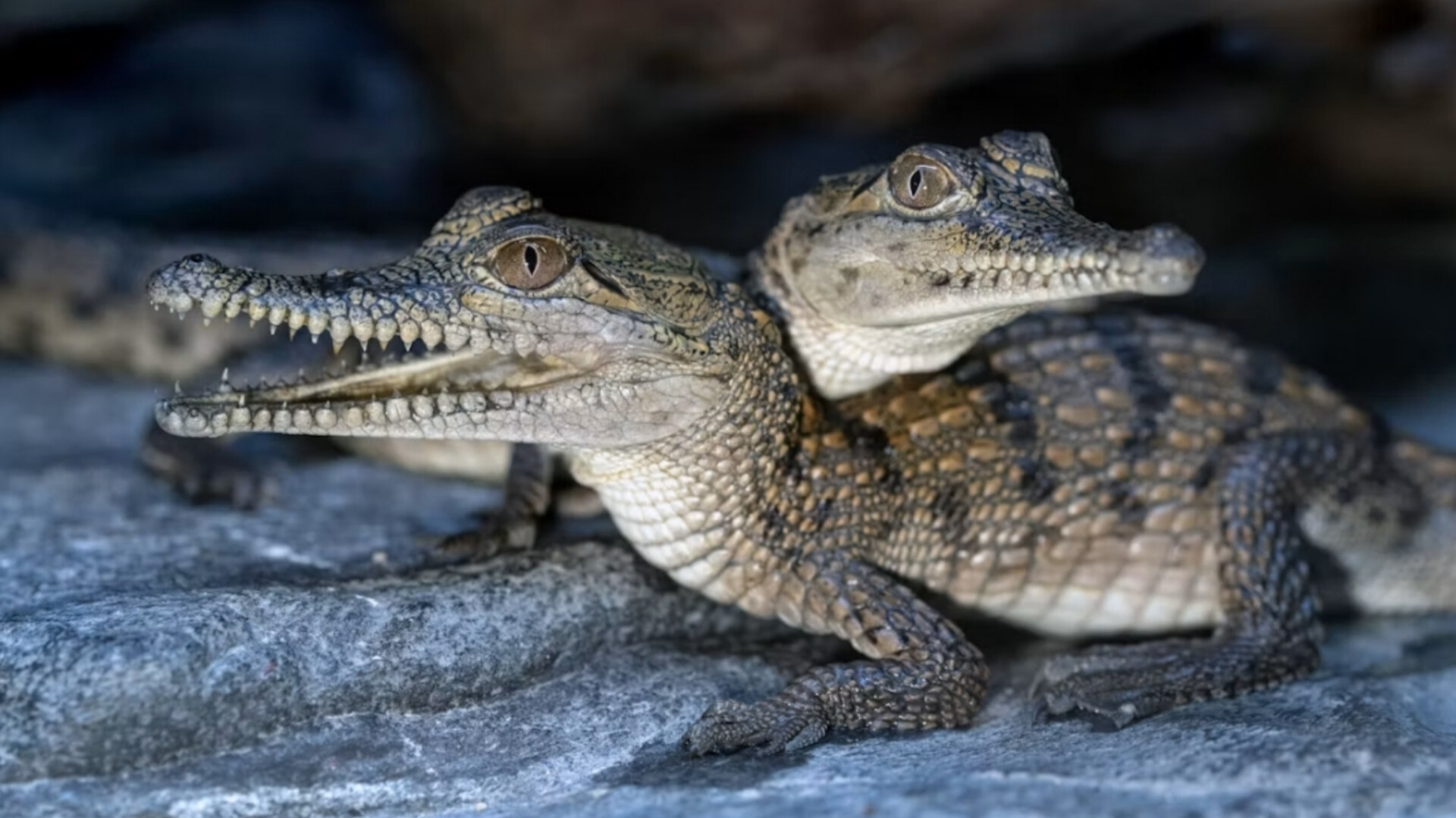
Cameras have recorded dwarf crocodiles hunting bats inside a Gabon cave, a behavior that the scientist who has studied them for about 15 years said he had never been able to see. The footage was shot for National Geographic’s series “Africa: Earth’s Wild Home,” in its “Jungle” episode.
Live Science reported that the crocodiles live in the Abanda Caves, a remote cave system in Gabon in West-Central Africa. They are African dwarf crocodiles, which grow to about 5 feet long. The population is believed to be the only permanent cave-dwelling crocodile group in the world.
What the Cameras Recorded
Scientists already knew the cave crocodiles ate bats and insects, but they did not know how they caught them. The new footage shows a sneak attack, Live Science reported. The series showrunner, Gavin Boyland, told PetaPixel that ultra-sensitive low-light pan-and-tilt cameras captured “the world’s first shots of dwarf crocodiles hunting bats inside a cave.”
Boyland called the shot as one of six “world firsts” in the series, which PetaPixel said took 300 days of filming in 33 countries. The claim comes from the production team and the researcher who advised it, not from a peer-reviewed paper. No journal article describing the hunting behavior has been published.
Why 15 Years Passed Without a Sighting
The reason is practical. The crocodiles do not hunt naturally while people are in the cave. Matthew Shirley, a conservation ecologist who has worked with this population for about 15 or 16 years, told Live Science that no matter how long he spends in the caves, the animals are not doing what they would otherwise be doing. He said hunting is “something we’ve never been able to see.”
The team got around this with remote cameras that ran without anyone nearby, according to Live Science. The observer was the obstacle. A researcher could document the diet by other means but could not watch the hunt, because his presence ended it.
The Caves
The Abanda Caves sit in the upstream of the Fernan Vaz Lagoon in Gabon, according to Wikipedia’s entry on the site. The entry describes two systems, Dinguembou at about 350 meters and Mugumbi at about 400 meters, each reached by vertical shafts of about 7 meters that open onto horizontal passages. It says more than 100,000 bats roost there, including Egyptian fruit bats, Sundevall’s roundleaf bats and giant roundleaf bats.
An earlier National Geographic article said archaeologist Richard Oslisly found the crocodiles in 2008 and estimated 100 to 200 animals across 10 to 12 caves. It said the caves hold tens of thousands of bats, a count that is lower than the Wikipedia figure. Both numbers are estimates.
Shirley’s Earlier Peer-Reviewed Work
Shirley and co-authors published the first systematic study of the cave crocodiles in 2016 in the African Journal of Ecology, titled “Diet and body condition of cave-dwelling dwarf crocodiles (Osteolaemus tetraspis, Cope 1861) in Gabon.” A summary of the paper reported that the cave animals fed exclusively on cave crickets and bats, unlike forest crocodiles that eat fish and crustaceans. The National Geographic article said stomach analyses turned up bat bones, fur and crickets.
The paper also tested body condition. Juvenile cave crocodiles were in significantly better condition than forest juveniles, the summary said. Adult differences were not statistically significant, which the authors attributed to small sample sizes. Florida International University (FIU) describes the finding more broadly, saying cave crocodiles stay in better condition than forest relatives despite darkness and corrosive bat waste. The paper itself supports that clearly only for juveniles.
The National Geographic article added that researchers collected blood from 30 to 40 cave crocodiles and about 200 above-ground animals, and that the cave group carries a haplotype not found in the surface population. Shirley estimated the crocodiles entered the caves at least a few thousand years ago and suggested the group is in the process of becoming a new species.
FIU says Shirley, a research assistant professor in its Global Forensic Science and Justice Center, is the only scientist actively studying the group. FIU said his fieldwork helped reclassify what was once treated as one dwarf crocodile species into three, and that he is still studying how cave life affects vision, body shape and physiology.
The Orange Skin
Many cave crocodiles are orange rather than gray, and accounts differ on why. Live Science reported that acidic bat guano tans their grayish skin and wears it away over time. The National Geographic article quoted Shirley saying bat guano is largely urea and that the cave water is alkaline, which acts as a natural tanning agent. The 2016 paper proposed a chemical bleaching process after long exposure to high urea concentrations. The accounts agree the color comes from the cave environment and not from a genetic change.
The Daily Galaxy reported that on some older males the skin has worn thin enough that skeletal features show on the head, with guano exposure as the leading but unconfirmed explanation. It also reported that about 10,000 disturbed bats once flew into Shirley’s face during a daytime visit.
Conservation Status and Where to See the Footage
Dwarf crocodiles are classified as vulnerable to extinction. Live Science said that the International Union for Conservation of Nature has not assessed these crocodiles in decades. The cave group is genetically isolated and lives outside protected areas, Live Science reported, which exposes it to overharvesting and habitat loss. FIU said “Africa: Earth’s Wild Home” is a seven-part series narrated by Wunmi Mosaku and filmed over four years. FIU listed the “Jungle” episode as airing Oct. 2 at 8 p.m. Eastern on National Geographic, with streaming on Disney+ and Hulu the next day.
National Geographic’s episode page lists an air date of Oct. 3. Shirley also appears in the October issue of National Geographic magazine. For now, the hunting footage exists as broadcast video and a researcher’s account. A full description of how the crocodiles ambush bats, and how often it works, would need a published study.