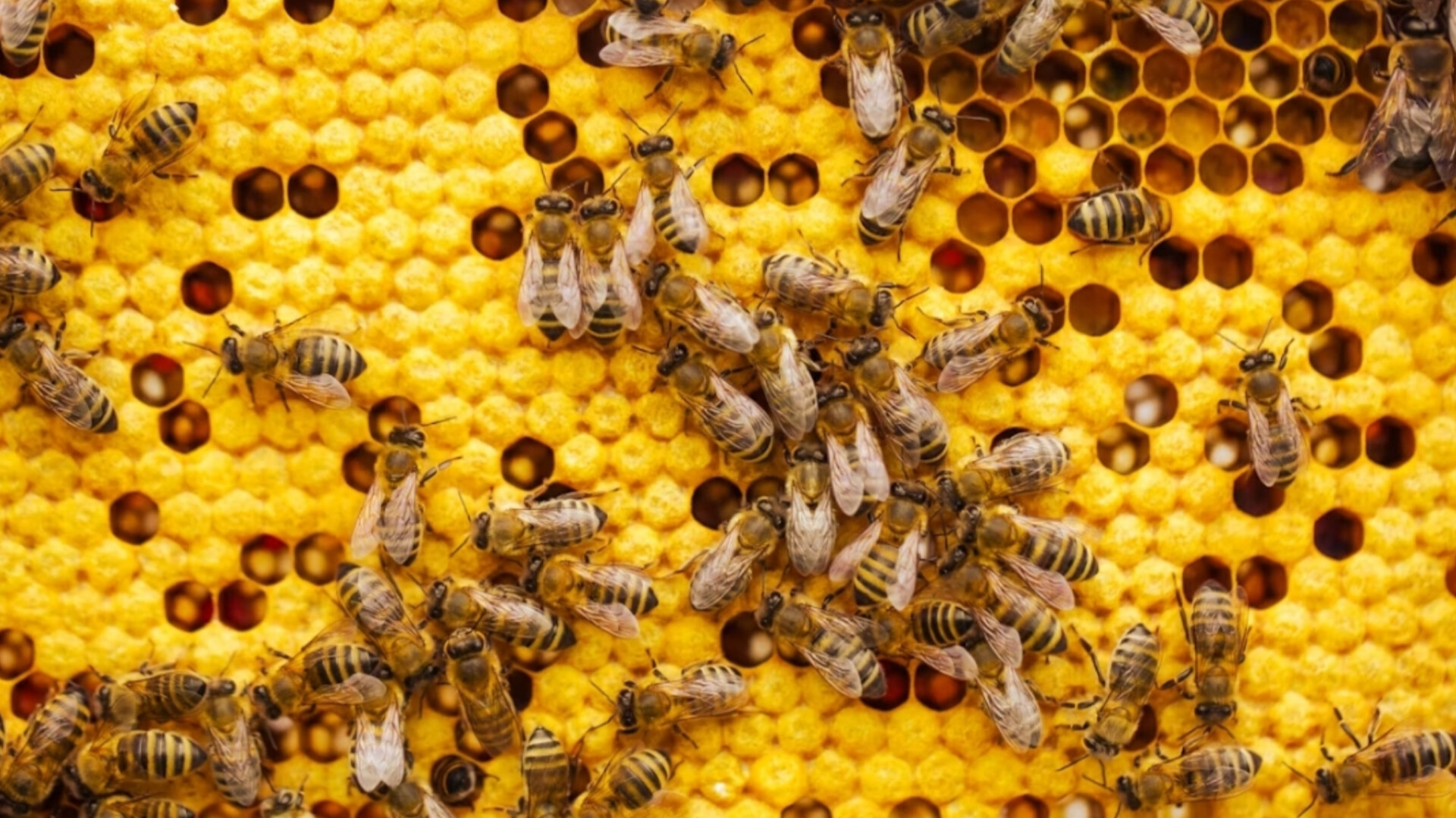
Two biologists argue that a honey bee colony is not immortal. In a review published Aug. 3, they say each colony is a mortal “superorganism” that dies when its queen is replaced, and that swarming is not how bees reproduce.
The paper, “On the life history of the honey bee superorganism”, appeared in the journal Insectes Sociaux. Hannes A. Bonhoff and Heikki Helanterä wrote it. Helanterä works in the Ecology and Genetics Research Unit at the University of Oulu in Finland. It is a review article, so it reinterprets existing research and does not report new field experiments.
What the Review Says about Honey Bee Colony Lifespan
Biologists have long treated a honey bee colony as a single unit that can live indefinitely, because workers die and a new queen replaces the old one. The review says that view mixes up parent and offspring. The authors write that colonial immortality rests on an “inverted identification of parent and offspring”.
They side with an older argument by Moritz and Southwick from 1992. A colony’s genetic makeup depends on its queen and the drones she mated with. When a new queen takes over, the colony has a different genotype. The review therefore counts a long-lived hive as a matrilineage, a line of mortal superorganisms in which each one is replaced by its daughter.
The review also takes on E.O. Wilson’s 1971 description of colonies as potentially immortal. It says Wilson’s own life cycle, described on page 98, implies the opposite view. The authors describe the colony as viviparous, meaning the offspring develops inside its mother. In their account, a young queen grows up inside the parent superorganism, which supplies a brood environment they compare to a uterus.
They liken the first nurse bees to a placenta and the guard bees to protectors of the developing offspring. Over time the daughter’s workers replace the mother’s, and the mother dies. They map the life cycle through zygotic, embryonic, fetal, juvenile and adult stages.
Why Swarming is Not Reproduction in This Account
Most descriptions call swarming the way a colony reproduces. The review disagrees. Swarming happens before a queen mates, so no fertilized offspring exists yet. The authors say the prime swarm, which leaves with the old queen, is the parent superorganism relocating. The offspring stays behind in the original nest.
That makes the prime swarm a survival strategy. The review says it lets the maternal superorganism live through reproduction. Afterswarms work differently. They leave with unmated virgin queens and let one superorganism produce more than one offspring in a single cycle. The authors compare this to marine worms of the family Syllidae, which split off reproductive segments called epitokes. In those worms the epitokes reproduce sexually and die soon after, while the rest of the animal regenerates.
The preprint version of the paper lists four routes to female reproduction. The first is supersedure, where a new queen replaces the old one in the same nest and the mother dies. The second is the prime swarm. The third is the afterswarm. The fourth is spontaneous reproduction, where workers raise emergency queens after the laying queen is lost. A single colony can use at least three of the four routes in one reproductive cycle, according to the authors.
The preprint’s Table 4 counts the output of each route. Supersedure and spontaneous reproduction yield one offspring per cycle. Afterswarms yield two or more. Three of four routes in one cycle means a single hive can be using 75% of the available pathways at once.
The authors also propose new names. Drones become “sperm bees” and virgin queens become “egg bees.” Mated queens become “fertilized egg bees,” laying queens become “stem bees” and workers become “somatic bees.” The colony itself is the superorganism.
What Requeening Means for Beekeepers
Beekeepers replace queens on purpose, often because younger queens can make colonies more productive. The review cites a recommendation from Gray and colleagues in 2020 to replace at least 50% of queens to reduce winter losses. The authors say that advice implies replacing at least every other superorganism in summer.
On the review’s logic, requeening ends one superorganism and starts another. The authors argue that it does not rejuvenate a colony. They say younger queens may still improve productivity and health, so the practice can have benefits. Their point is about what the act is, not whether it pays.
The numbers add up quickly at commercial scale. An operation with 100 colonies that follows the 50% recommendation replaces 50 queens in a year, so 50 superorganisms end. An operation with 1,000 colonies replaces 500. Those figures are Onsite! arithmetic from the review’s cited recommendation, and the paper does not itself tally them.
The review says the question matters for monitoring as well. Surveys that check whether a nest is still occupied cannot reliably detect supersedure, swarming or absconding. Genetic sampling can detect supersedure but cannot tell it apart from swarming.
How the Argument Changes Varroa Mite Research
Studies of wild honey bees often ask how long a colony survives after the Varroa destructor mite arrives. The review cites 1992 work by Korpela and colleagues finding that a nest may become vacant three to five years after an initial infestation. That equals 36 to 60 months.
The authors say the figure may not show how long one colony lived. A nest can be occupied by several consecutive superorganisms, each the daughter of the last. By the time the nest empties, the original superorganism may have moved elsewhere and multiplied. The authors write that the original line’s descendants may be the ones that finally die.
They call continuous nest occupancy an abstract trait of questionable significance, and say studies of how well wild populations cope with Varroa may need revisiting. The review also notes how it counts survival. It describes superorganisms in established nests as following a type I survivorship curve, in which most individuals live to old age.
Those founded in new nests through afterswarms follow a type II curve, with steady losses at all ages. It credits Thomas Seeley’s earlier work for the lower survival of swarms in new nests. The authors say the framework could apply to any sexually reproducing social insect that replaces its queen. They note rare exceptions, such as clonal reproduction in the ant Mycocepurus smithii.
The review is a proposal about how to read the evidence. It reports no experiment that tests whether beekeeping practice changes a hive’s long-term health. The paper’s acknowledgments, as stated in the preprint, say the review began as part of Bonhoff’s master’s thesis at Lund University. The work is open access under a Creative Commons license.