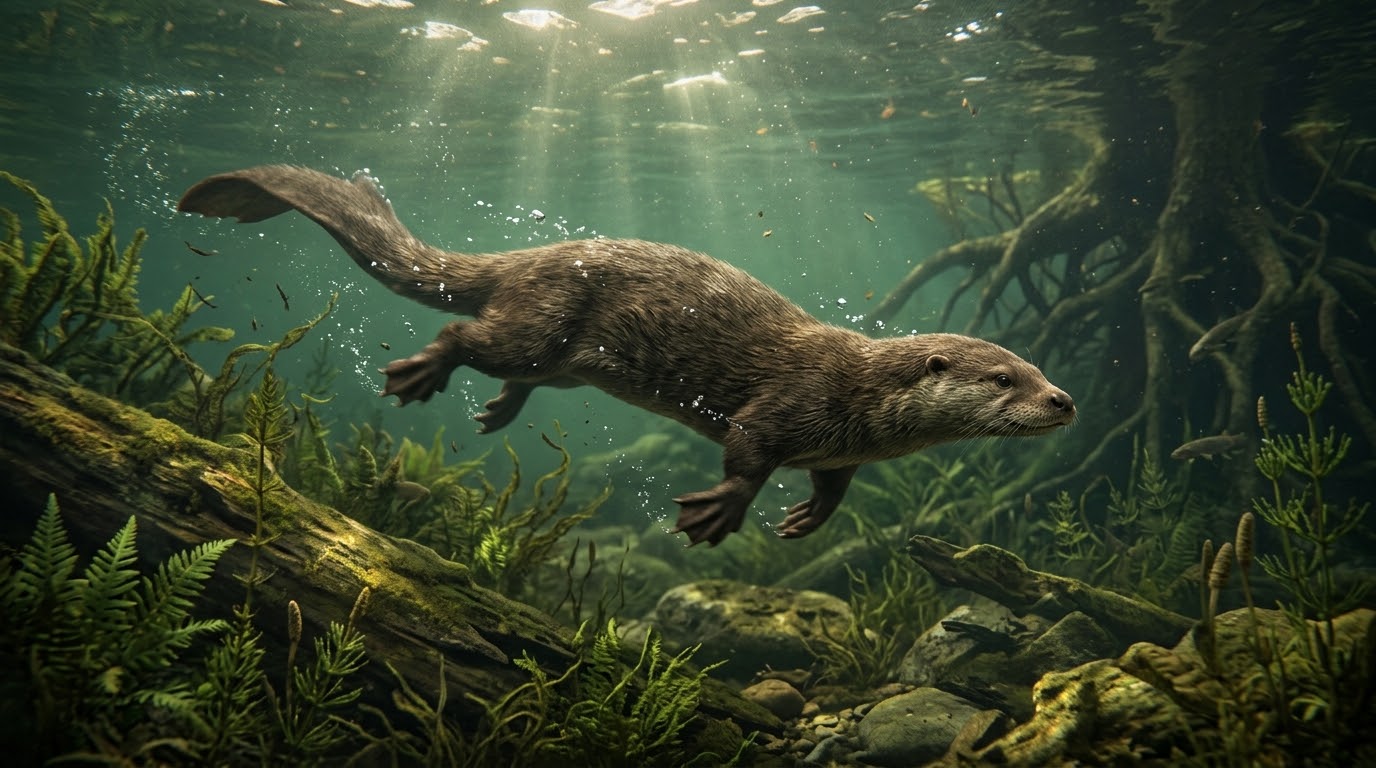
Researchers in China, Germany and the United States described a 165-million-year-old fossil, Megacauda sungei, in Nature on Oct. 7. About 0.5 meter long and roughly 2 kilograms, it is the largest Jurassic mammaliaform found and appears to have swum in water.
What the Fossil is
The animal belongs to the docodonts, an extinct group of early mammaliaforms, which are relatives of true mammals. A University of Bonn release says the fossil comes from Xiayingzi in Inner Mongolia and dates to about 165 million years ago, in the Jurassic. The authors named it Megacauda, meaning “large tail,” and sungei for Sun Ge, honorary director of the Paleontological Museum of Liaoning in Shenyang, which holds the specimen.
The Nature paper, titled “A Jurassic mammaliaform swimmer and transformation of the mammalian pharynx,” lists Y. Li, P. Li, A. I. Neander, H. Zhang, C.-F. Zhou, T. Martin and Z.-X. Luo among its authors. The specimen number is PMOL-AM00026, in two parts, the main slab and its counterpart. The paper places the animal in the Middle Jurassic.
Size sets it apart. Thomas Martin, a paleontologist at the University of Bonn, said in the release that Megacauda sungei is the largest of the Jurassic mammaliaforms. The release says Mesozoic relatives of mammals were often only a few grams. If a typical small relative weighed 5 grams, a 2-kilogram animal would weigh 400 times as much. That is an illustration from the release’s figures, not a measurement.
Three of the authors, C.-F. Zhou, Martin and Z.-X. Luo, are listed as corresponding authors. The release names the Paleontological Museum of Liaoning in Shenyang, the University of Chicago and the University of Bonn as institutions on the project, and the paper’s page lists Shandong University for Zhou. The Bonn release says the museum obtained the specimen with other finds and that the team examined it jointly.
What the Fossil Shows about Swimming
The authors interpret the animal as semiaquatic and compare its lifestyle to the platypus. The paper points to several features. Its pelvis has a strong attachment point and a large notch that suggest large hip muscles. The ankle appears able to rotate outward, and the outer toes are long and asymmetrical, a shape the authors describe as suited to paddling. The ribs have broad, overlapping, calcified plates that the paper compares to those of monotremes, the egg-laying mammals.
Computed tomography scans of the fossil let the team reconstruct the skeleton in three dimensions. The Bonn release says the reconstructions suggest the animal paddled with its front legs, moved its tail in a wave-like motion and steered with its hind legs. The teeth also fit a life near water, according to the release. The cusps curve backward, which would help hold slippery prey, and the canines have three roots.
The paper says the teeth indicate a diet of animals, and it describes the cheek teeth as having a shearing geometry opposite to that of the carnassial teeth of carnivorans. It separates the new animal’s teeth from those of a form called Castorocauda by the arrangement of their cusps.
The Throat Anatomy
The paper’s title also refers to the mammalian pharynx, and that is the second claim. The fossil preserves the roof of the throat and the hyoid, a set of small bones that support the tongue. The authors report a soft-palate-related structure that looks like the one in living therian mammals, the group that includes marsupials and placentals.
Martin said the structure matters because a soft palate separates the mouth from the throat and allows swallowing and breathing to proceed together. Crocodiles lack one and rely on gravity to move food down. Mammals can swallow against gravity. Martin said the adaptation made possible the brain development that eventually led to humans.
The paper concludes that the soft tissue anatomy for swallowing, drinking and suckling evolved in the common ancestor of docodonts and mammals. ## Claims the Authors Hedge
The paper uses cautious language throughout. It repeatedly states that the authors “interpret” features, including the soft palate and muscle reconstructions, the positions of the rib plates and the swimming lifestyle. Some outlines are composites built from both halves of the slab, and some elements were mirrored from the counterpart. Swallowing and suckling abilities are described as suggested by the anatomy, not observed. The swimming conclusion rests on a single fossil.
One statement in the release invites a closer look. Martin said the fossil is “the earliest evidence of an aquatic lifestyle in mammals.” The same release says other Jurassic docodonts lived in trees, underground and in water. The release does not reconcile the two statements.
One possible difference is the word “mammals,” since Megacauda is a mammaliaform and not a true mammal, but the release does not say that is what Martin meant. The release quotes only members of the research team, and it identifies no outside paleontologist commenting on the interpretation.
What Comes Next
The Bonn release does not name specific follow-up work. Martin described the research as the product of a long period of teamwork. The open question is how much of the picture rests on interpretation of a single slab, since the paper itself labels the soft-tissue reconstructions and the lifestyle inference as interpretations.