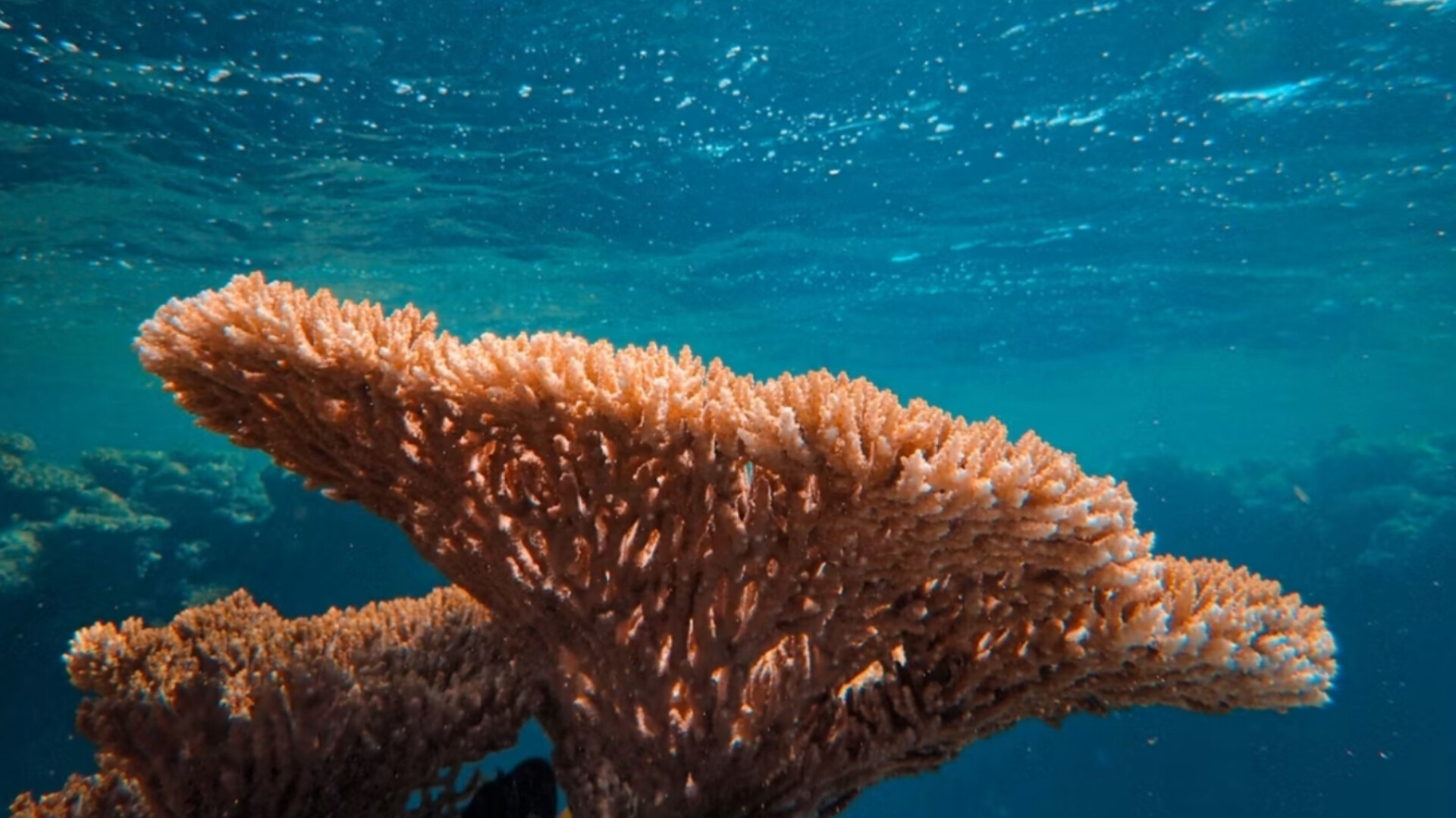
Stanford researchers reported Oct. 14 that all five bleached coral fragments placed in contact with healthy, genetically identical fragments fully recovered within seven weeks. The five bleached fragments held a few millimeters away from their partners died, according to Stanford’s announcement.
What the Stanford Coral Experiment Found
The study appeared Oct. 14 in Science Advances under the title “Rapid coral bleaching recovery via symbiont transfer from healthy corals.” Danny Collins, a doctoral student in oceans at the Stanford Doerr School of Sustainability, led the work. Steve Palumbi and Fiorenza Micheli were senior authors. The National Science Foundation and Stanford, including seed money from the Big Ideas for Oceans grant program, funded it.
Collins used 10 pairs of fragments, each pair cut from one coral animal. In each pair one fragment was healthy and one was bleached. Five pairs touched and five sat a few millimeters apart. Every bleached fragment that touched its healthy partner recovered fully in seven weeks, and the five that did not touch died. Stanford called the seven-week recovery the fastest documented to date. Collins said, “While bleached corals may be dying, they are not dead yet.”
How the Experiment Began
Stanford said the first observation of the effect came from fragments that had tipped over in a tank. At the time Collins was studying how coral disease spreads, particularly through bacteria on plastic debris. The observation led him to test whether contact could reintroduce beneficial algae, the algae that live in coral tissue and provide the energy corals need to grow. When corals lose those algae, they turn pale and become vulnerable to harmful algae, Stanford said.
The team documented recovery with a powerful microscope fitted with a phone through a 3Dprinted mount that Tom Rolander designed. The Molecular and Cellular Biodiversity Imaging Center supplied the image analysis. Stanford did not name the coral species or say where the colony was collected, and it did not describe how the fragments were bleached for the experiment.
How Algae Moved between Touching Corals
Stanford said microscopy showed channels in the tissue of touching fragments lining up after contact, and the team saw algae move from the healthy fragment to the bleached one within three days. Palumbi said genetically identical corals recognize one another when they touch. Stanford said corals reproduce by cloning, which forms colonies of genetically identical individuals, and that the tissues of touching fragments fuse. Palumbi compared the result to organ transplants working better when the donor is an identical twin.
One week of contact was enough for the bleached fragments to receive the algae they needed to recover on their own, and in some cases five days was enough. Five days is about 10% of the 49day recovery window, a calculation from the study’s dates. During the second week, algae in the bleached fragments doubled about every four days, roughly 10 times faster than rates seen in wild corals, Stanford said. Palumbi described the algae as flooding in and dividing at the fastest rates seen in corals.
Micheli, a professor of marine science and a senior author, said bleached corals are often considered a lost cause because recovery after a heat wave is slow, if it happens at all. She said she hopes the research will help keep corals healthy long enough to recover naturally through growth, reproduction and recruitment.
Limits of the Coral Recovery Result
The study was done in a laboratory with 10 fragment pairs, and five of them touched. Five recoveries from five touching pairs is a small sample, and Stanford described the findings as laboratory results. Stanford said the method cannot scale as designed because each bleached coral needs a healthy, genetically identical partner, which the team calls not feasible at the scale reef restoration needs.
The team plans to test ways to deliver beneficial algae without continuous contact. One idea is to collect algae from healthy corals before a heat wave and deliver them in large batches to bleached corals afterward. Stanford said the work has not yet tested that approach.
Scale of Coral Bleaching Worldwide
The experiment responds to a global problem. Stanford said some estimates, which it links to a study published on nature.com, put the loss of corals within a few decades as marine heat waves grow more frequent and intense. The National Oceanic and Atmospheric Administration said in June that the world’s fourth global bleaching event likely ended in mid-2025 after running from early 2023.
Bleaching-level heat stress affected 84% of the world’s coral reef area, and mass bleaching was documented in at least 83 countries and territories. NOAA confirmed the event on April 15, 2024, and waited for the December 2025 to February 2026 austral summer to pass without widespread bleaching before saying it had ended.
Each global event since 1998 has coincided with a strong El Niño and has been more widespread and severe than the last, NOAA said. At the time of its June release, it expected El Niño to emerge within months and said the risk of renewed bleaching was high across much of the North Pacific, including Hawaii, and in Florida and the Caribbean later in the summer.
Derek Manzello, coordinator of NOAA’s Coral Reef Watch, said reefs are now in an era of bleaching on a “near-annual basis.” NOAA also said some reef areas did not bleach under high ocean temperatures and that scientists are studying why. A comparison shows the gap between the experiment and the problem. The Stanford test covered 10 fragments, and NOAA’s figure covers 84% of the world’s reef area. The study does not offer a way to treat a reef, and Stanford does not describe it as one.