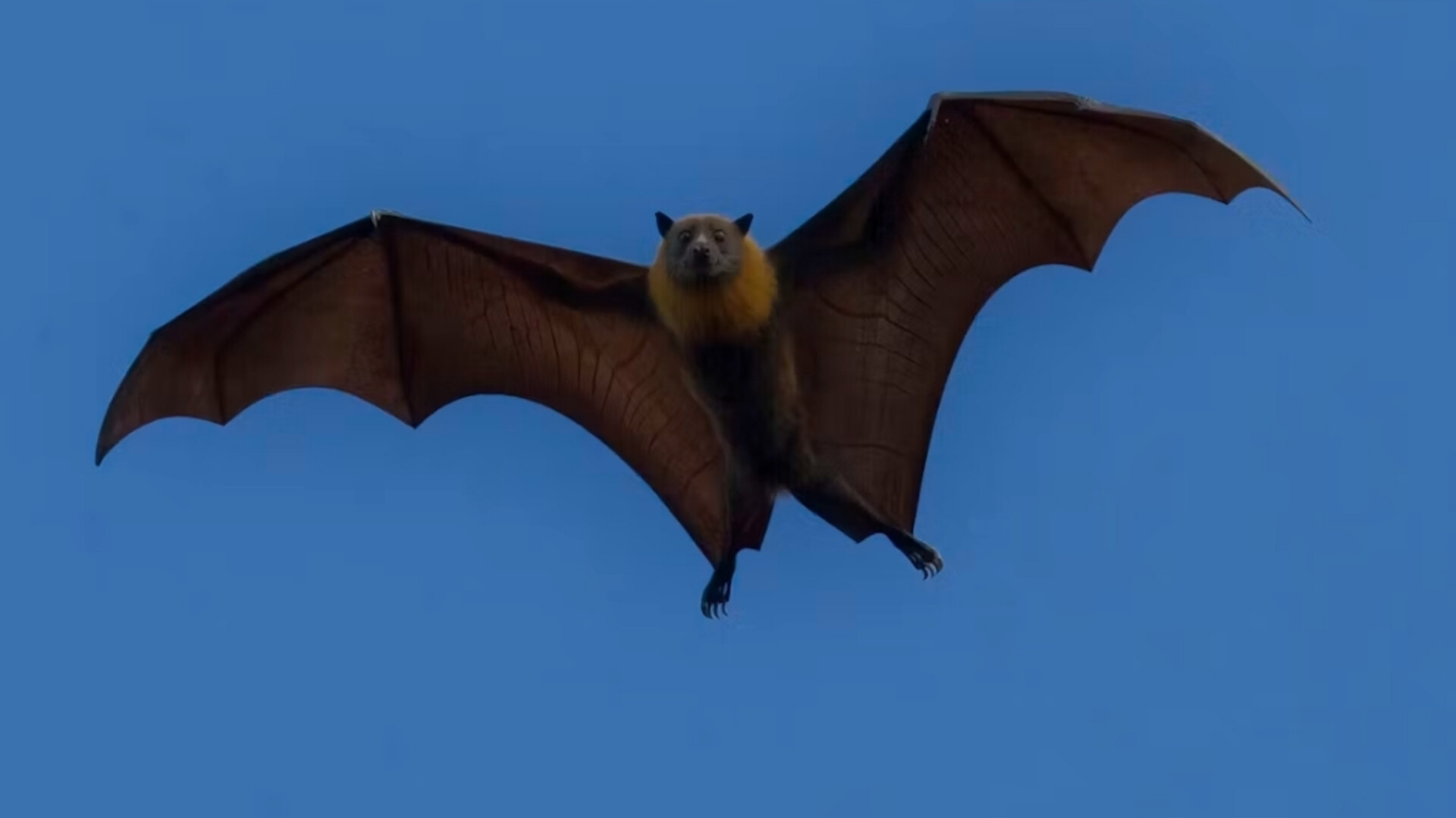
Bats, and with them powered flight in mammals, probably began in Europe about 65 million years ago, according to a study published Sept. 23 in Nature. The finding contradicts earlier theories that placed the first bats in Africa, Asia or North America roughly 50 million years ago.
The paper comes from Bat1K, an international genome consortium. The Museum für Naturkunde Berlin said 137 scientists from 64 countries took part. The team combined genomes from 103 bat species with 44 fossils, which the museum called the largest combined genome and fossil study of bats ever done.
What the genomes say about where bats began
The study’s abstract says the genomes are chromosome-level, long-read assemblies covering all 21 recognized bat families. It counts 42 new assemblies among the 103. Live Science reported 41 newly sequenced species, with 62 existing sequences making up the rest.
From that tree, the authors conclude that bats “probably originated in Europe in the late Palaeocene,” in the words of the Nature abstract. The team also placed Myzopodidae, the Madagascar sucker-footed bat family, as the earliest branch within one large group of bats called Vespertilionoidea. The analysis also supports 26 ancestral bat chromosomes.
The genomes were only half the dataset. Sci.News reported that the team also scored anatomical data from 699 characters across 65 species, including the 44 fossil species that predate the Quaternary period. Its account said the analysis assigned a 99.2% probability to a European origin and rejected earlier proposals for Africa, Asia or North America. That percentage is the output of the team’s statistical model.
After the origin in Europe, Euronews reported, early bats spread into Africa and formed a Euro-African core. Species from that core later reached Asia, the Americas and Australia. Its list of species examined ranges from the bumblebee bat of Thailand and Myanmar, one of the smallest mammals on Earth, to the sucker-footed bat of Madagascar and New Zealand’s lesser short-tailed bat.
The dispersal timeline and the warming event behind it
Sci.News said the major diversification of bats came about 56 million years ago in the Early Eocene, at the same time as the Paleocene-Eocene Thermal Maximum, a sharp episode of global warming. On the team’s dates, that puts the first diversification about 9 million years after the origin at 65 million years ago.
The same report said bats reached North America about 54 million years ago. For the superfamily Noctilionoidea, the analysis favored a route from Europe to North America across the North Atlantic over a passage through the Bering region. By that arithmetic, the trip from Europe to North America came about 11 million years after the origin and about 2 million years after the warming event.
The 50-million-year-old fossil that anchors the tree
Earlier work produced conflicting answers about bat origins. Emma Teeling, a professor of molecular evolution at University College Dublin, said the team finally uncovered “how and when bats evolved” after decades of conflicting findings.
The fossil doing much of the work is *Vielasia sigei*, an extinct species from southern France that Live Science dated to 50 million years ago. It shows advanced echolocation features and sits on the oldest branch of the bat family tree. That placement means echolocation existed before modern bats split into their many lineages, according to the Berlin museum.
The Nature abstract is specific about the type of echolocation involved. It says fossil evidence shows laryngeal echolocation, the kind bats make with the larynx, evolved before the living bat groups diversified. The Berlin museum said flight and echolocation therefore appeared near the origin of the group, not in later stages. Liliana Dávalos, a professor at Stony Brook University, said the method let researchers “place the oldest group of fossil bats” while taking the genomic data into account.
The gap between the fossil and the origin date
The dates leave a gap that the coverage does not spell out. *Vielasia sigei*, the fossil that anchors the oldest branch, is about 50 million years old, and the genomes point to an origin near 65 million years ago. That puts the anchor fossil 15 million years after the estimated start.
The earlier theories placed the origin at about 50 million years, so the new estimate pushes the start back by 15 million years, or 30%. The date comes from the genomes and the family tree rather than from a specimen. Live Science reported that scientists continue working to reconstruct the genome of the common ancestor of all living bats. The sample is also a small share of living diversity. Live Science put the count at more than 1,500 bat species, so 103 genomes cover about 7% of them or less.
What the ancestral bat genome could reveal about aging
The team reconstructed the genome of the bats’ ancestor, which Ismael Galván, a researcher at Spain’s National Museum of Natural Sciences, called the first time the genome of a flying mammal has been reconstructed, Euronews reported. The study’s authors say it gives researchers a framework for studying the genes behind bats’ distinctive traits. The Otago release said the framework may eventually inform human research into aging, immunity and disease resistance.
Live Science reported that bats live 8 to 10 times longer than mammals of similar body size. Bats make up about one-fifth of living mammals, according to Euronews. Sonja Vernes, a professor at the University of St Andrews, said, “Get the tree right, and everything else about bat evolution starts to fall into place.”
Samples from the field and from a freezer
Some of the genomes came from field teams. The Wildlife Conservation Society said its scientists Sarah Olson and Alain Ondzie supplied biological samples from fieldwork in the Congo for the hammer-headed bat genome. In the WCS release, Olson, the group’s director of health research, said WCS is proud its fieldwork helped bring the hammer-headed fruit bat into the study. Ondzie is the group’s Congo field veterinarian.
The University of Otago said in a Sept. 24 release that one of its scientists, Professor Neil Gemmell, co-authored the paper. His group sequenced a lesser short-tailed bat, called pekapeka in New Zealand, that was found dead on Ngāti Rangi iwi territory more than 25 years ago and stored in a lab freezer.
The sequencing had the iwi’s permission. Gemmell said in that release that the “genetic blueprint, now established through this study” should empower further studies that aid the species’ conservation.