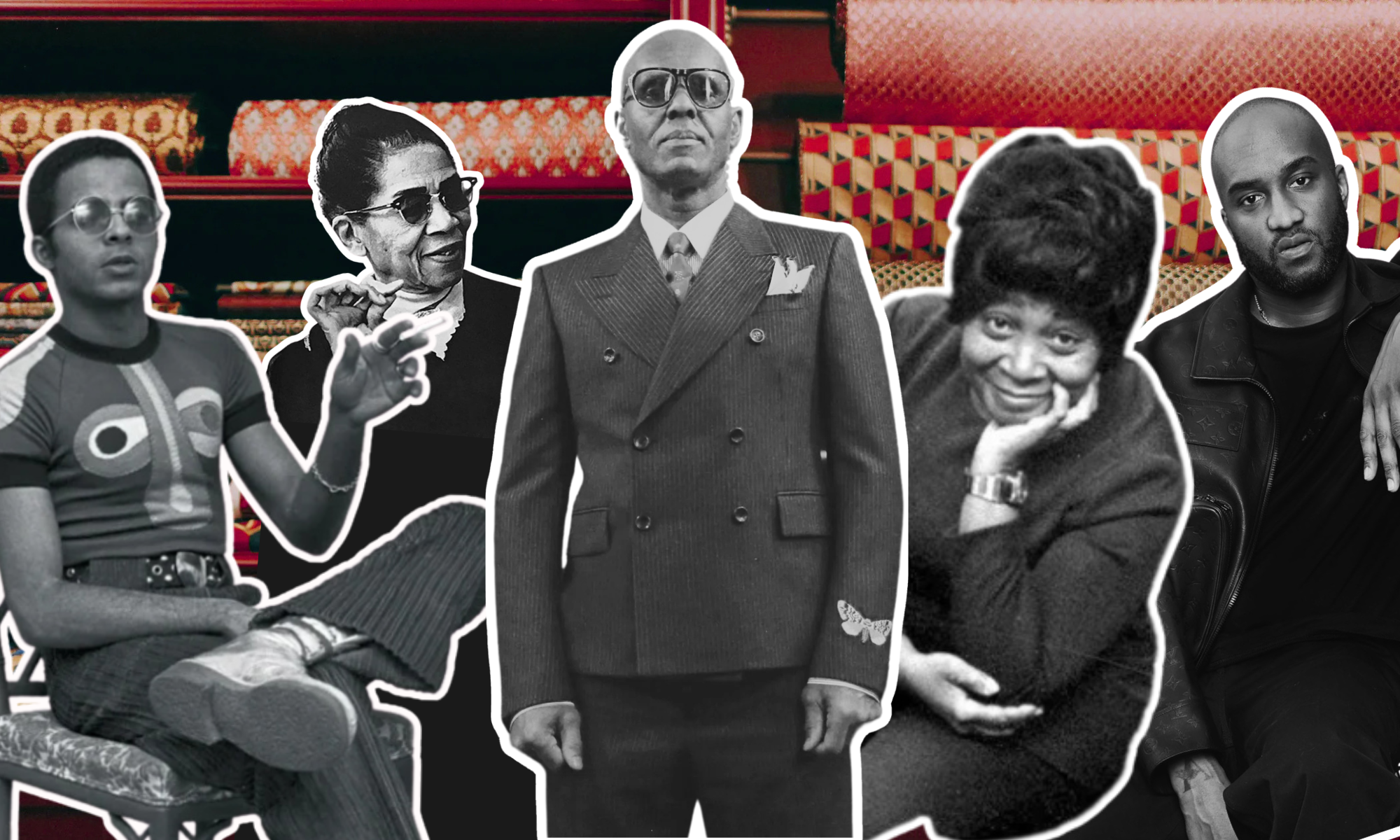
Fashion owes Black designers a debt it hasn’t finished paying. From the enslaved seamstresses who dressed America’s wealthiest families to the creative directors now leading the world’s biggest luxury houses, Black designers have shaped how people dress, often without the credit, capital, or contracts they earned.
The names below span more than a century. What they share isn’t just talent. It’s persistence inside a system that was built without them in mind, and in many cases, was hostile to their presence. Here’s who they are, what they built, and why the industry still hasn’t caught up to what it owes.
Ann Lowe: The Designer America Refused to Credit
Ann Cole Lowe designed the most photographed wedding dress in American history, the ivory silk taffeta gown Jacqueline Bouvier wore to her wedding to John F. Kennedy in 1953. Fifty yards of fabric, a portrait neckline, and handmade floral embellishments that took weeks to construct. When the press asked who designed the dress, Kennedy reportedly answered with “a colored dressmaker.”
Lowe was born in Alabama in 1898, the great-granddaughter of an enslaved woman and a plantation owner. Her mother and grandmother were seamstresses who dressed Montgomery’s elite families. When her mother died, 16-year-old Ann took over the family business and completed four ball gowns for the first lady of Alabama.
She moved to New York and enrolled at the S.T. Taylor Design School, where she was segregated because of her race. She graduated in half the required time. By the 1940s and 1950s, she was designing for the Roosevelts, the DuPonts, and the Whitneys. She designed the gown Olivia de Havilland wore to accept the Academy Award for Best Actress in 1946, under someone else’s label.
Ten days before the Kennedy wedding, a flood destroyed the bridal gown and nine bridesmaid dresses. Lowe and her staff rebuilt everything in eight days, the original timeline had been eight weeks. Instead of profiting, she lost $2,200 on the project. She never mentioned the flood to the family. The Saturday Evening Post later called her “society’s best-kept secret.” That phrase tells you everything about how the industry treated her.
A biopic is in development, produced by Serena Williams and Oscar-winning costume designer Ruth E. Carter, and acquired by Sony TriStar.
Elizabeth Keckley: To the White House
Before Lowe, there was Elizabeth Keckley, born enslaved in Virginia in 1818 and taught to sew as a child. She eventually purchased freedom for herself and her son with money earned as a dressmaker. She became the personal modiste to Mary Todd Lincoln, designing gowns for the first lady during the Civil War years.
Keckley made 15-16 gowns in the first spring she worked for Lincoln. She was, by any measure, one of the most skilled dressmakers in the country. Her work carried no public credit during her lifetime.
Zelda Wynn Valdes: Broadway’s First
In 1948, Zelda Wynn Valdes opened her boutique on Broadway in New York City, the first Black woman to do so. Her client list read like a who’s who of mid-century glamour: Ella Fitzgerald, Josephine Baker, Dorothy Dandridge, Mae West, Eartha Kitt.
By 1949, she was president of the National Association of Fashion and Accessories Designers, founded by Jeanetta Welch Brown and Mary McLeod Bethune, an organization that existed specifically because the mainstream fashion industry gave Black designers no pathway in. She’s also been credited with designing the original Playboy Bunny costume, though the evidence suggests multiple people were involved in the design and Wynn’s team manufactured some of the costumes.
Stephen Burrows: The Man Who Won Versailles
Stephen Burrows was the first Black designer to win a Coty Award, fashion’s highest American honor, in 1973. That same year, he was one of five American designers invited to the Battle of Versailles, the legendary fashion show held on November 28, 1973, pitting American designers against French couturiers. He was the only Black designer on the docket. He was also the youngest by more than a decade.
The French brought elaborate sets, a live orchestra, and two and a half hours of production. The Americans showed up with pre-recorded Barry White, ten Black models, an unprecedented number at the time, and 35 minutes of energy that made the French presentation look stiff.
Yves Saint Laurent called Burrows “the American designer,” a statement Burrows still describes as the highlight of his career. Givenchy later said he only began using music in his shows after seeing the Americans walk to a soundtrack at Versailles.
Burrows invented the lettuce-edge hem, that curled fabric edge you’ve seen on a thousand garments since. His color-blocked matte jersey dresses defined 1970s New York nightlife. He won two more Coty Awards, in 1974 and 1977. He’s now 80 and the last living American designer from the Versailles group.
Willi Smith: The Man Who Invented Streetwear
Willi Smith is often credited with creating what we now call streetwear. By 1976, Smith created WilliWear Ltd, a sportswear line that merged quality fashion and affordability, the aesthetic that now generates millions annually in the global market. Relaxed silhouettes, comfortable fabrics, and price points that actual people could reach.
WilliWear became the most successful line by an African American designer of the 20th century. He received his first Coty Award in 1983.
Smith died in 1987 from AIDS complications. He was 39. The most commercially successful Black American designer of his century, largely forgotten outside fashion circles.
Patrick Kelly: Mississippi to Paris
Patrick Kelly was born in Mississippi and worked his way from nightclub costumer to one of fashion’s most celebrated designers, but it was Paris, not America, that embraced him first. Kelly became the first American admitted to the Chambre Syndicale, the governing body of the French ready-to-wear industry.
His designs were loud, joyful, and deliberately provocative. His pieces often featured provocative imagery as his way of bringing attention to racial stereotyping issues. Oversized buttons and heart motifs became his signatures. He died of AIDS-related complications in 1990 at 35.
Dapper Dan: The Godfather of Hip Hop Fashion
Daniel Day, Dapper Dan, opened his boutique in Harlem in 1982 and ran it as a 24-hour operation. His clients included Mike Tyson, LL Cool J, Salt-N-Pepa, Eric B. & Rakim, and Jay-Z. He made custom pieces using luxury logos from Gucci, Louis Vuitton, and Fendi, screen-printed onto leather and fur, before any of those brands would dress a Black customer walking through the front door.
The fashion houses sent lawyers. By 1992, he was forced to close.
Twenty-five years later, Gucci sent a design down its Cruise 2018 runway that was based on a jacket Dapper Dan made in 1989, without crediting him. The backlash was immediate. Gucci responded by partnering with Dan, opening a new atelier on Lenox Avenue in 2018, and supplying him with raw Gucci materials for bespoke pieces.
As Dan told Fashionista: “Everyone paid homage to Dapper Dan, but no one ever paid him.”
He was included in Time‘s 100 list in 2020. His memoir, Dapper Dan: Made in Harlem, was published by Random House in 2019.
Virgil Abloh: The Door He Opened
In March 2018, Virgil Abloh was named artistic director of Louis Vuitton’s menswear line, making him the first person of African descent to lead the brand’s menswear collection. He was born in Rockford, Illinois, in 1980 to Ghanaian immigrant parents. His mother, a seamstress, taught him to sew. His degrees were in civil engineering and architecture, with no formal fashion training.
He founded Off-White in 2013, built it into one of the most influential streetwear brands in the world, and caught the attention of LVMH. His first Louis Vuitton show, at Paris Fashion Week in 2018, drew a standing ovation and an emotional embrace with Kanye West in the front row.
In 2019, Abloh was diagnosed with cardiac angiosarcoma, a rare and aggressive cancer. He kept the diagnosis private and continued working, helming both Off-White and Louis Vuitton, while undergoing treatment. He died on November 28, 2021, at the age of 41.
LVMH had taken a 60% stake in Off-White just months before his death. Pharrell Williams was chosen as his successor at Louis Vuitton menswear.
Abloh’s legacy isn’t just the clothes. It’s proof that streetwear and luxury aren’t separate worlds, and the doors he pushed open for every designer who comes after him.
Telfar Clemens: Luxury for Everyone
The Telfar Shopping Bag, the “Bushwick Birkin”, became one of the most talked-about accessories of the 2020s by doing the opposite of what luxury fashion does. Telfar Clemens, born in 1985 in Queens to Liberian parents, founded his label in 2005 and made the bag from vegan leather at accessible prices. His brand motto: “Not for you, for everyone.”
When the bag started selling out in seconds, crashing his website, Clemens didn’t restrict supply. He created the Bag Security Program, a pre-order system guaranteeing that anyone who wanted a bag could get one. The opposite of artificial scarcity.
He won CFDA Accessories Designer of the Year in both 2020 and 2021. In 2020, three Black designers, Clemens, Kerby Jean-Raymond of Pyer Moss, and Christopher John Rogers, took home top honors in what was the most diverse group of recipients in the awards’ history.
In 2021, Telfar designed the official uniforms for the Liberian Olympic team at the Tokyo Games.
The List Isn’t Complete
Tracy Reese, who made international news when Michelle Obama wore her dress. Kerby Jean-Raymond of Pyer Moss, whose fashion shows are as much cultural commentary as they are collections. Christopher John Rogers, who has dressed Beyoncé, Lizzo, and Michelle Obama. LaQuan Smith, whose figure-hugging designs have been worn by Beyoncé and Lady Gaga. Anifa Mvuemba of Hanifa, who staged a fully digital fashion show during the pandemic. Aurora James of Brother Vellies, who launched the 15 Percent Pledge.
The list of designers who changed fashion while the industry looked for reasons not to acknowledge them is long. What holds them together isn’t just talent. It’s the fact that they built inside a system that wasn’t built for them.
What This History Actually Means
The story of Black fashion designers is not a story about representation, it’s a story about ownership. Who gets to create, who gets credit, and who gets paid. Ann Lowe dressed the most powerful families in America and died with little to show for it. Dapper Dan made the aesthetic that luxury brands spent decades profiting from, and they sent lawyers instead of checks. Virgil Abloh got the top creative job at Louis Vuitton, but it took the industry until 2018 to put a Black designer there.
The designers on this list didn’t just make clothes. They made the industry acknowledge what it owed.
The fact it took this long is the point.