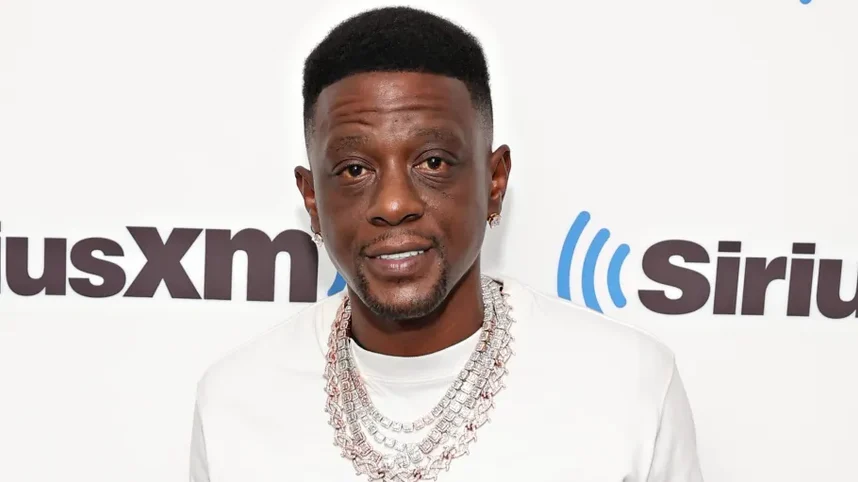
Boosie Badazz was arraigned Sept. 17 in a Harris County, Texas courtroom on a felony charge of aggravated assault with a deadly weapon, stemming from a Houston nightclub fight where he allegedly struck a security guard with a glass hookah base, according to DancehallMag. The rapper, whose legal name is Torrance Hatch, is now fighting the criminal case alongside a civil lawsuit from the injured guard and a separate federal effort to send him back to prison over a prior gun conviction.
Bond was set at $85,000, according to AllHipHop, which also reported that the aggravated assault charge is a second-degree felony in Texas carrying a possible sentence of 2 to 20 years.
What Happened at the Houston Nightclub
The incident took place around 2 a.m. on May 24 at Dome Nightclub in downtown Houston, according to Complex. A woman with Boosie’s group was denied restroom access as the venue closed and became combative with a security guard, later identified in a civil suit as Edward Iglehart. When the guard bent down to retrieve items she had dropped, Boosie allegedly struck him in the head with a glass hookah base, a wound that required eight staples to close, according to ABC13 Houston. A second guard told investigators he heard glass shatter and saw Boosie holding the broken hookah base while the injured man bled on the floor, DancehallMag reported.
Boosie’s attorney, Carl A. Moore, said in a statement reported by TMZ that “we plan to vigorously investigate and defend Mr. Hatch against these allegations,” adding that Boosie “was trying to defend his female relative who was being escorted out of the club by the security guard.” Boosie has separately called Iglehart’s related civil suit “a money grab,” telling followers on social media, “This is what you go through as an entertainer,” according to Complex.
The Civil Suit Names the Venue, Too
Iglehart’s civil complaint does not rest on the assault claim alone. He is also pursuing a defamation claim against Boosie, alleging the rapper made false public statements about him on social media after the incident, according to Complex. The suit additionally names the club’s operator, 1720 Main Street Entities, accusing the venue of over-serving alcohol to Boosie’s group in the VIP section that night, a claim that would extend liability beyond Boosie himself to the business that hosted him.
Iglehart’s suit says he went to a nearby hospital for treatment after the attack, though the complaint does not specify a dollar figure in damages sought.
Why a Nightclub Fight Could Send Him Back to Federal Prison
The Houston case does not stand alone. Boosie is three years into federal supervised release from a 2026 conviction for being a felon in possession of a firearm, after officers found him with a loaded Glock 19 pistol during an Instagram-livestreamed music video shoot in San Diego, according to WAFB, the CBS affiliate in Baton Rouge, Louisiana.
The underlying gun case traced back to a 2023 traffic stop, after officers matched Boosie to a firearm he had displayed on an Instagram Live video; DNA testing later linked him to both weapons recovered from the stop, which his girlfriend had purchased in Georgia, according to his defense team. He pleaded guilty, and U.S. District Judge Cathy Ann Bencivengo sentenced him in January 2026 to time served plus three years of supervision, a $50,000 fine and 300 hours of community service, with conditions that barred new criminal charges, required advance court approval before performing at venues and mandated clean drug tests.
Federal probation supervisors moved to revoke that release after the Houston incident, citing three separate violations in the same filing: the new assault charge itself, an unapproved club appearance at Dome Nightclub, and a positive drug test for cannabinoids in January. Court documents cited by WAFB stated that “within weeks of starting supervision, he exhibited a pattern of non-compliance, and he has failed to adhere to the most basic monitoring restrictions.
” Probation officers are recommending 18 months in prison, to run consecutively with any sentence from the Texas case, plus another 18 months of supervised release afterward. Court filings described Boosie’s broader criminal record as extensive, citing prior convictions for assault, disorderly conduct and resisting arrest, along with a 2011 conviction for possession of a controlled substance with intent to distribute, according to ArtistDirect.
That means the Houston felony charge and the federal violation case are not competing threats — a conviction or even a probation violation finding on the state case could trigger the federal prison time on top of whatever Texas imposes.
A Failed Pardon Deal Adds Another Lawsuit to the Pile
Four days before his arraignment, Boosie appeared on the CBS newsmagazine “60 Minutes” for a segment on so-called pardon brokers, discussing how he paid political operatives Jack Burkman and Jacob Wohl $600,000 upfront on the belief they could secure him a presidential pardon, according to TMZ. No pardon came through.
Boosie sued Burkman and Wohl in July, alleging their deal included a $300,000 refund clause that they have not honored. Burkman told “60 Minutes” only that “we tried very, very hard,” and has denied any refund agreement existed.
Boosie has since said publicly that the broadcast did not tell his full story, writing on social media that the segment left out details about meeting with a White House pardon official before the lobbyist arrangement fell apart and arguing the coverage undercut his position that he deserves compensation, according to HotNewHipHop. “MY STORY WASNT TOLD FULLY BUT HOPEFULLY THIS INTERVIEW WILL PROVE MY POINT CLEARLY N CIVIL COURT THAT I NEED TO BE COMPENSATED X10,” he wrote.
That lawsuit does not affect the Houston criminal case directly, but it means Boosie is now managing three separate legal fronts at once: a felony charge that could carry up to 20 years, a federal revocation proceeding that could add 18 months regardless of the state outcome, and his own fraud suit trying to claw back $600,000. No trial date has been set in the Harris County case.