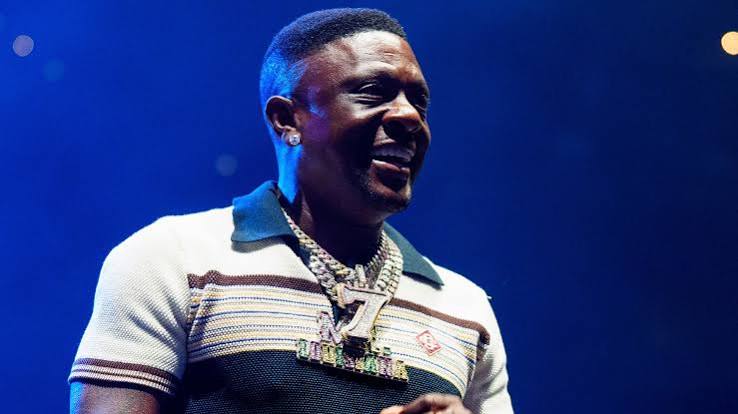
Rapper Boosie Badazz has sued political operatives Jack Burkman and Jacob Wohl to recover $600,000 he paid them to secure a presidential pardon, after publicly leaking text messages this month that he says show the men fabricating excuses while the promised pardon never materialized.
The Deal and the Missed Deadline
Boosie, born Torrence Hatch, hired Burkman and Wohl’s firm, JM Burkman & Associates, in October 2024 to pursue a pardon tied to his federal firearm case, to which he pleaded guilty in 2023. He paid $600,000 upfront under a contract he says guaranteed a $300,000 refund if no pardon was secured by Jan. 31, 2026. That deadline passed without a pardon. When Boosie threatened legal action, the firm allegedly told him it could still deliver and separately suggested it might file for bankruptcy, according to Complex.
“A Ponzi Scheme”
Boosie went public with his frustration Aug. 6 on the radio program “Rickey Smiley on the Spot,” calling the arrangement “a Ponzi scheme” and saying he had contacted people the firm claimed to have reached on his behalf, only to find they “had no affiliation with it.” He discussed the failed pardon effort again Sept. 14 on CBS’s “60 Minutes.”
The following week, Boosie escalated further, posting screenshots on X of text exchanges with Burkman spanning November 2025 through February 2026. In the messages, Burkman allegedly assured Boosie that efforts were underway and blamed delays on President Trump “handling the Venezuelan crisis,” claiming Trump was “very sympathetic” to the case. Boosie wrote alongside the leaked screenshots: “They were lying about their connections to Trump and were feeding him bogus excuses,” according to TMZ.
Burkman denied that any refund clause exists and told reporters, “We tried very, very hard.” Wohl has not issued a separate public statement.
The Connection Nobody Else Drew
Burkman and Wohl are not first-time subjects of controversy. Both men were previously convicted for orchestrating robocalls that spread false information about voting by mail, calls that specifically targeted predominantly Black neighborhoods in an effort to suppress turnout. That history means the same operatives now accused of taking $600,000 from a Black artist under false pretenses about a presidential pardon have a documented record of running schemes aimed at disenfranchising Black voters.
Boosie’s lawsuit does not raise that history as a legal claim, but it places two documented voter-suppression operators back at the center of a story involving alleged deception of a Black public figure.
Why the Case Matters Beyond One Artist
Pardon brokering exists in a legal gray area: there is no formal licensing requirement to lobby the White House for clemency, and the process itself offers no public transparency into who is actually communicating with the administration versus who is simply claiming to. That opacity is what let Burkman and Wohl’s firm allegedly maintain the appearance of an active pardon effort for more than a year without producing any verifiable result, according to Boosie’s account, and it is the same opacity that makes cases like his difficult to prove or disprove without exactly the kind of internal text records he has now made public.
How the Actual Pardon Process Differs From What Was Promised
The Department of Justice’s Office of the Pardon Attorney runs the standard federal clemency process, which involves a formal petition, an FBI background investigation and a nonbinding recommendation that eventually reaches the president’s desk, a process that typically takes months to years and offers no guarantee of a specific outcome regardless of who is involved.
A private firm charging a flat fee with a promised deadline and a contractual refund clause operates outside that formal channel entirely, functioning instead on claimed personal access to the president or his advisers rather than on the documented petition process every other applicant for clemency goes through. That structural difference is central to Boosie’s allegation: rather than filing a petition through the standard channel, he says he paid for direct access that the leaked texts suggest may not have existed in the way it was described to him.
The Underlying Case Boosie Was Trying to Resolve
Boosie’s push for a pardon stems from a federal firearm case to which he pleaded guilty in 2023. He has described himself publicly as a “non-violent felon” who was unfairly targeted by the case, a characterization that reflects his own framing of the underlying conviction rather than a court’s formal finding. That conviction, and the restrictions that come with a federal felony record, is the specific legal problem the $600,000 payment was meant to solve, and it remains in place regardless of how the fraud dispute with Burkman and Wohl is ultimately resolved.
What Happens Next
Boosie’s lawsuit against Burkman and Wohl remains active. Should the case proceed to discovery, it would likely require the firm to produce records of who it actually contacted inside or connected to the administration on Boosie’s behalf, evidence that could either substantiate or contradict the firm’s account of “trying very, very hard.” Boosie’s underlying federal case, the one he was seeking a pardon for in the first place, remains unresolved by any of this dispute.