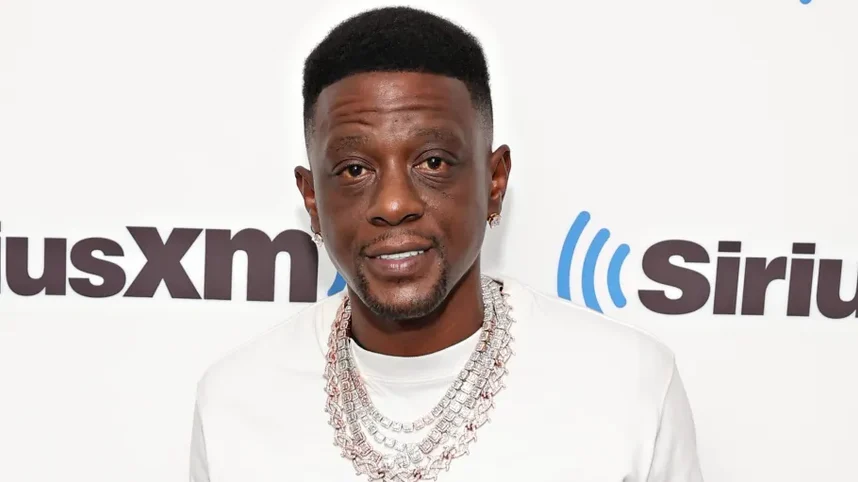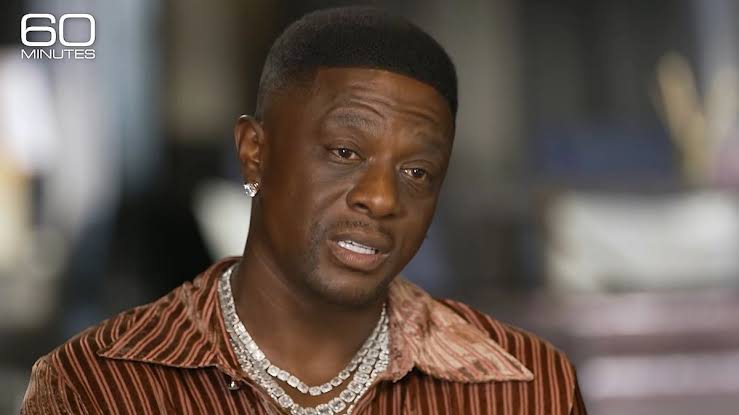
Rapper Boosie BadAzz told “60 Minutes” he paid $600,000 to Washington political operatives for a presidential pardon that never arrived, and he is now trying to recover $300,000 of it through arbitration. The Baton Rouge, Louisiana, rapper, whose legal name is Torence Hatch, said he believed the payment was simply how clemency worked in Washington.
What Boosie Told ‘60 Minutes’
Hatch appeared on the CBS newsmagazine’s broadcast Sunday, Sept. 14, and confirmed the amount when asked directly. “$600K. Yeah,” he said. He told correspondents he handed the money to political consultants Jack Burkman and Jacob Wohl, operating as JM Burkman & Associates, in 2025 in exchange for a promise that President Donald Trump would pardon him for a 2023 federal firearm conviction out of San Diego.
That conviction carried three years of supervised release, 300 hours of community service and a $50,000 fine. No pardon came. Hatch said the brokers presented the fee as standard practice. “This is what I was led to believe if you come with this money, you will get a pardon,” he said. “I just thought, I mean, ‘This is the way it’s done.’” When the pardon failed to materialize, he said he told the men bluntly: “Just return it. You didn’t give me my pardon…a bunch of BS.”
How the Deal Was Structured
According to Hatch’s account, the $600,000 was split into two halves under the arrangement he made with Burkman and Wohl: $300,000 was nonrefundable up front, and the remaining $300,000 was refundable if no pardon materialized by an agreed deadline. That deadline passed without action from the White House, and Hatch has since filed an arbitration claim seeking the return of the conditional half.
His criminal-defense attorney has separately submitted a formal pardon request directly to the White House through official channels, bypassing the brokers entirely.
Pardon brokering has become a recurring undercurrent of the current administration, with rates cited elsewhere in reporting on the practice running as high as $3 million for access to a presidential signature. Hatch’s case puts a concrete dollar figure and a specific, named celebrity behind what has largely been discussed as rumor.
How Official Pardons Are Supposed to Work
The Justice Department’s Office of the Pardon Attorney normally reviews clemency petitions through a formal application process that does not require paying a private broker: petitioners submit a request, the office investigates and makes a recommendation to the president, who has final authority to grant or deny it. That process carries no official fee.
Hatch’s account describes a parallel, informal channel in which private consultants with claimed access to the White House offered to move a request faster, or with a higher chance of success, in exchange for a direct payment — a practice legal ethics experts have criticized precisely because it operates outside that public review process and outside any court’s oversight.
Hatch pleaded to the underlying San Diego firearm charge in 2023 as part of a broader legal history that includes a prior Louisiana attempted first-degree murder charge, of which he was acquitted in 2012, and other past weapons and drug cases dating back more than a decade. He has built a national fan base as an outspoken hip-hop artist from Baton Rouge known for candid commentary on his own legal troubles, and his willingness to discuss the $600,000 payment publicly, rather than pursue a quiet settlement, is itself consistent with that public persona.
The Brokers Push Back
Burkman and Wohl dispute that Hatch is owed any refund. According to their account, no enforceable written contract existed between the parties, only an unsigned oral understanding, which they argue undercuts any claim for guaranteed money back. Four other names that surfaced in reporting around the arrangement — conservative activist Laura Loomer, Erika Kirk, House Speaker Mike Johnson and Natalie Harp — each denied any involvement in the deal, according to CBS’s reporting.
The White House distanced itself from the entire episode. Press aide Lauren Bis said in a statement carried by CBS that “anyone spending money to lobby for pardons is foolishly wasting their money,” a pointed rebuke of the market Hatch says he paid into.
Why It Matters
Hatch’s allegation exposes a specific transaction inside what critics have described as an informal marketplace for clemency, where access and influence are allegedly sold to people seeking to have convictions erased outside the Justice Department’s standard pardon-review process.
A working recording artist with an active fan base going public with a dollar figure, a broker’s name and a broken promise gives the arrangement a level of documentation that vague rumors about pardon-for-sale schemes have lacked.
It also raises the question of exposure for other public figures who may have entered similar arrangements quietly, without going on national television to describe it. Hatch’s decision to detail the transaction on “60 Minutes,” rather than settle it privately, put pressure on Burkman and Wohl to respond publicly rather than in a closed arbitration room.
What Happens Next
The arbitration claim over the $300,000 conditional payment is proceeding outside public court records, so its outcome will not necessarily surface on a public docket. Hatch’s attorney’s direct pardon request to the White House remains pending, separate from the money dispute; whether that application succeeds or fails will determine whether Hatch ultimately gets both his freedom from any remaining supervised-release conditions and a portion of his money back, or neither.
Burkman and Wohl have not filed any public response beyond disputing the existence of a binding contract, and no arbitration ruling has been announced.