Astronomers say they have detected radio waves coming from an exoplanet itself for the first time. The planet is Beta Pictoris b, a young gas giant, and the signal gave the team the first direct measurement of an exoplanet’s magnetic field, according to a paper posted to arXiv in September.
Kevin Ortiz Ceballos and Edo Berger of the Center for Astrophysics | Harvard & Smithsonian and Yvette Cendes of the University of Oregon wrote the paper. The study is a preprint and has not been peer reviewed. The team used the MeerKAT radio telescope array in South Africa, and the arXiv record shows a Sept. 15 submission date.
What the radio telescope picked up from Beta Pictoris b
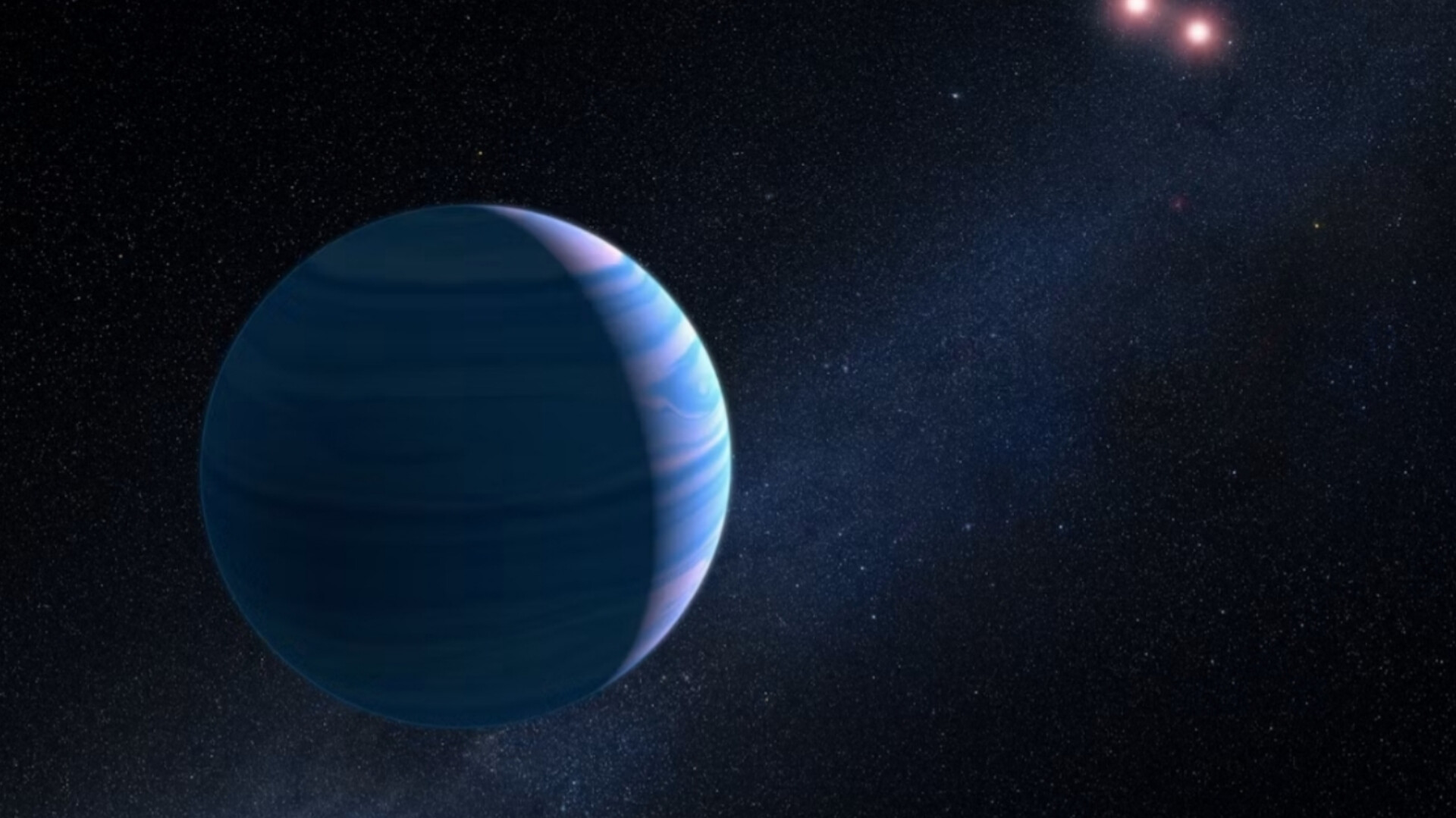
Beta Pictoris b is a gas giant with 9 to 13 times Jupiter’s mass that orbits about eight times as far from its star as Earth does from the sun. Astronomers found it in 2008 with the European Southern Observatory’s Very Large Telescope. Sci.News put the system about 63 light-years away, while Live Science reported 64.
The paper lists four observing sessions between February 2025 and May 2026, about 15 months. They include a 9.3-hour L-band follow-up and later sessions in the higher S band, and together they cover 0.85 to 3.5 gigahertz.
The authors describe “rapid, recurring, and highly circularly polarized bursts” plus persistent emission. The circular polarization runs about 40% to 70%. The handedness differs between sessions: left-handed on May 31, 2025, and right-handed on May 2, 2026. The brightest burst measured 307 microjanskys in the L band, or 0.307 millijanskys. The abstract says no earlier exoplanet detection had been conclusively localized.
How the team localized the signal
Radio waves from a planet can be confused with radio waves from its parent star, which sits close by on the sky. The team anchored its positions to reference points from background quasars, a method Tech Times described as using Gaia quasar positions. The corrected position matches the planet, with a Mahalanobis radius of 1.1 (a probability of about 0.53). The paper rules out the host star at 4.4 sigma and the system’s inner planet, Beta Pictoris c, at 4.8 sigma.
Physicists often reserve the word discovery for results at 5 sigma or higher, and both figures fall short of that convention. The 4.4 sigma number measures how strongly the data disfavor the star as the source. The authors add several physical arguments. The paper limits the star’s own dipole field to about 0.3 kilogauss. It says a moon interacting with the planet, as Io does with Jupiter, lacks the energy and conflicts with existing mass limits.
It says the planet’s interaction with the star’s wind would under-predict the emission by three orders of magnitude. Suzanne Aigrain, an astrophysics professor at the University of Oxford, called the result “the first truly convincing direct detection” of an exoplanet in radio, Live Science reported. The outlet said the study is a preprint.
Joe Callingham, an astronomer at the University of Amsterdam who was not part of the team, said the signal is “probably auroral.” Cendes, a co-author at the University of Oregon, told Tech Times the field is much stronger than anything in the solar system.
Why the signal implies a magnetic field 290 times Jupiter’s
The team attributes the bursts to the electron cyclotron maser instability, the process that produces auroral radio emission on Earth, Jupiter, Saturn, Uranus and Neptune, as well as on some brown dwarfs. In that process, electrons spiral along magnetic field lines and emit radio waves at a frequency set by the field strength.
That link between frequency and field is what makes the detection useful. The paper gives the relation as a frequency of about 2.8 gigahertz for every kilogauss. The highest frequency the team recorded, 3.5 gigahertz, points to a field of at least 1.25 kilogauss, or 1,250 gauss. The paper calls this the first direct field-strength measurement for any exoplanet.
Live Science listed Jupiter’s field at 4.3 gauss and Earth’s at 0.5 gauss. By that arithmetic, the planet’s field is about 290 times Jupiter’s and about 2,500 times Earth’s. The comparison with mass adds context. Sci.News gave the planet 9 to 13 Jupiter masses, so its field runs about 22 to 32 times stronger than Jupiter’s for each unit of mass. Sci.News described the figure as a minimum, because the team can only calculate the field from the highest frequency it saw.
The number also matches a prediction. The paper says a dynamo model calibrated on solar system planets gives a mean surface field of about 1.2 kilogauss for a planet like this one, with a polar dipole of about 0.8 kilogauss. That sits close to the radio-derived floor of 1.25 kilogauss.
Beta Pictoris b is young. The star system is about 23 million years old, per Sci.News, compared with roughly 4.6 billion years for the solar system. The paper reports a rotation period of 8 to 9 hours from spectroscopy and JWST photometry, and it puts the separation between two L-band bursts at about 8 hours, close to that spin period.
Which planets could be next
The authors identify seven more directly imaged giant exoplanets in five other systems within 45 parsecs, or about 147 light-years, according to the arXiv paper. They estimate next-generation radio observatories could improve sensitivity by a factor of five to seven, and Live Science said the Square Kilometre Array should make similar measurements possible for many more planetary systems.
If other planets show similar bursts, astronomers would gain a way to measure planetary magnetic fields from radio data alone. Astrobiology.com posted the abstract on Sept. 24, nine days after the Sept. 15 submission date. The field estimate rests on one preprint and four observing sessions, and it has not yet gone through peer review.