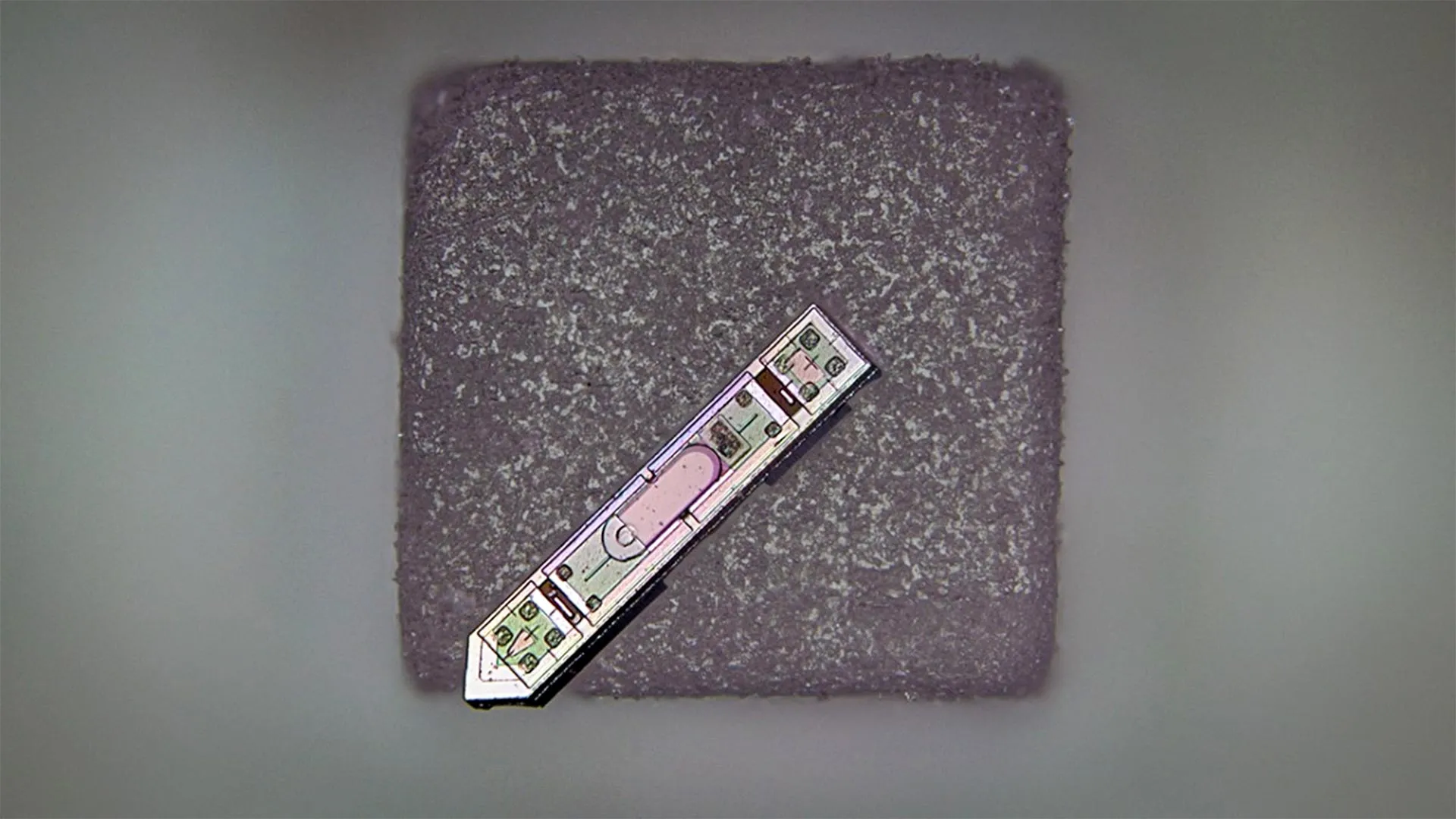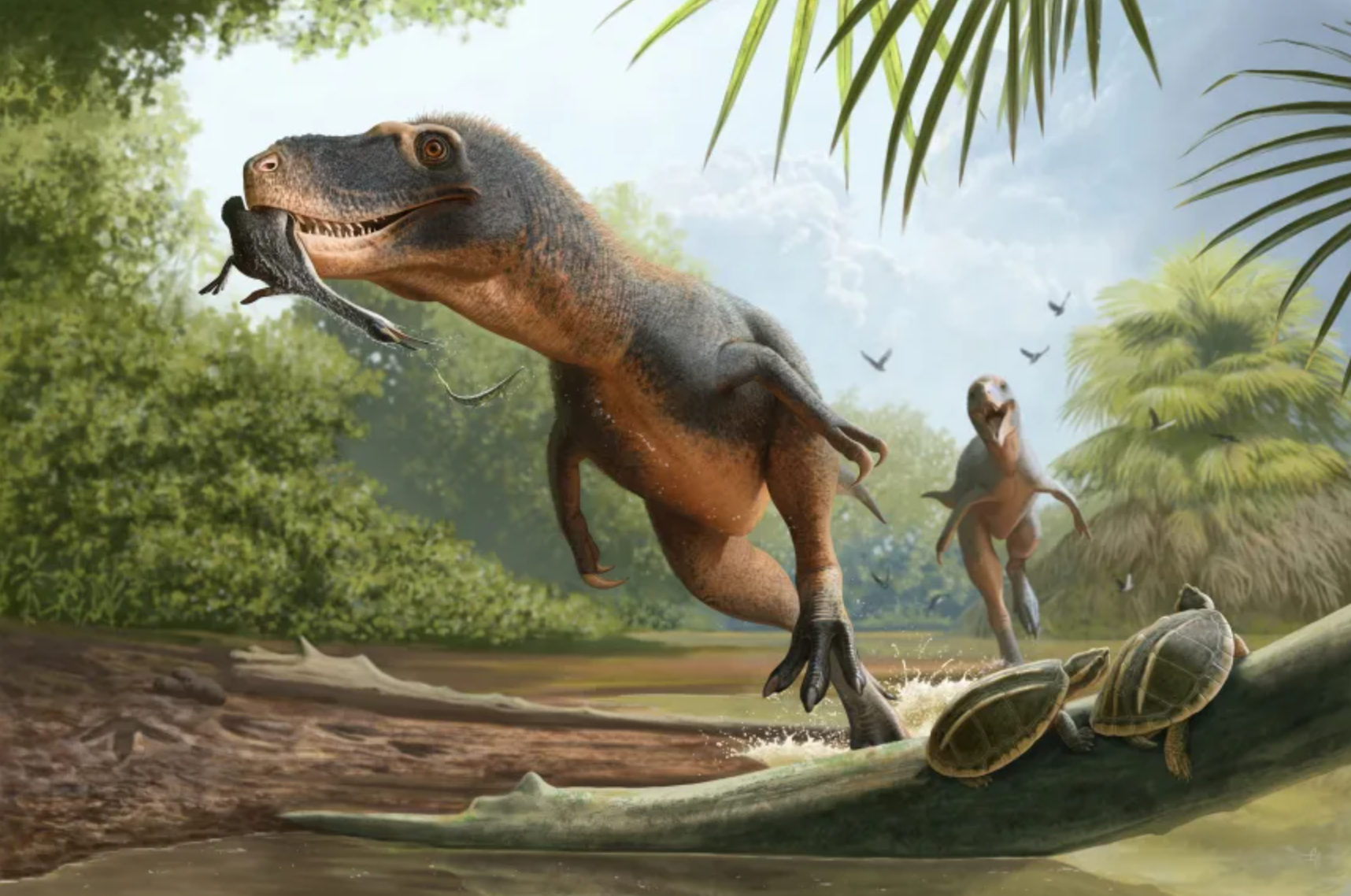
Paleontologists scanned a fossilized dinosaur dropping about half the size of a golf ball from Montana’s Hell Creek Formation and found feathers, fish scales and leg bones from an extinct diving bird inside it. A large meat-eating dinosaur ate that bird roughly 66 million years ago.
The findings were published in Current Biology on Sept. 10. The bird was a hesperornithiform, a loon-like diver that could not fly. These are the first hesperornithiform feathers ever identified. The animal died shortly before the asteroid impact that ended the Cretaceous.
Jingmai O’Connor, associate curator of fossil reptiles at the Field Museum of Natural History, said the specimen is “without a doubt, the best feather we’ve ever found from the age of dinosaurs.”
A Bird Inside a Dropping, and Fish Inside the Bird
The coprolite contains three animals at once. A large predator produced it. Inside are the feathers and leg bones of the bird it ate. Inside the bird are tiny fish scales from the bird’s own last meal.
O’Connor said the team “hypothesise that those tiny fish scales were in the stomach of the bird when the bird was consumed.” That nesting is what Julia Clarke, an evolutionary biologist at the University of Texas at Austin who was not involved in the research, described when she said it was “almost like they’ve discovered a Cretaceous turducken.” A predator, its prey and its prey’s prey sit in one object.
The methodological point matters as much as the novelty. Most fossil feathers come from slabs of stone, where the tissue is flattened into a film. Steven Salisbury, a vertebrate palaeontologist at the University of Queensland who was not involved in the work, said that with slab fossils “most of the time you’re just looking at impressions of feathers … the actual feather is not there. This is cool because it’s actually the preserved feather in 3D.” A coprolite holds its contents in three dimensions.
Researchers had not been looking in droppings. Nate Carroll, a paleontologist at the Carter County
Museum in Ekalaka, Montana, said he had been “relying on far-flung amber mines as my main source of 3D feather data, realizing that fossil poop from my home state could yield such exceptional specimens was a game changer.” He said that “every hour processing the data revealed another feather, another scale, another bone—in stunning 3D.”
How the Fossil Was Found and Scanned
David DeMar Jr., a University of Washington research scientist in biology and collections manager for the Hell Creek Project, picked the specimen up in the field in 2016. He recognized the feather at the surface right away. “I rolled it over and I was like, ‘You got to be kidding me,’” DeMar said.
The full analysis came years later. Researchers micro-CT-scanned the coprolite at the University of Southern California’s medical campus, stacking thousands of X-rays to build a three-dimensional model of the interior. Eight institutions took part, including the Field Museum, the Burke Museum, Carter County Museum, the University of Colorado Boulder, the Institute of Vertebrate Paleontology and Paleoanthropology at the Chinese Academy of Sciences, the University of Alabama, the Natural History Museum of Los Angeles County and USC.
DeMar said the scans showed anatomy that only modern birds have. “Two of the feathers, including the one exposed at the surface of the coprolite, have features found only in those of living birds — and their immediate ancestors. This includes a square feather shaft with a sponge-like center,” he said. The next oldest record of that sponge-like shaft center comes from Early Eocene deposits in Denmark, about 10 million years younger.
O’Connor said the work was unlike her usual research. “I usually work with fossils that are preserved in big stone slabs… But with this project, we just had this coprolite—and its contents—to go off of, and it made me feel like a detective, piecing together all these little clues,” she said.
The team cannot identify the predator with certainty, but the size of the dropping narrows the field. O’Connor said she “would argue thatTyrannosaurus rex or Nanotyrannus are the more likely candidates.”
Gregory Wilson Mantilla, a University of Washington professor of biology and Burke Museum curator of vertebrate paleontology, said the specimen captures an interaction that fossils almost never record. “We rarely find fossils of birds and even more rarely their feathers… these bird feathers found within a large fossilized dinosaur dung give us an incredible window into predator-prey interactions 66 million years ago,” he said.
The Extinction Hypothesis and the Pushback
The feathers themselves are primitive. O’Connor argues that their structure may help explain why hesperornithiforms died out while other bird lineages lived.
“The primitive body feathers of hesperornithiforms were not a problem for these birds during the greenhouse world of the Mesozoic, but the asteroid impact triggered an impact winter and global temperatures dropped significantly,” O’Connor said. She said that “now the primitive body feathers and their less effective insulation is problematic — it takes more energy to stay warm but there is less food available through which to acquire this energy.”
She was careful about how far she pushed the idea. “I’m saying it’s a contributing factor,” O’Connor said.
Clarke is not convinced by that part. “I think it’s a stretch to explain the survivorship of some species and the extinction of others,” she said.
Other outside researchers praised the specimen. Richard Prum, an ornithologist at Yale University who was not involved in the study, said the preservation is exceptional. “It’s certainly impressive that this amazing feather morphology could be detected in dinosaur poop. That is remarkable, unexpected. There’s nothing of that age that’s so beautifully preserved,” Prum said.
Anthony Fiorillo, executive director of the New Mexico Museum of Natural History and Science, who was not involved in the research, said he [“continue[s] to marvel over the kinds of things we find in the fossil record that were never thought possible.”](https://www.cp24.com/news/world/2026/09/15/some-birds-survived-the-asteroid-thatwiped-out-dinosaurs-a-fossilized-poop-can-help-explain-why/)
Salisbury said the underlying question remains open. “One of the great mysteries of any extinction event, and in particular the Cretaceous extinction event, is why some groups of animals get through, and others don’t,” he said.
What Would Settle the Question
O’Connor said a second specimen of similar quality would be needed to test the insulation hypothesis. “It would have to be preserved in amber or in another exceptionally preserved coprolite so that the feathers are preserved in 3D and with enough bone to be certain about the identification,” she said.
The fossil is on permanent display at the Burke Museum in Seattle, in its “Drama at the K-Pg” exhibit. Donations to the Hell Creek Project funded the fieldwork that recovered it.