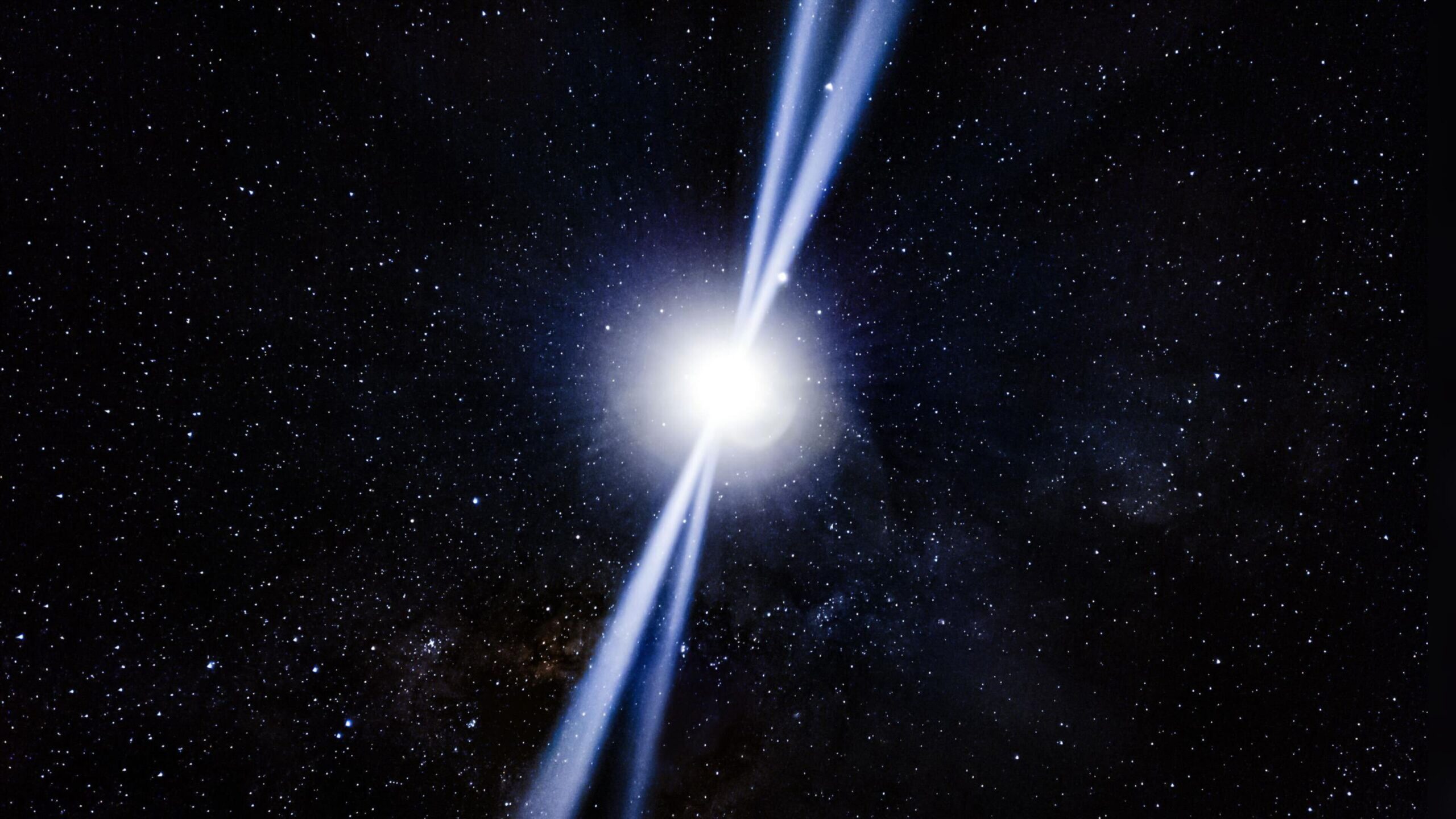
A white dwarf called WD J1330+6435 would look chartreuse green to a human observer nearby, according to astronomers at the University of Warwick in England. The team says that as far as it knows, no other star has been credibly reported as green, which would make this the first.
The finding comes from a University of Warwick press release dated Oct. 15 and a paper in the journal RAS Techniques and Instruments. No one has photographed the star in green. The color is a calculation.
How Spectra Become Colors
Dr. Mark Hollands, a Warwick Prize Fellow in the university’s Astronomy and Astrophysics Group, led the work. The paper, titled “Any colour you like: the diverse chromaticities of white dwarfs”, lists Hollands, Gänsicke, Tremblay and Koester as authors.
The method has three steps. The authors took a star’s spectrum, which records how much light it gives off at each wavelength. They converted it to a standard set of color coordinates used to model human vision. Then they converted those coordinates to a color a computer screen can display. The paper says the work used SDSS spectra and photometry and a Python package called colorpy.
For hydrogen-dominated and helium-dominated white dwarfs, the team used model atmospheres rather than observed spectra. The hydrogen models cover temperatures from 3,000 to 140,000 kelvin. The helium models cover 3,000 to 40,000 kelvin. For carbon-rich stars and stars with infrared-faint spectra, the authors used observed SDSS spectra because models handle those stars poorly.
The paper flags a limit on the display step. Colors that fall outside the range a standard screen can show get clipped, and the displayed color is the one a distant white surface would receive.
Why Dense Atmospheres Change Color
Most stars behave like what physicists call a blackbody, so their color follows their temperature: orange when cool, white in the middle, blue when hot. The Warwick release says most white dwarfs do the same. The exceptions have very dense atmospheres. The paper says the coolest white dwarfs have atmospheres up to about 1 gram per cubic centimeter. At that density, the light-absorbing behavior of carbon, calcium or sodium broadens enough to carve large pieces out of the spectrum. What is left is no longer a blackbody color.
The release describes how that sorts stars into groups. Carbon-rich white dwarfs tend to look pink or purple. Dwarfs enriched with debris from asteroids and comets lean yellow. Cool atmospheres that mix hydrogen and helium often look cyan or pale blue, because hydrogen molecules collide with helium atoms.
Green Star, Pink Neighbors
WD J1330+6435 sits at about 4,000 degrees Celsius. Its atmosphere holds calcium, lithium and sodium, which the release says came from rocky material the star pulled in from its own planetary system. The sodium does most of the work. Hollands said in the release, “Imagine standing on a planet and looking up at a green star.”
A second star, WD J1011+2845, is about 48 light years away. The release calls it possibly the reddest star recorded, with most of its light beyond 600 nanometers, and the team’s models give it a salmon-pink glow. The paper’s wording is more guarded: it calls the star “likely” the reddest known in perceived color. A third, WD J0902+2010, looks pink because a deep convection zone carries carbon molecules to the surface.
Temperature units differ between the two sources, so a conversion helps. Using the standard offset of 273 kelvin, 4,000 degrees Celsius is about 4,270 kelvin. That is a calculation from the release’s figure. It sits well below the roughly 6,800 kelvin median the team found for nearby white dwarfs.
What 151 Nearby Stars Show
To see how common odd colors are, the team studied the 151 white dwarfs within 20 parsecs of Earth, about 65 light years. Five of them had unusual colors: two yellow and three pink. The other 146 had a median color temperature of about 6,800 kelvin, which the eye reads as white. The paper concludes that the average white dwarf is, in its words, “on average” white.
From those five oddballs, the team estimates roughly one in 30 white dwarfs in the universe is unusually colored. Gänsicke, a professor in Warwick’s Department of Physics, said in the release that one in 30 might not sound like a huge fraction.
The arithmetic checks out. Five of 151 is 3.3%, or about one in 30. The same release also argues that the popular picture of blue white dwarfs comes from surveys that favor the brighter, hotter stars. Here the sample is volume-limited, meaning it counts every white dwarf in a fixed volume of space, which avoids that bias.
A calculation of the uncertainty shows how small the count is. With only five stars, a simple counting error is the square root of five, about 2.2. That puts the count between roughly 2.8 and 7.2 stars, or 1.8% to 4.8% of the sample, which is about one in 21 to one in 54. This range is a calculation from the release’s counts, not a figure the Warwick team published.
Sample Limits, Funding
The authors say two of their samples are not representative. The 15 infrared-faint stars come from earlier catalogs by Hollands and colleagues in 2017 and by Bergeron and colleagues in 2022. The paper also uses 36 carbon-rich stars, 10 of them drawn from a catalog by Blouin and Dufour in 2019 and 26 from Kepler and colleagues in 2016. The authors chose these groups to show extreme cases.
The paper also notes one blue example, WD J1251+4403, at about 12,700 kelvin. Its spectrum has low signal-to-noise, so its color is less certain. Older SDSS spectra stop at about 380 nanometers, and the authors argue that the missing blue end has a negligible effect on the colors. Neither the Warwick release nor the paper text reviewed for this report lists funding for the work.