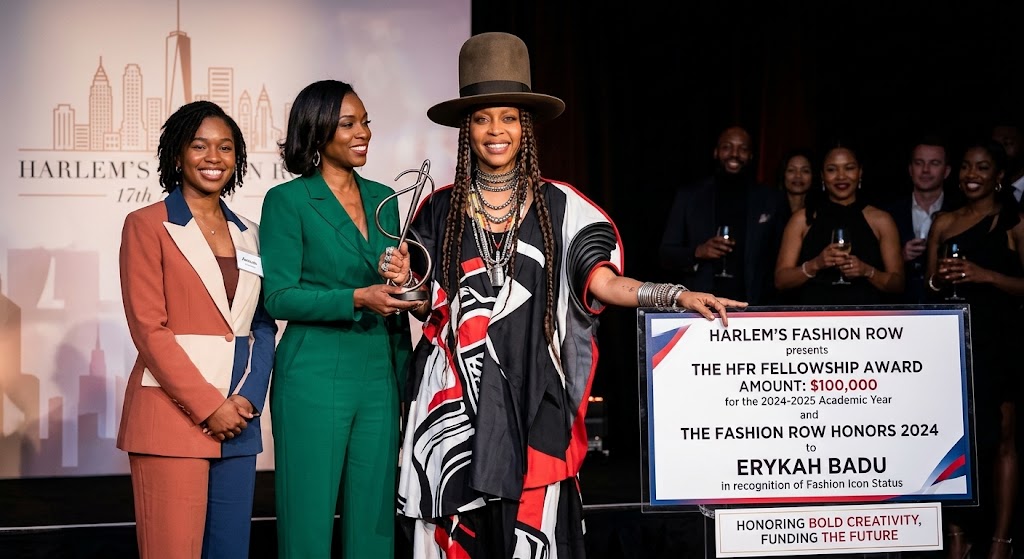
Harlem’s Fashion Row handed out a $100,000 designer fellowship and honored singer Erykah Badu with its Fashion Icon Award at its 19th annual Style Awards during New York Fashion Week, marking the largest single funding commitment the nonprofit has made to an emerging designer in its nearly two-decade history.
What Happened
The nonprofit held its 19th annual Fashion Show & Style Awards Sept. 8 at The Glasshouse in New York, under the theme “Peace by Piece.” Erykah Badu received the Fashion Icon Award. Designer Brandon Blackwood was named Designer of the Year. Content creator and model Wisdom Kaye received the Virgil Abloh Award, presented by LVMH.
Stylist Audrey Smaltz received the Ann Lowe Maverick Award, Jahleel Weaver was named Stylist of the Year, and Recho Omondi was named Editor of the Year. Three designers — Waïna Chancy of Atelier Ndigo, Rey Jaiteh and Chuks Collins — showed collections on the runway.
What We Know
The organization awarded a $100,000 Runway Ahead Designer Fellowship through a partnership with ICON360 and the PVH Foundation, the first time Harlem’s Fashion Row has backed the fellowship at that dollar figure in its 19 years of operating. The event drew celebrity attendees including Gunna, Tracee Ellis Ross, Justine Skye and Sheinelle Jones.
The LVMH-sponsored Virgil Abloh Award category ties the event directly to one of the luxury industry’s largest holding companies, underscoring the organization’s role as a pipeline connecting Black design talent to major fashion houses.
Brandon Blackwood built his eponymous handbag and accessories label into one of the more visible Black-owned brands in American fashion over the past decade, known in part for a tote bag emblazoned with the message “Buy From A Black Woman” that circulated widely during the broader wave of attention to Black-owned businesses in the early 2020s.
Badu, honored for a career spanning more than three decades as a singer, songwriter and cultural figure associated with the neo-soul movement, has increasingly been recognized in fashion circles for her personal style as much as her music.
The Virgil Abloh Award, presented in partnership with LVMH, carries particular weight in the industry because it is named for the late designer who became artistic director of Louis Vuitton’s menswear line in 2018, one of the highest posts a Black designer had held at a major European luxury house before his death in 2021. Presenting the award to Wisdom Kaye, a content creator known for elaborate, high-fashion styling videos rather than a traditional runway career, signals the organization’s willingness to recognize newer forms of fashion influence alongside conventional design credentials.
The Ann Lowe Maverick Award given to stylist Audrey Smaltz similarly honors a lineage: Ann Lowe was a mid-20th-century Black American designer who made Jacqueline Bouvier’s wedding dress for her marriage to John F. Kennedy but received little public credit for it during her lifetime.
Why It Matters
Founded nearly two decades ago, Harlem’s Fashion Row has built its reputation specifically on the gap between talent and access in the fashion industry — the idea that Black designers with real ability have historically lacked the same entry points to retailers, licensing deals and luxury-house partnerships that white designers have had.
The organization’s model pairs a high-visibility annual ceremony with direct funding mechanisms like the Runway Ahead fellowship, aiming to convert recognition into capital rather than stopping at recognition alone. A six-figure fellowship, rather than a symbolic award alone, gives an emerging designer money to put directly toward producing a collection.
Quote
Harlem’s Fashion Row founder Brandice Daniel said of the organization’s mission, “There is nothing that we can’t do if we decide right now to do it together.”
What Happens Next
Attention now turns to how the $100,000 fellowship recipient’s collection is developed and placed, and whether LVMH and the PVH Foundation extend further financial backing to the program in future cycles. The three runway designers featured this year — Waïna Chancy of Atelier Ndigo, Rey Jaiteh and Chuks Collins — represent the next tier of talent the organization is positioning for the kind of retail and licensing opportunities its more established alumni, including Blackwood, have already secured.
The event’s celebrity turnout, including Grammy-nominated rapper Gunna and actor Tracee Ellis Ross, also underscores how Harlem’s Fashion Row has grown from a niche industry showcase into a mainstream New York Fashion Week fixture that draws attention well beyond the fashion trade press, giving its honorees and fellowship recipients a visibility boost that smaller industry awards ceremonies typically cannot offer.
The ceremony’s placement during New York Fashion Week itself matters strategically: buyers, editors and retail executives are already in the city for runway shows from major labels, meaning Harlem’s Fashion Row’s honorees and fellowship recipients get exposure to exactly the audience capable of translating recognition into wholesale orders, licensing conversations and future collaborations, rather than reaching an audience limited to the organization’s existing supporters.
Sources: Hello Beautiful/Urban One; RunwayLive; Rolling Out.