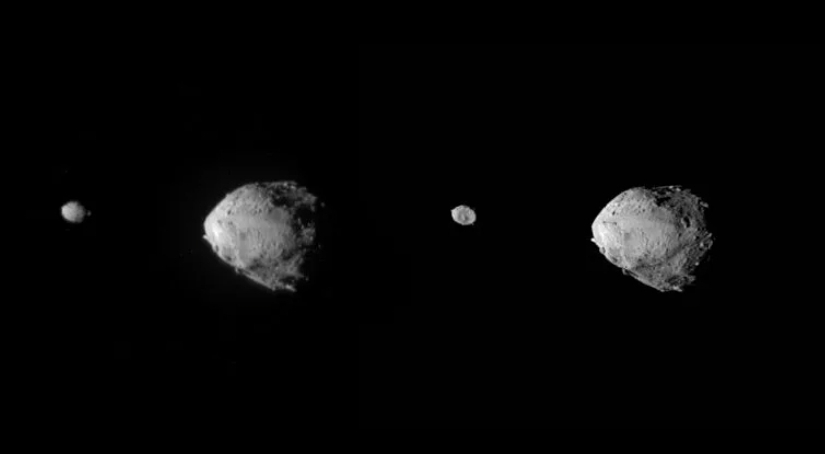
The European Space Agency’s Hera spacecraft found that asteroid Dimorphos, which NASA’s DART probe struck in 2022, now has a stadium-sized crater across its whole width and is tumbling chaotically, ESA said Nov. 25.
Scientists spent four years arguing about what a spacecraft did to a small asteroid. The answer settles the argument by making everyone right, and it gives planetary defense its first look at what a real deflection leaves behind.
What Hera Found at Dimorphos
Dimorphos is 151 meters across and orbits a larger asteroid, Didymos, which is 730 meters across. The pair is 193.5 million kilometers from Earth. The face DART hit is now a crater spanning the whole asteroid. Dimorphos has lost a steady spin and tumbles. Hundreds of previously unknown boulders, each a few meters across, orbit the pair.
“Scientists debated whether Dimorphos had sustained an impact crater, changed its shape or stayed the same,” said Patrick Michel, Hera’s principal investigator at CNRS and the Côte d’Azur Observatory. “Much to our surprise the answer turns out to be all three at once!” Michael Kueppers, ESA’s Hera mission scientist, said “the DART impact has left Dimorphos tumbling wildly in its orbit.”
Why the DART Asteroid Results Matter
DART struck Dimorphos on Sept. 26, 2022, and shortened its orbit around Didymos by 33 minutes, more than predicted. That proved a spacecraft could push an asteroid. It did not show what the push did to the rock itself, which matters when a future mission has to plan a deflection with no second chance.
A calculation from the dates: Hera’s images came 1,521 days after the impact. “Today, for the first time in history, humanity is validating how to prevent such an event from happening again,” said Ian Carnelli, Hera’s mission manager. ESA Director General Josef Aschbacher credited both agencies. “This is international collaboration at its best: NASA having demonstrated that an asteroid can be deflected,” he said.
How Hera Studies the Asteroid
Hera flies about 25 to 30 kilometers from the asteroids on what ESA calls rectangular orbits, at an average of 12 centimeters per second, slower than walking pace. It carries a monochrome framing camera, a camera that captures 25 colors at once and a thermal imager from Japan’s space agency, JAXA. A consortium of 18 ESA member states built the spacecraft, led by OHB in Germany.
The timing gives the results a practical use. Asteroid Apophis passes about 32,000 kilometers above Earth on April 13, 2029, and ESA and JAXA plan to study it with a mission called Ramses, ESA said. A calculation from the dates: that flyby is 868 days away. The tumbling result complicates the next phase. A rock that does not spin predictably is harder to approach, and harder to model for anyone planning a future deflection. Hera moves to about 13 kilometers from the asteroids in December, and it deploys two small satellites, Juventas and Milani, in January.