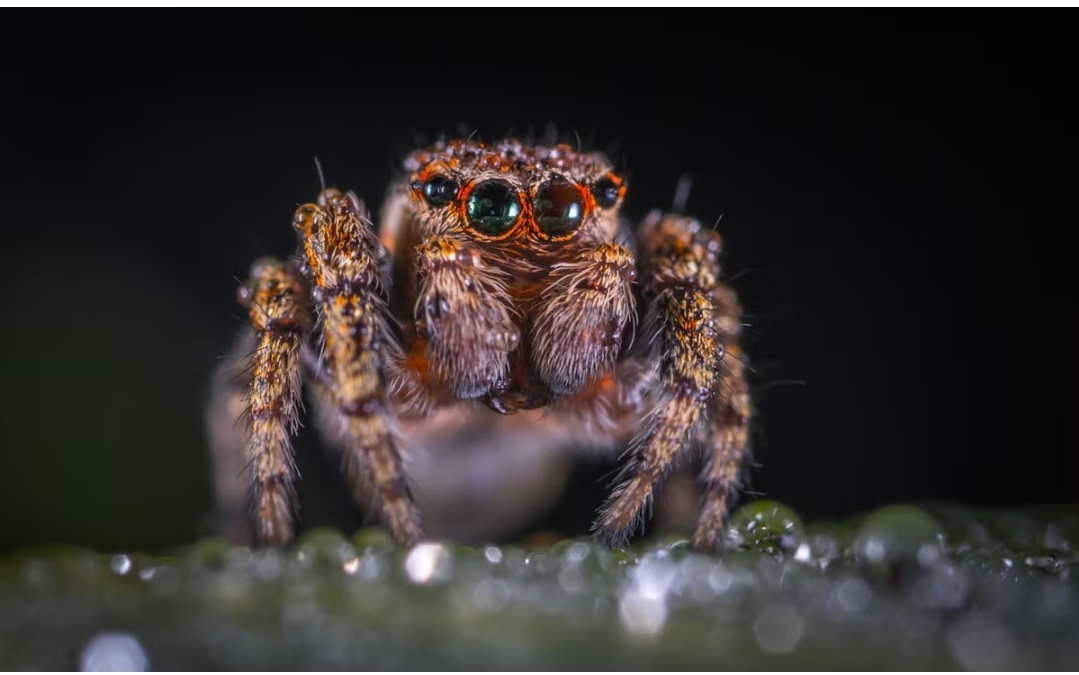
Jumping spiders sleep in two distinct stages, including a REM-like state with eye movements and muscle twitches, according to a study from the University of Bonn published in the Proceedings of the National Academy of Sciences. The university announced the finding on Oct. 27. The researchers call it the first comprehensive confirmation of sleep in a spider. The team measured behavior and did not record brain activity, so the study stops at “REM-like,” the university said.
What the Jumping Spider Sleep Study Found
The paper, “Behavioral evidence for two-stage sleep in spiders,” appears in PNAS. Its authors are Nadja Geiger, Maxim Q. Capelle, Phillip Rosentreter, Marie E. Herberstein, Armin Bahl, Massimo De Agrò, Barrett A. Klein and Daniela C. Rößler. Rößler leads an Emmy Noether research group at the Bonn Institute for Organismic Biology.
The subject was the Australian jumping spider Portia fimbriata, an adult of which is about the size of a one-euro coin. The genus preys on other spiders and is known for elaborate hunting tactics. The researchers said in a University of Bonn Q&A that the spider shows “true, regulated sleep” with two clearly distinguishable stages.
How the Researchers Tested for Sleep
The team kept spiders in 12-centimeter plastic dishes and filmed them for several days and nights under varying light to track daily rhythms. Infrared cameras recorded sleep positions, resting phases and the REM-like phases that occurred at night. Three lines of evidence support the sleep finding: day-and-night video, reaction-time tests and rebound after disruption. To confirm the animals were asleep and not just still, the researchers played an acoustic stimulus and measured reaction times. They also disrupted sleep and tested for rebound, the pattern in which an animal that loses sleep makes up for it afterward. The recordings produced very large volumes of video, the university said.
What Researchers Did Not Measure
The study did not record brain activity. The researchers said they “had to remain cautious” about the REM-like movements to avoid overinterpreting them. The finding rests on what the spiders did on camera, not on what their nervous systems did. The work is funded by the German Research Foundation’s Emmy Noether Program.
What Comes Next
The authors say the results matter for basic research on how sleep evolved and how widespread REM-like states are, and they recommend studying sleep in animals with very different nervous systems or extreme adaptations. They say they want to study sleep across the range of spider species, compare wild spiders with lab spiders, examine links between sleep and cognition, and measure brain activity in arachnids and insects. They also plan to look at how climate change and artificial light at night affect sleep.