Chinook salmon have recolonized 88% of their historic range in the upper Klamath River Basin just two migratory seasons after the completion of the largest dam removal project in world history, according to a peer-reviewed study published Aug. 27 in the journal Scientific Reports.
What Happened
Researchers found that Chinook salmon reoccupied roughly 214 miles of river and tributaries in the Klamath Basin, spanning California and Oregon, within two years of the removal of four hydroelectric dams that was completed in August 2024. The study, led by Damon Goodman, regional director for California Trout’s Shasta Cascade region, was conducted with the Karuk, Klamath and Yurok tribes, Oregon and California wildlife agencies, NOAA, the U.S. Geological Survey and Cal Poly Humboldt.
What We Know
The numbers show an accelerating recovery. In fall 2024, researchers counted 7,742 Chinook in the basin, 18% of that year’s basin-wide return. By fall 2025, the count had grown to 13,310 Chinook, or 19% of the basin-wide return. Separate agency tallies using stationary sonar and underwater cameras recorded more than 20,000 Chinook migrating upstream across the two years since dam removal, including 2,497 fish that passed through Keno Dam and 210 that passed through Link River Dam into Upper Klamath Lake in 2025 — compared with zero confirmed fall-run salmon passing Keno Dam in 2024.
Fish reached as far as Beatty Gap on the Sprague River, more than 360 river miles from the ocean at an elevation of 4,101 feet. Researchers also detected coho salmon, steelhead and Pacific lamprey using the newly reopened habitat.
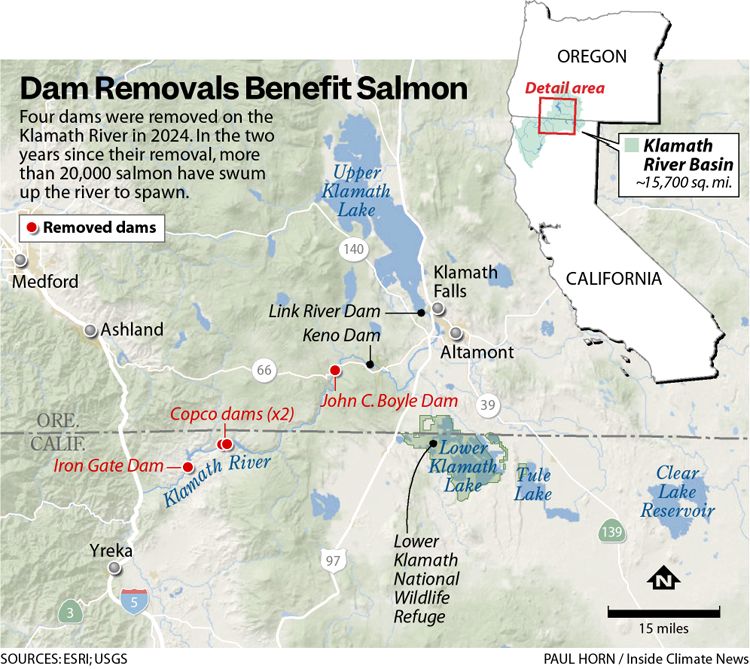
The Klamath had been blocked by dams for more than a century before their removal, which followed a decades-long campaign led by the Yurok, Karuk and Klamath tribes. The four dams removed — J.C. Boyle, Copco No. 1, Copco No. 2 and Iron Gate — had operated for power generation since the early-to-mid 20th century, and their removal, overseen by the Klamath River Renewal Corporation, ranks as the largest dam-removal and river-restoration project ever completed anywhere in the world, opening the river’s mainstem to fish passage for the first time in generations.
The Caveats
The recovery is not complete, and researchers were careful to say so. Two smaller dams, Keno and Link River, remain in place and still impede full fish passage upstream, and spring-run Chinook have not yet returned to the upper basin. George Pess, chief operating officer and science director at Conservation Angler, cautioned against overstating the result: “It’s not a magic bullet. There are still plenty of issues with the Klamath.
” The basin faced a difficult 2026 with drought and low snowpack straining recovery efforts, a parasite outbreak that killed hundreds of juvenile Chinook, and a botulism outbreak that killed 13,730 birds at Tule Lake National Wildlife Refuge, according to Inside Climate News. Water-allocation conflicts between agricultural users and environmental flow requirements also continue.
Researchers tracked the recolonization using stationary multibeam sonar units, underwater video cameras and in-person fish surveys placed at multiple points along the river, a monitoring network built specifically to measure how quickly fish would respond once the dams came down. That infrastructure is what allowed scientists to say with confidence, rather than estimate loosely, that zero fall-run Chinook passed Keno Dam in 2024 compared with 2,497 in 2025 — a level of precision that gives the recolonization figures unusual credibility for a wildlife recovery claim made this early after a restoration project.
Why It Matters
Goodman, the study’s lead author, said even he was surprised by the pace. “The biological response has been much faster than I, and most of us, expected,” he said. Scientists are calling it one of the fastest ecological recolonization responses documented after a major dam removal anywhere in the world, and tribal leaders see it as vindication of a campaign that spanned decades. “We’re just trying to move back into balance,” said Amy Cordalis of the Ridges to Riffles Indigenous Conservation Group.
Mark Bransom, chief executive of the Klamath River Renewal Corporation, which oversaw the dam removal, struck a measured tone about how much work remains even with a free-flowing river. The current condition, he said, is “not the complete story.”
What Happens Next
The tribal and agency consortium that led the research plans continued multiyear monitoring of salmon and other fish populations in the basin. Whether spring-run Chinook return to the upper basin, and how the basin’s fish populations weather continued drought conditions, remain open questions researchers are tracking season to season.
The Klamath dam removal is frequently cited by conservation groups nationally as a test case for whether large-scale river restoration can produce measurable ecological results quickly enough to justify similar projects elsewhere, and the speed of this recolonization — a majority of the historic range reoccupied within two migratory seasons rather than over decades — is already being used in advocacy for other proposed dam removals on rivers in the Pacific Northwest and beyond.
For the Yurok, Karuk and Klamath tribes, whose fishing rights and cultural practices were built around salmon runs that the dams cut off for more than a hundred years, the recolonization numbers carry a significance that goes beyond biology. Tribal leaders involved in the monitoring effort have described the returning fish as a direct, measurable validation of a campaign that spanned multiple generations of tribal members who worked toward dam removal without knowing whether they would live to see it completed, let alone see fish return this quickly afterward.
Sources: Scientific Reports study, Aug. 27, 2026; NOAA Fisheries; Inside Climate News, Aug. 27, 2026; California Trout.