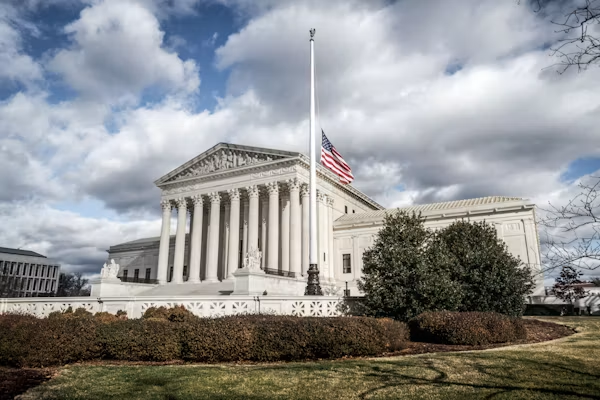
The Supreme Court on Monday, Oct. 5, declined to hear a First Amendment challenge to a Michigan middle school’s ban on “Let’s Go Brandon” sweatshirts. The order leaves in place a 6th U.S. Circuit Court of Appeals ruling that schools may bar political slogans their administrators reasonably read as vulgar. The justices gave no reasons, and the docket entry for No. 25-1143 reads “Petition DENIED.”
The case is D.A. v. Tri County Area Schools. It appeared on the Oct. 5 order list among the first denials of the new term. The denial ends the students’ effort to overturn the appeals court. It does not decide the constitutional question for the country, because the Court’s refusal to take a case carries no precedent.
What Happened at Tri County Middle School
The students are two brothers at Tri County Middle School in Howard City, Michigan. One was in sixth grade and the other in eighth, according to the Sixth Circuit’s opinion, which is reproduced in the appendix to their Supreme Court petition. Their mother gave them the sweatshirts for Christmas 2021.
In February 2022, Assistant Principal Andrew Buikema told the younger brother to take his sweatshirt off, saying the phrase “means the F-word,” the opinion records. Weeks later, teacher Wendy Bradford told him to remove it or go to Buikema’s office. In May 2022, Buikema told the older brother to remove his sweatshirt because of its “profane double meaning.” A third student was also asked to take off a similar sweatshirt.
The opinion describes no formal discipline. The boys changed clothes and stayed in school. Principal Williams testified that he knew of no disruption caused by the apparel, and the dress code allowed political clothing that did not violate its ban on lewd, indecent, vulgar or profane messages. Both brothers had seen classmates wear “Make America Great Again” and other proTrump clothing without being stopped, the opinion says.
The family sent a cease-and-desist letter in May 2022 and sued in April 2023. U.S. District Judge Paul Maloney in the Western District of Michigan granted summary judgment to the school district and the administrators, reasoning that a school that may ban profanity may also ban clothing reasonably read as profane.
How the Sixth Circuit Ruled in October 2025
A divided three-judge panel affirmed on Oct. 14, 2025. Judge John Nalbandian wrote the majority opinion and Judge Moore concurred. The majority applied Bethel School District v. Fraser, the 1986 decision that lets schools discipline vulgar student speech, and held that administrators’ reasonable, good-faith readings of a slogan deserve deference. The opinion states: “In the schoolhouse, vulgarity trumps politics.”
The majority also declined to follow the 3rd Circuit’s 2013 en banc decision in B.H. v. Easton, which protected “I ♥ boobies!” bracelets by limiting Fraser to speech that is plainly lewd. Judge Bush dissented. He wrote that the Supreme Court’s 1969 decision in Tinker v. Des Moines, which allows schools to restrict student speech only when it disrupts school, governs the case, and that the majority’s rule hands schools open-ended power to label political speech vulgar. He added that the district never claimed the sweatshirts caused a material disruption, according to the dissent.
What Each Side Told the Supreme Court
The Foundation for Individual Rights and Expression represented the brothers and filed the petition on March 26, 2026. It asked whether Fraser lets schools censor nondisruptive political speech that is not plainly profane or lewd. The petition traced the slogan to a 2021 NASCAR broadcast, where a commentator described a crowd chant as “Let’s Go Brandon,” and said the phrase has since appeared on broadcast television and radio, by President Biden’s campaign and in floor speeches by members of Congress. It also pointed to the 3rd Circuit’s B.H. decision and a 1992 9th Circuit decision, Chandler v. McMinnville School District, as evidence that circuits disagree on how far Fraser reaches.
Lisa Blatt of Williams & Connolly, counsel for the district, Buikema and Bradford, filed a brief in opposition on June 17. It conceded that only the 3rd Circuit has adopted the “plainly” versus “ambiguously” vulgar test the students wanted, and it argued that even that court never held that a coded vulgar phrase falls outside Fraser.
The district said the slogan carries a “plainly vulgar meaning” and noted that the brothers admitted in discovery that they knew it. It also argued that qualified immunity would keep the Court from ever reaching the merits of the damages claims.
In a reply brief filed July 1, the students answered that “requests for injunctive relief are not subject to qualified immunity,” and cited the Court’s handling of NRA v. Vullo, where it ruled on the First Amendment question and left immunity for the lower courts.
Four groups filed friend-of-the-court briefs supporting review: Defending Education, the First Amendment Scholars group, the National Coalition Against Censorship and the Buckeye Institute, according to the docket.
The 193-Day Path From Petition To Denial
The docket shows the petition took months to resolve. By Onsite! arithmetic, 193 days passed between the March 26 filing and the Oct. 5 denial. The district first waived its right to respond on May 1, and the case was distributed for the May 28 conference. On May 18 the Court requested a response, which set the district’s deadline at June 17. After the reply on July 1, the case was set for the Sept. 28 conference, and the Court denied the petition one week later.
The same timeline shows how long the underlying dispute ran. The first sweatshirt was removed in February 2022, and the case ended almost four years and eight months later. The district’s qualified-immunity argument, which it raised in its opposition brief, would have applied to any damages claims if the Court had taken the case.
What the denial means for schools in the 6th Circuit
The Sixth Circuit’s decision stands as binding law in Michigan, Ohio, Kentucky and Tennessee. In those states, a school that reasonably reads a slogan as a vulgar double meaning can require students to remove it without showing any disruption. In the 3rd Circuit, which covers Pennsylvania, New Jersey and Delaware, the en banc B.H. decision applies a narrower test for ambiguously vulgar messages.
The Court has not said whether a split among circuits exists, and the district argued none does. A different student in another circuit could bring the same question to the justices later. The order on Oct. 5 resolves only this case.