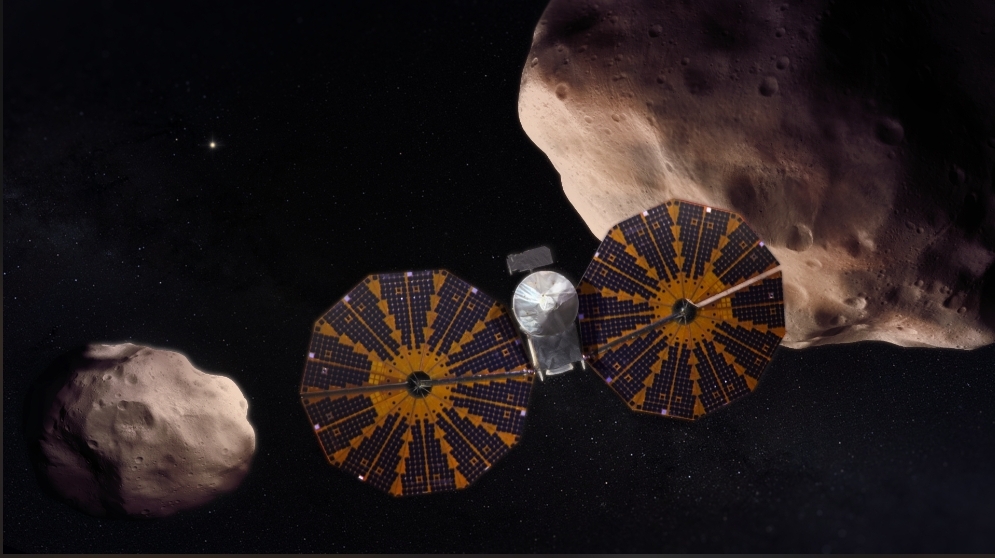
NASA’s Lucy spacecraft has entered the region of Jupiter’s Trojan asteroids, five years after its Oct. 16, 2021, launch and after more than 2.2 billion miles of travel, NASA said on Oct. 28. Lucy has averaged about 440 million miles a year, a calculation from NASA’s distance and five-year span, and its first flyby will last only a few hours. The Eurybates encounter on Aug. 11, 2027, is the first of a tour that runs into 2033.
Where Lucy is Now
Katherine Kretke of the Southwest Research Institute wrote on NASA’s mission blog that Lucy is “the first spacecraft to enter a region of primitive solar-system bodies.” Lucy is more than five times farther from the Sun than Earth is, and its instruments and spacecraft are operating as expected.
The Trojans form two groups in Jupiter’s orbit that NASA calls islands of stability. The L4 group leads Jupiter and the L5 group trails it, and both sit about 484 million miles from the planet. Individual asteroids are separated by more than 6 million miles on average, so they appear to Lucy as points of light until it gets close.
The Lucy Encounter Schedule
Lucy has already flown past two main-belt asteroids: Dinkinesh and its contact binary satellite Selam on Nov. 1, 2023, and Donaldjohanson on April 20, 2025, NASA’s mission page lists. The Trojan flybys run on a fixed schedule:
- Eurybates and its satellite Queta: Aug. 11, 2027
- Polymele and an unnamed satellite: Sept. 14, 2027
- Leucus: April 18, 2028
- Orus: Nov. 11, 2028
- Earth gravity assist, the third and final: 2030
- Patroclus and its satellite Menoetius: March 3, 2033
Counting satellites, the tour covers eight Trojan bodies, a count from NASA’s schedule. Lucy spans more than 52 feet tip to tip, and each solar panel is close to 24 feet across. The Eurybates flyby is about 41 weeks away, and the Patroclus flyby comes 5 years and 7 months after it, both calculations from NASA’s dates. Teams are finalizing the encounter plans in the year before the Eurybates flyby.
What Scientists Want from the Trojans
NASA said studying Trojans up close should help scientists refine theories about how the planets formed about 4.5 billion years ago and how they came to their current arrangement. Kretke wrote that only a spacecraft built for the purpose has had a reason to travel to the regions where these asteroids sit. Lucy reaches Eurybates on Aug. 11, 2027.