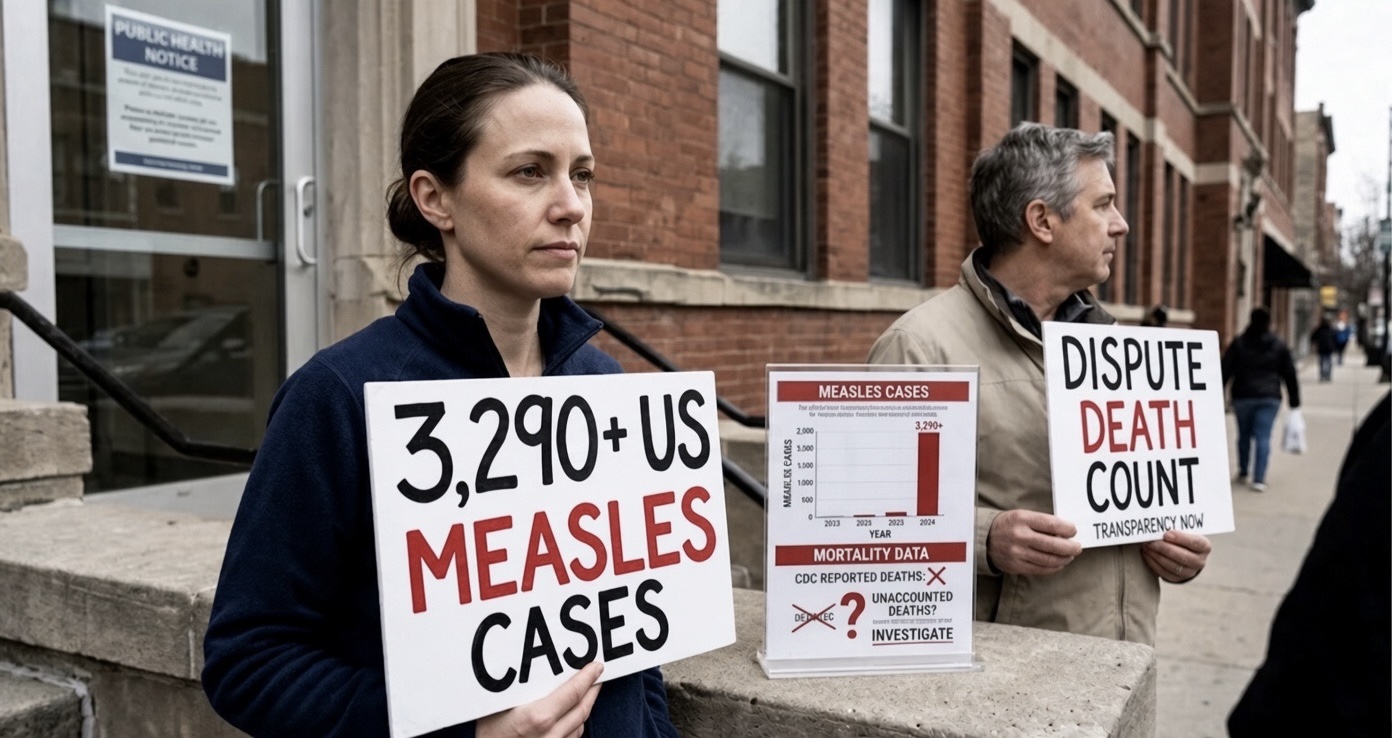
The United States has recorded 3,659 confirmed measles cases in 2026, according to the CDC’s measles tracker, making this the worst year for the disease since before the country eliminated measles in 2000.
The CDC’s tracker, updated Sept. 25 and reflecting confirmed cases as of noon Sept. 24, shows 3,642 cases among U.S. residents spread across 47 jurisdictions, meaning nearly every part of the country has recorded at least one confirmed case this year, plus 17 additional cases among international visitors who were not U.S. residents at the time of diagnosis.
That total surpasses the full-year 2025 count of 2,289 cases by more than 1,300 cases, an increase of roughly 60% year-over-year with three months still left in 2026. The CDC said 95% of this year’s confirmed cases are linked to one of 40 separate outbreaks reported so far in 2026, meaning the overwhelming majority of cases can be traced to a defined chain of transmission rather than scattered, unconnected infections.
The CDC declared measles eliminated in the United States in 2000, a designation that means the disease no longer spreads continuously within the country on its own, though outbreaks can still occur when travelers reintroduce the virus from abroad and it finds enough unvaccinated people to spread among. The scale of the 2026 outbreaks, and the sustained chains of transmission behind 95% of this year’s cases, mark the most sustained domestic spread the country has recorded since it achieved that elimination status.
Vaccination rates have slipped below the herd-immunity threshold
National kindergarten vaccination coverage fell to 92.4% in the 2025-2026 school year, down from 95.2% in 2019-2020, according to the CDC. Only 10 states met the 95% coverage level the agency said is needed for herd immunity in the most recent school year, meaning the large majority of states fell short of that mark heading into the school year in which this outbreak accelerated.
A 2.6 percentage-point gap between 92.4% and the 95% threshold sounds small, but herd immunity does not work on a straight line. Measles is among the most contagious diseases known, and epidemiologists treat 95% coverage as a threshold rather than a target: above it, enough of the population is immune that chains of transmission tend to break down before they spread widely; below it, even by a small margin, the virus finds enough unvaccinated people in close contact with each other to sustain outbreaks that grow rather than die out.
That threshold dynamic is why a shortfall of just a few percentage points in the national average is consistent with a year that produced 40 separate outbreaks and more than 3,600 cases rather than a modest, proportional increase.
The national average also masks how uneven coverage is underneath it. A statewide or countywide rate near 92% or 93% can still contain individual schools, congregations or neighborhoods where vaccination rates are far lower, because parents who decline vaccines are not randomly distributed across the population. Measles spreads through close, sustained contact, so a cluster of unvaccinated children in the same school or community can sustain an outbreak on its own even while the surrounding county or state posts a coverage rate that looks close to adequate on paper.
That is why outbreaks concentrate in specific communities rather than appearing evenly across the map, and why the national kindergarten coverage figure, while useful as a broad indicator, understates the risk in the specific pockets where an outbreak actually takes hold.
Two separate, both-true counts of measles deaths
Pennsylvania’s Lancaster County reported measles-linked deaths among unvaccinated individuals in August 2026, the state’s first measles deaths in 35 years.
The death toll itself is reported two different ways by two different sources, and the two figures should not be added together or averaged. The CDC’s own tracker, updated Sept. 25, lists one death for 2026 nationally, marked with an asterisk and an explicit note that the number is subject to change as more information comes in. Separately, a Lancaster County coroner has confirmed at least one measles-related death in the county this year, a local finding that had not yet been folded into the CDC’s national provisional count as of the agency’s last update.
The CDC figure is a provisional federal tally still being reconciled with state and local reporting; the coroner’s finding is a separate, county-level confirmation reached through the standard local process of investigating and certifying a cause of death. Both are accurate as far as they go, and the discrepancy reflects the ordinary lag between a local death investigation and its inclusion in the federal count, not a dispute over whether the deaths occurred.
Federal death counts for outbreaks typically finalize weeks or months after a death occurs, once state health departments complete their own review and report the classification up to the CDC, which is why a national tracker updated Sept. 25 can still show a lower, asterisked figure even after a county coroner has already confirmed a death locally.
What health officials recommend
The Pennsylvania Department of Health said getting vaccinated is the best protection against the measles virus, and that the vaccine is 97 percent effective at preventing measles after two doses. The standard measles, mumps and rubella vaccine is given in two doses, and health officials attribute most severe outcomes and deaths in the current outbreak to people who were unvaccinated rather than to vaccine failure.
State and local health departments continue to update case counts and vaccination data as the school year proceeds, and the CDC tracker is updated on a rolling basis as jurisdictions report new confirmed cases, meaning both the national case total and the death count are likely to change again before the year is out. Health officials continue to point to the same two-dose vaccination schedule as the primary tool for closing the gap between the current 92.4% coverage rate and the 95% level needed to restore herd immunity in communities where case counts remain highest.