Researchers formally described a new wild cat species from Bolivia’s Andean cloud forest on Sept. 17, the first entirely new species of wild cat named anywhere in the world in more than 100 years.
A Rescued Kitten That Turned Out to Be a New Species
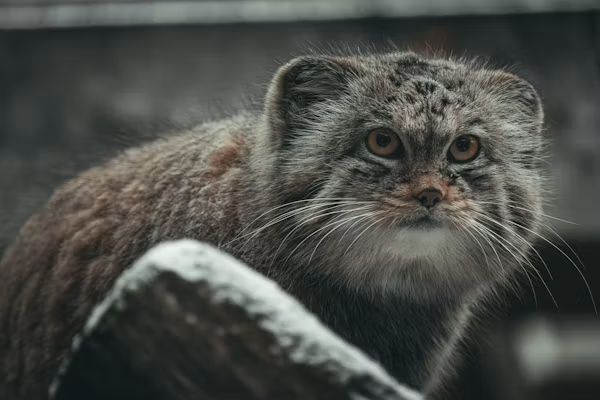
The animal behind the discovery, a three-pound male now named Leopardus tilcayo, has lived at the Senda Verde Wildlife Sanctuary near La Paz since roughly 2017, after a local resident found what he believed was an abandoned kitten and surrendered it once it grew increasingly wild. The cat, now about 10 years old, stands roughly 18 inches long, smaller than an average house cat, with a light brown coat marked by dark, leopard-like spots.
Researchers led by Bolivian biologist Paola Nogales-Ascarrunz, head of the Bolivian Felids Research Program and a National Geographic Explorer, worked with geneticist Eduardo Eizirik of Brazil’s Pontifical Catholic University of Rio Grande do Sul and co-lead researcher Jonas Lescroart of the University of Antwerp, alongside collaborators from Belgium, Brazil, Bolivia, the United States,
Colombia, the United Kingdom and Peru. Their findings were published in Current Biology. “It had never been given a scientific name, and it had never been formally described in a scientific way that was published,” Lescroart said, according to National Geographic.
What the Genetics Revealed
The team compared genomes from between 30 and 38 tiger cats across Bolivia, Colombia, Peru and Brazil, finding that tilcayo’s lineage split from its closest relatives roughly 1.4 million years ago. That analysis revealed that what scientists had long treated as a single species, the so-called tiger-cat complex, is actually at least five distinct species, four previously named and tilcayo the fifth. “What we once thought to be a single species… was actually a species complex,” Eizirik said.
The last time a new wild cat species was formally named was the pampas cat, in 1923, meaning more than a century passed without a comparable taxonomic addition to the cat family. Panthera’s Wai-Ming Wong, who was not involved in the research, cautioned against reading the discovery as evidence the animal was previously unknown to anyone: “This isn’t an animal that nobody had ever seen before. Local communities knew it existed,” he said, framing the gap as one of formal scientific documentation rather than genuine novelty.
Why Genetic Testing, Not a New Sighting, Solved a Century-Old Gap
The century-long gap since the last new cat species existed largely because distinguishing between closely related, visually similar wild cat species requires genetic comparison that was not widely available or applied to this group until recent years. Tiger cats across South America look similar enough to the eye that researchers long assumed they belonged to one variable species, rather than several genetically distinct ones separated by over a million years of evolution. It took comparing dozens of individual genomes across four countries to reveal the split, a process that would not have been possible with visual identification alone, which explains why the discovery arrived through a genetics lab rather than through a new specimen being spotted in the wild.
A Sanctuary Cat Becomes a Type Specimen
Senda Verde Wildlife Sanctuary, where tilcayo has lived since he was surrendered around 2017, was not built as a research facility, but the cat’s decade there gave researchers consistent, long-term access to a single living individual, something that is unusual in describing a new mammal species, since most new species descriptions rely on wild-caught or museum specimens rather than an animal that has spent years in the same known location.
That access let the research team supplement genetic sampling with direct observation of tilcayo’s physical characteristics over time, strengthening the case for formally distinguishing him from other tiger cats beyond what genetic data alone would have shown.
What Happens Next
Researchers say basic facts about tilcayo, including its total population size, full geographic range, diet, natural predators and reproductive biology, remain undocumented. Fieldwork is expected to continue in Bolivia’s Yungas region and potentially into neighboring Peru and northern Argentina to establish the species’ full range.
Tiger cat populations broadly have declined by as much as 80% from historical levels, and tilcayo’s known habitat faces pressure from deforestation and gold mining, meaning a formal conservation assessment is likely to follow now that the species has a recognized scientific identity.
Formal recognition by the International Union for Conservation of Nature typically follows well after a species is first scientifically described, since that process requires its own population and range data before a threat category, such as vulnerable or endangered, can be assigned. Until that assessment happens, tilcayo exists in an unusual position: a scientifically named species with no official conservation status, even as the broader tiger-cat group it was split from is already known to be in steep decline.
Researchers involved in the discovery have said establishing that population and range data is now among their top priorities, given how narrow tilcayo’s confirmed range in Bolivia’s Yungas cloud forest currently is compared with the wider territory the broader tiger-cat complex covers across South America.