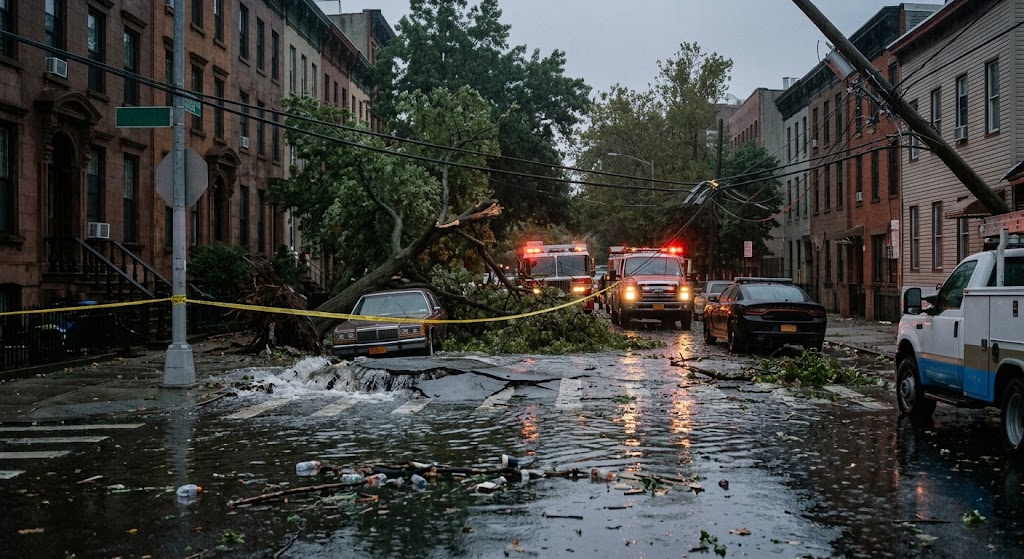
A powerful nor’easter killed one man in Brooklyn and cut power to more than 130,000 customers across the Northeast over the weekend of Sept. 26-27, with wind gusts reaching 81 mph on Long Island and coastal flooding reported from North Carolina to New England.
A 56-year-old New York City Housing Authority employee died when a tree fell on him in a parking lot in Brooklyn, according to NBC News, which cited utility outage trackers and a statement from the housing authority. Four other people were injured when a separate tree fell in the same borough. The New York City Housing Authority said in a statement that it was deeply saddened by the tragic loss and extended its heartfelt condolences to his family and the NYCHA community.
How the storm formed and why flooding stretched so far
Nor’easters draw their name from the direction the wind blows as the storm approaches the coast, typically out of the northeast, as a low-pressure system spins counterclockwise off the Atlantic seaboard. That circulation pulls moisture in off the ocean while pushing water toward the shoreline ahead of the storm, which is why nor’easters tend to produce coastal flooding over a wide stretch of coastline rather than a single landfall point, unlike a hurricane making direct landfall.
That mechanism explains why this storm produced flooding from North Carolina to New England at once rather than concentrated damage in one state, even before accounting for the wind damage that knocked out power and downed trees inland.
Wind and flooding hit New York hardest
Wind gusts reached 81 mph at Montauk Point on Long Island, the storm’s highest recorded gust, and exceeded 35 mph in New York City itself. Forecasters expected sustained gusts of 35 to 40 mph Monday morning from the Jersey Shore to Long Island as the storm continued to move through the region. Coastal flooding stretched from North Carolina to New England, with waves overtopping seawalls and boardwalks in multiple locations.
New York state, including Long Island, took the brunt of the damage, consistent with Long Island’s exposed Atlantic-facing coastline sitting closest to the strongest part of the storm’s wind field.
The geographic spread of the storm, from North Carolina up through New England, meant emergency management agencies in multiple states were responding at once rather than a single state absorbing the full impact. That spread is typical of nor’easters, which move parallel to the coastline as they intensify and can affect a stretch of shoreline hundreds of miles long over the course of a single weekend, in contrast to more localized damage patterns from storms that make a single landfall.
Comparing outage totals across states
More than 130,000 customers lost power across the region. New Jersey reported roughly 50,000 outages and Connecticut reported roughly 25,000, figures that national coverage cited side by side without comparing them to each other. New Jersey’s outage total was roughly double Connecticut’s, even though the two states have customer bases of a similar order of magnitude, which suggests New Jersey took a disproportionately harder hit from this storm relative to its size rather than simply reflecting a larger population base. New York’s outages made up the largest share of the 130,000-plus total, consistent with the state absorbing the storm’s strongest winds on Long Island.
Adding New Jersey’s roughly 50,000 outages to Connecticut’s roughly 25,000 accounts for about 75,000 of the storm’s more than 130,000 total outages, leaving roughly 55,000 or more concentrated in New York alone, the single largest state share of the three. That distribution lines up with where the storm’s most severe winds and the fatal tree collapse in Brooklyn both occurred, reinforcing that New York, and Long Island in particular, bore the heaviest physical brunt of this storm even though the flooding itself reached coastal communities well outside the state.
The falling-tree deaths and injuries in Brooklyn point to the storm’s biggest hazard away from the coastline itself: wind acting on trees and limbs weakened or stressed by wet ground, rather than the flooding that dominated coverage of the shoreline. Outages of this kind tend to concentrate in areas with more tree cover near power lines, consistent with the reported outages spreading across suburban and coastal New Jersey, New York and Connecticut alongside the direct storm damage in New York City itself.
Recovery and the storm’s path forward
Utility crews were working to restore power through the start of the week, and forecasters said the storm’s strongest winds would continue to taper through Monday as it moved farther offshore. Forecasters advised coastal communities from New Jersey to New England to expect continued rough surf and beach erosion even after the heaviest wind and rain moved out, a common trailing effect of nor’easters that can leave shoreline damage visible for days after the storm itself has passed.
What Monday morning commuters should expect
With sustained gusts of 35 to 40 mph forecast to continue from the Jersey Shore to Long Island through Monday morning, residents in the hardest-hit corridor were still facing conditions strong enough to bring down additional weakened trees and branches, particularly in areas where Saturday and Sunday’s winds already loosened root systems in saturated ground.
Downed power lines remained a hazard in neighborhoods still without electricity, and utility crews prioritized restoring service to hospitals, water treatment facilities and other critical infrastructure before moving to individual residential blocks, the standard order of operations utilities in the region follow after a wind event of this scale. Officials urged drivers in coastal areas of New Jersey, New York and Connecticut to watch for standing water on low-lying roads left behind by the weekend’s tidal flooding, even as the rain itself moved out ahead of the new work week.