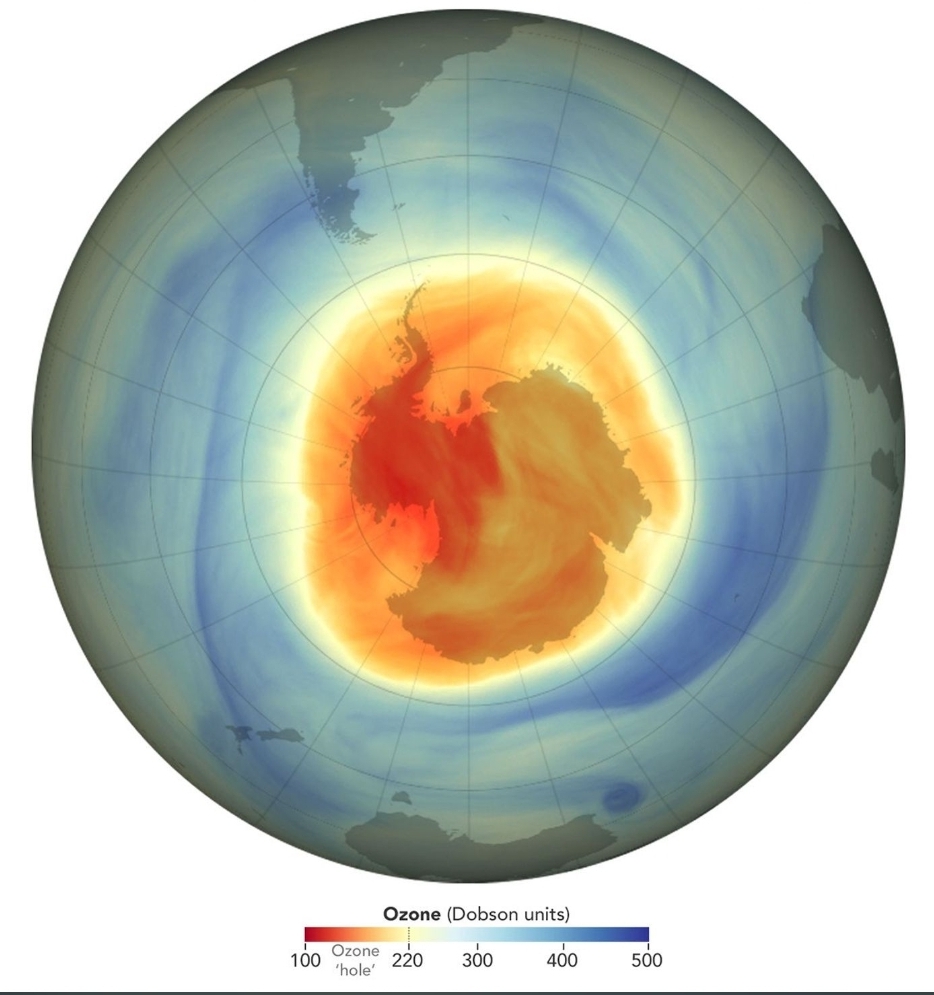
The 2026 Antarctic ozone hole was the seventh largest in 48 years of satellite and ground monitoring, NOAA and NASA said on Nov. 4. Scientists attributed the size to an unusually strong polar vortex, not to a rise in ozone-depleting chemicals. The hole averaged about 9.6 million square miles during peak depletion from Sept. 7 to Oct. 13, more than twice the area of the United States.
How Large the 2026 Ozone Hole Got
The hole reached its maximum on Sept. 18 at 10.5 million square miles, about 90% of the record set on Sept. 9, 2000. That implies a record near 11.7 million square miles, a calculation from the agencies’ “about 90%” figure.
At the South Pole, the lowest reading of ozone overhead was 105 Dobson units on Oct. 17, taken with NOAA instruments. The record low is 92 Dobson units, set in October 2006, so this year’s low sat about 14% above the record, a calculation from the two figures. A reading of 100 Dobson units is about as thick as a dime.
Why Weather Made It Bigger
Planetary-scale weather waves were especially weak in August and September, the agencies said. Amy Butler, a research scientist at NOAA’s Chemical Sciences Laboratory, said the weak wave action kept the strongest vortex winds several degrees of latitude farther from the South Pole. Paul Newman, a senior scientist at the University of Maryland who led NASA’s ozone research team at Goddard, said an unusually powerful vortex extended the depletion.
What the Chlorine Numbers Show
Stephen Montzka, a senior scientist at NOAA’s Global Monitoring Laboratory, said Antarctic stratospheric chlorine from ozone-depleting substances is down about a third from its peak in the 1980s. The agencies credit the 1987 Montreal Protocol. Newman said the hole has formed later in the season in recent years, which tells us the ozone layer is healing.
The hole could have been 1 million to 2 million square miles larger if ozone-depleting substances were as prevalent as at their year 2000 peak, the agencies said. The best case for caution is year-to-year swings: a big hole in a cold, calm vortex year says little about the long trend. Scientists estimate the hole will recover by the 2070s, about five decades from now. NOAA’s South Pole ozone site and NASA’s Ozone Watch will keep posting measurements.