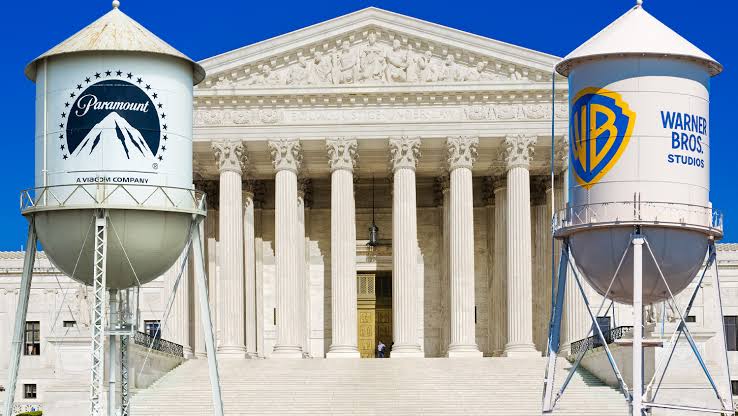
The Supreme Court has ordered a dozen Democratic-led states to respond by Sept. 25 to an unusual bid by Iowa and Montana to shut down their antitrust lawsuit against the $111 billion merger of Paramount and Warner Bros. Discovery, pulling the nation’s highest court directly into a fight over one of the year’s largest media deals.
What Happened
The Supreme Court’s Sept. 9 order gives California Attorney General Rob Bonta and 11 other state attorneys general until Sept. 25 to respond to a motion filed by Iowa Attorney General Brenna Bird and Montana Attorney General Austin Knudsen. The Iowa-Montana motion asks the court to use its original jurisdiction over disputes between states to dismiss the blue-state antitrust suit outright, calling it “politicized.” ”Their filing argues that “twelve states have effectively vetoed a transaction that the other thirty-eight and the United States declined to challenge.”
Separately, in the underlying case, U.S. Magistrate Judge Thomas Hixson of the Northern District of California set an in-person settlement conference for two consecutive days in late October, according to a written notice issued after a Sept. 11 virtual hearing. Paramount, Bonta’s office, Warner Bros. Discovery and the Writers Guild of America were all directed to attend and submit an agenda ahead of time.
What We Know
California led 11 other states — Arizona, Colorado, Connecticut, Massachusetts, Minnesota, Nevada, New Jersey, New Mexico, New York, Oregon and Washington — in suing in the Northern District of California on July 13, alleging the merger, which combines CBS and Paramount+ with HBO Max, CNN, TNT, TBS, Discovery and sports rights spanning CBS Sports and Turner Sports, would raise prices and reduce competition and content variety.
The Justice Department and roughly 70 global regulatory jurisdictions have already cleared the deal. Settlement talks between the states and the companies had already broken down once before the Supreme Court got involved: Bonta canceled a planned Aug. 26 meeting after accusing Paramount of leaking confidential negotiation details to the press, an accusation Paramount disputed. The underlying antitrust trial remains scheduled for March 2, 2027, unless the case is resolved sooner or the Supreme Court intervenes directly.
Financial stakes are attached to the delay itself. According to NPR, the merger agreement includes a ticking fee of $650 million for every 90 days the deal is delayed past Oct. 1, and a $7 billion breakup penalty payable by Paramount to Warner Bros. Discovery if the deal fails to close by June 4, 2027.
Why the Supreme Court Is Involved at All
The Supreme Court’s original jurisdiction over lawsuits between states is normally reserved for disputes like border and water-rights fights, not corporate antitrust cases. Iowa and Montana are not defendants or parties to the underlying California-led suit; instead, they are asking the court to intervene from outside the case entirely, arguing that a bloc of Democratic-led states is improperly blocking a transaction the federal government and most other states have already cleared.
Legal scholars describe the maneuver as untested, since it would require the Supreme Court to treat one state’s antitrust enforcement decision as an actionable grievance by other states, rather than a matter left to ordinary federal antitrust litigation. Whether the court agrees to hear the underlying dispute at all — as opposed to simply reviewing the states’ response before deciding whether to proceed further — remains an open question after the Sept. 25 filing deadline passes.
The Two Sides
Bonta has defended the suit as necessary to prevent industry consolidation from raising consumer prices. “With this lawsuit, California and our sister states are fighting for free and fair markets, not rigged markets,” he said when the states filed suit in July. He has separately said he is seeking “robust structural” remedies, including divesting some cable networks and keeping studio operations separate, and accused Paramount of “bad faith” after the collapsed August settlement talks.
Paramount has argued the states’ suit threatens jobs rather than protecting consumers. “Delaying this transaction will only harm entertainment workers … and cost California tens of thousands of entertainment jobs,” the company said in response to the suit. Iowa Attorney General Bird’s office framed the states’ suit as government overreach: “Attorney General Bird is fighting to protect Iowans from higher streaming costs and fewer entertainment choices because California, once again, refuses to stay in their lane,” a spokesperson said, adding that “federal antitrust enforcers, 68 regulators around the world, Governor Newsom and Mayor Bass all think California’s lawsuit is unnecessary, at best, and harmful at worst.”
The Writers Guild of America and SAG-AFTRA also oppose the merger, siding with the blue states rather than the companies. Both unions have pointed to a history of media consolidation reducing the number of buyers for scripts, talent and productions, arguing that combining two of the largest remaining entertainment conglomerates into one company would give workers fewer options when negotiating pay and working conditions, regardless of whether consumer prices rise.
Why It Matters
The case tests whether states that were not part of a merger lawsuit can use the Supreme Court’s authority over disputes between states to short-circuit another state’s antitrust enforcement — a novel federalism question layered on top of an already high-stakes media consolidation fight. The outcome could shape how future interstate mergers are challenged when some states object and others do not.
What Happens Next
The 12 states must file their Supreme Court response by Sept. 25. The settlement conference before Judge Hixson is set for late October. Absent a settlement or Supreme Court intervention, the underlying antitrust trial is scheduled to begin March 2, 2027.