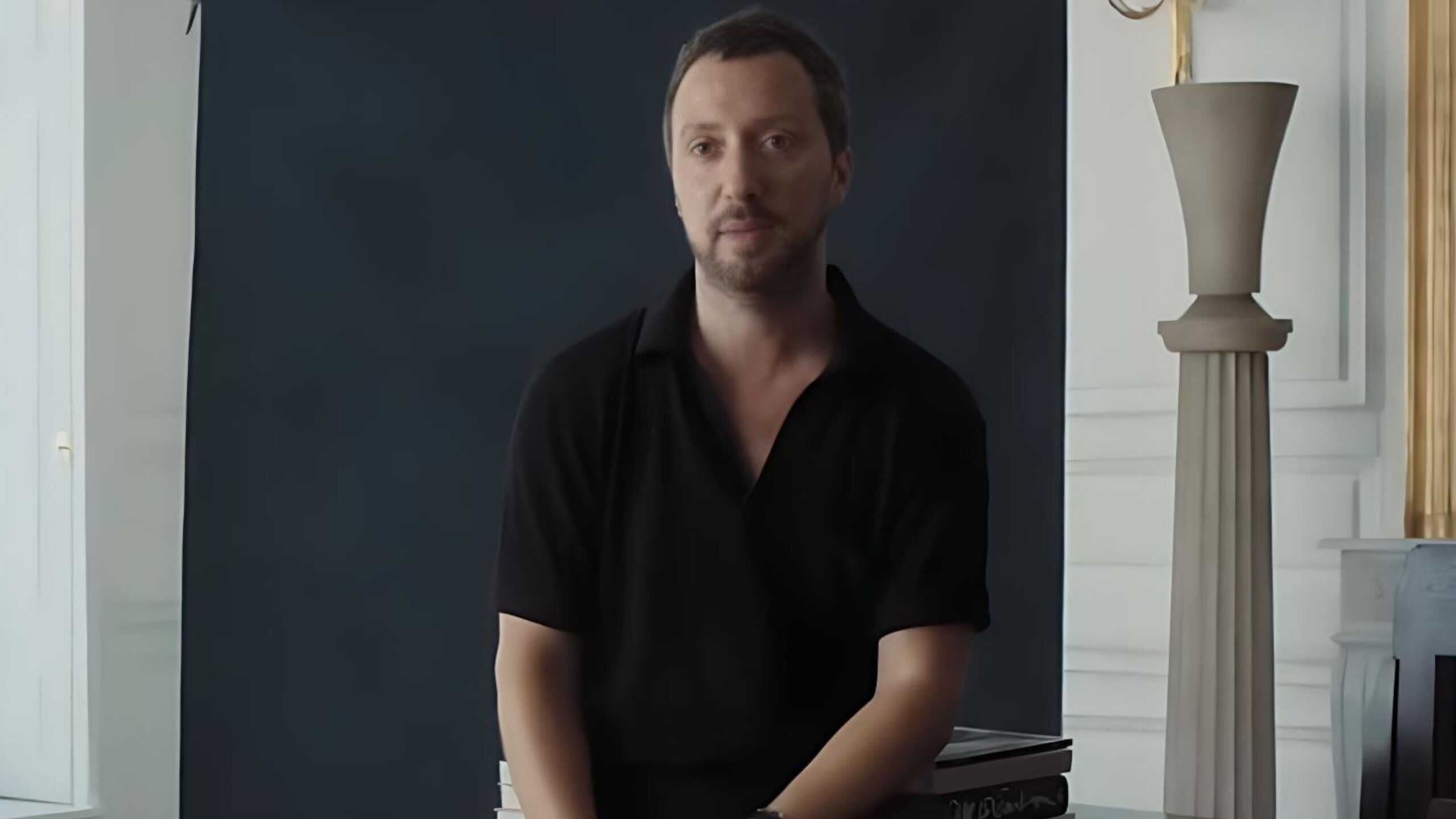
Saint Laurent creative director Anthony Vaccarello is leaving the house after about 10 years, and Saint Laurent has not named a replacement. Kering announced the exit on Oct. 9. Saint Laurent produced about 32% of Kering’s recurring operating income last year on 18% of its revenue.
What Kering Said about the Vaccarello Departure
Kering announced the change in a press release dated Oct. 9, 2026. The release says Vaccarello had led Saint Laurent’s creative direction since 2016. Kering CEO Luca de Meo thanked him for strengthening “the enduring influence of one of France’s greatest couture Houses,” according to the same release. Cedric Charbit, president and CEO of Saint Laurent, credited Vaccarello with moving the house to the forefront of desirability and image.
The release does not say when Vaccarello’s departure takes effect, and it names no successor. It says only that the house “will soon announce its new creative leadership.” Neither Vaccarello nor Kering gave a reason for the exit in the release.
How Much Saint Laurent Earns for Kering
Kering owns Gucci, Saint Laurent, Bottega Veneta, Balenciaga, McQueen and Brioni. Its full-year 2025 results, published Feb. 10, 2026, break out each house. Saint Laurent reported revenue of 2,643 million euros in 2025 and recurring operating income of 529 million euros. Kering as a group reported revenue of 14,675 million euros and recurring operating income of 1,631 million euros.
Those figures give Saint Laurent a share of 18% of group revenue (2,643 divided by 14,675) and 32% of group recurring operating income (529 divided by 1,631). The house earned nearly twice the profit share that its sales share would suggest.
The gap was wider in 2024. Saint Laurent’s 2024 revenue was 2,881 million euros and its recurring operating income was 593 million euros. Kering’s 2024 group figures were 16,874 million euros in revenue and 2,440 million euros in recurring operating income. That puts Saint Laurent at 17% of revenue and 24% of recurring operating income that year.
Saint Laurent’s share of profit rose by about eight percentage points in a year because the rest of Kering fell faster. Group recurring operating income dropped 809 million euros, from 2,440 million to 1,631 million. Saint Laurent’s own income fell 64 million euros, or about 8% of the group’s decline.
Saint Laurent Margin Compared with the Rest of Kering
Kering’s release states Saint Laurent’s 2025 recurring operating margin at 20.0%, which it describes as maintained versus 2024. The release’s own table figures for 2024 imply a different 2024 margin: 593 million euros on 2,881 million euros works out to about 20.6%. The 2025 figures check out at 20.0%, since 529 divided by 2,643 is 20.0%.
The group’s 2025 margin was lower. Kering’s 1,631 million euros of recurring operating income on 14,675 million euros of revenue is about 11.1%. Saint Laurent’s margin was therefore about 1.8 times the group’s.
Kering’s first-half 2026 results show the group margin at 12.8%, up from 12.4% a year earlier, on revenue of 7,220 million euros. Kering did not publish a margin for Saint Laurent in that release. It said Saint Laurent returned to growth in the semester, with a sequential acceleration in every region except Asia Pacific, and a solid performance in North America and Western Europe.
What Changed at Saint Laurent before the Exit
The 2025 release credits the house’s recovery to product. Kering wrote that performance in the fourth quarter was “driven by new product introductions across all categories.” Fourth-quarter sales were stable on a comparable basis, and the release described that as another quarter of improvement.
The year as a whole was weaker. Saint Laurent revenue fell 8% as reported and 6% on a comparable basis, which is a drop of 238 million euros (2,881 million minus 2,643 million). Sales from directly operated stores fell 6%, and wholesale fell 14% on a comparable basis.
The house held its margin by cutting costs. Kering credited “efficiency measures that offset negative operating leverage.” It also said the house kept investing in collections, stores and clienteling.
New product introductions are the output of the creative director’s studio. The 2025 release ties Saint Laurent’s fourth-quarter stabilization to that product work, and the first-half 2026 release says new collections gained traction. Both releases came while Vaccarello led design. The replacement will inherit a house that has just returned to growth after a year of declining sales.
Why a Creative Director Change is a Group Event for Kering
Kering has changed creative leadership at several houses during de Meo’s turnaround. The 2025 results release notes creative leadership changes at Gucci and Balenciaga, and it records Bottega Veneta management committing to continue that house’s momentum. De Meo said in that release that the group’s 2025 performance “does not reflect” its potential.
Kering’s other houses carry lower margins and heavier restructuring. The 2025 release says soft performance at Balenciaga and losses at Alexander McQueen weighed on group profitability, while Saint Laurent held 20.0%. A creative director change at the house that held its margin puts the steadiest earner through the same transition the weaker houses went through.
The first-half 2026 release gives the group’s current position. De Meo said in it that revenue returned to growth in the second quarter. First-half group revenue was 7,220 million euros, down 3% as reported and up 1% on a comparable basis, against 7,439 million euros a year earlier. Recurring operating income was 921 million euros, against 920 million euros.
For scale, Saint Laurent’s 2025 recurring operating income of 529 million euros equals 57% of the 921 million euros the whole group earned in the first half of 2026. Saint Laurent said its new creative leadership would be announced soon. Until then, the house has a decade of Vaccarello’s work in stores and no named designer for the next collections.