Astronomers say a gas giant may have formed from the debris of a dead star, and the evidence is an element that Hubble recorded in 1999 and nobody recognized. The finding, published Oct. 5 in Nature Astronomy, describes a “second-generation planet candidate” orbiting the white dwarf HS 0209+0832. The team has not confirmed the planet, and the paper calls it a candidate.
What Hubble recorded in 1999
NASA reported that the Hubble Space Telescope first observed HS 0209+0832 in 1999. The spectrum contained about 100 features that no one could assign to a known element. They sat in the archive as an open question.
Jamie Williams, a doctoral candidate at the University of Warwick in England, reopened the data. She compared the unexplained lines against an updated chemical database and matched many of them to niobium, according to NASA. Niobium is a metal that forms in the late stages of a star’s life. NASA said no other white dwarf analyzed so far has had niobium reported in it.
The paper puts a number on how unusual the signal is. Niobium in the star’s atmosphere is more than three orders of magnitude, or more than 1,000 times, more abundant relative to calcium than it is in the Sun, the authors wrote. They identified it from five lines of singly ionized niobium and 57 lines of a more highly ionized form. The atmosphere is also enriched in zinc and copper and short on silicon and iron.
That mix does not look like rock. The authors describe the material as unlike any Solar System object and report a nickel-to-iron ratio above 2.09 by number. They compared it with about 0.05 in a common class of primitive meteorites known as CI chondrites. That is a difference of roughly 40 times, using the paper’s own figures.
How a second-generation planet forms
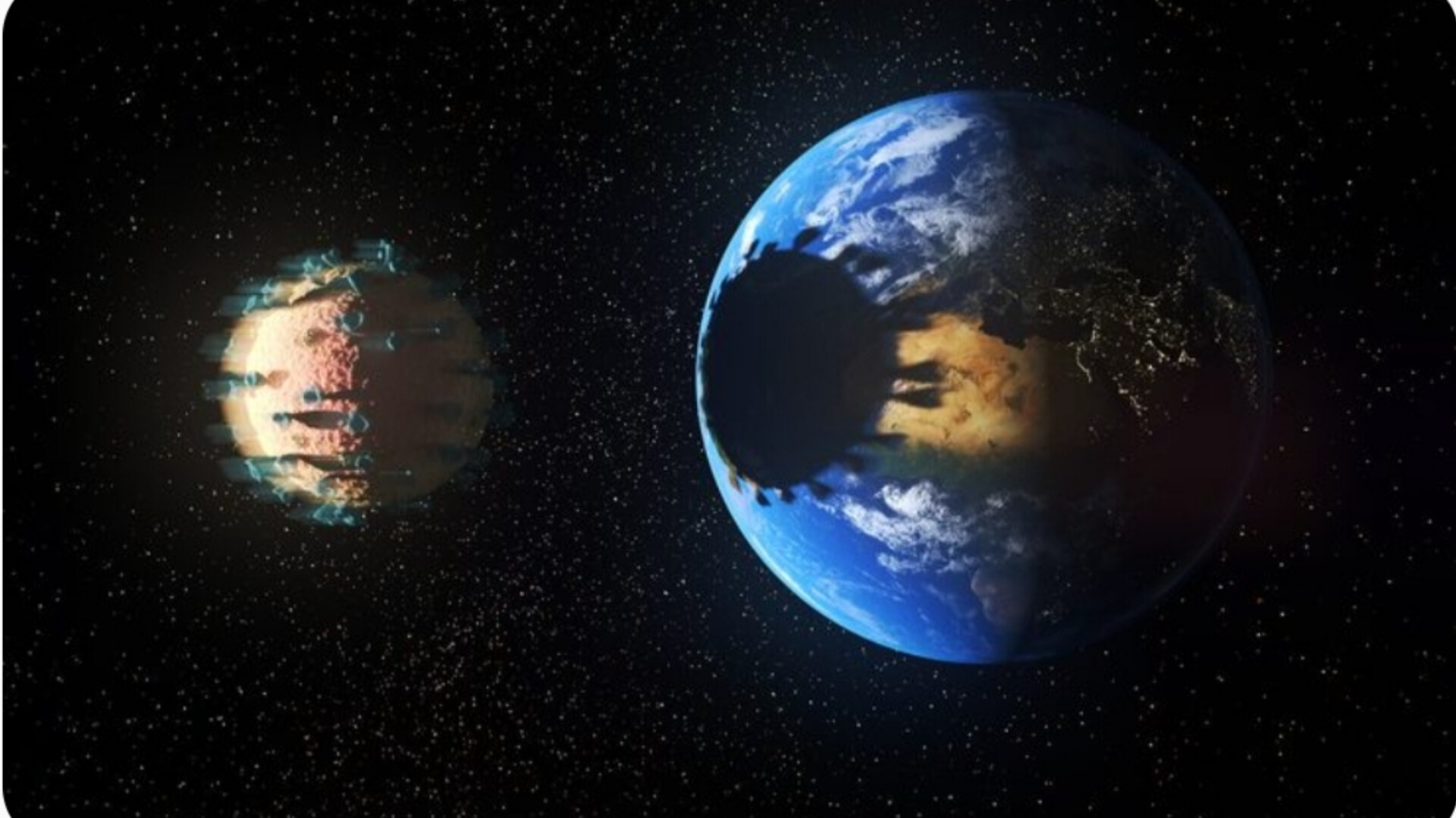
Most planets form from the disk of gas and dust around a young star. A second-generation planet would form later, after the star has swollen into a giant, thrown off its outer layers and collapsed into a white dwarf. The paper’s argument is that the ejected material cooled into a new planet.
The authors write that the star’s cooling age is about 5 million years, a short time for a white dwarf. The star’s effective temperature is about 35,000 kelvin, according to the paper’s methods section. The odd chemistry fits a planet built from the star’s own discarded innards, the authors suggest, rather than from a typical rocky body.
Nicholas Stone, a theoretical astrophysicist at the University of Wisconsin-Madison and a member of the team, described niobium to NASA as a signpost of the star’s death throes. Boris Gaensicke, a Warwick astronomer and co-author, told NASA he was gobsmacked when Williams asked him about niobium in the context of the study.
What TESS saw around the white dwarf
Chemistry alone does not make a planet. The team turned to NASA’s Transiting Exoplanet Survey Satellite, known as TESS, which watched the star for about four months. NASA said TESS detected periodic changes in brightness.
The paper gives the details. The brightness varies in a pattern that repeats every 4.399 days, plus or minus 0.026 days, with an amplitude of about 0.12%. The authors used TESS observing sectors 42, 43, 70 and 71. They put the false alarm probability of the periodic signal at about 4.4 in 10 quadrillion.
The authors say the pattern can be explained by a giant planet at an orbital separation of 0.04 astronomical units. NASA described that as roughly 3.7 million miles (6 million km) from the star. NASA noted that is much closer than Mercury orbits the Sun. The authors give two explanations for the brightness cycle. One is a day-night cycle on the planet. The other is a comet-like tail of escaping gas.
The planet would be losing material. The team estimates a Jupiter-sized gas giant whose atmosphere is boiling off under the white dwarf’s heat, NASA said. The paper models evaporation at about 1.1 trillion grams per second for a planet of one Jupiter mass and about 14 trillion grams per second for 13 Jupiter masses. The white dwarf’s measured accretion rate is 430 million grams per second.
That is far lower than either evaporation rate. If the paper’s models hold, the white dwarf catches only a small fraction of the gas the planet loses.
Why the finding is not settled
The authors call the object a candidate, and NASA’s headline uses the word “suspected.” The paper does not report a direct image or a measured mass. The brightness cycle has two possible explanations, and the chemistry has been read from archival spectra rather than a new observation.
Williams said the planet could outlast the conditions that threaten it. “If the second-generation planet is there, I think it is likely to survive,” she told NASA. The conditional in her sentence matches the paper’s wording.
The work also depended on data collected by several missions. NASA credited Hubble, TESS and the retired Far Ultraviolet Spectroscopic Explorer, known as FUSE, which also recorded strong niobium signatures that support the Hubble result. Hubble is a NASA and European Space Agency project, and the Space Telescope Science Institute runs its science operations for NASA.
What the 27-year gap shows
The lines were in the Hubble archive from 1999 to the day Williams matched them in this study, a span of 27 years. The data did not change. The reference database of atomic lines did. NASA said she used an updated chemical database to identify the features. A list of lines that was incomplete in 1999 left about 100 features unnamed, and a better list let a graduate student name many of them.
That gap is also a practical point for other white dwarfs. The paper says the star’s atmosphere is unlike any Solar System object, and NASA said no other analyzed white dwarf has reported niobium.
Archival spectra of other white dwarfs were taken with the same instruments and could be rechecked against the same updated line lists, though the paper does not say whether the team plans to do so.
The next test for the planet candidate is more observation. A direct measurement of the planet’s day-night swing, or of the tail, would help distinguish the two explanations the authors offer for the brightness cycle. Until then, the planet remains a candidate.