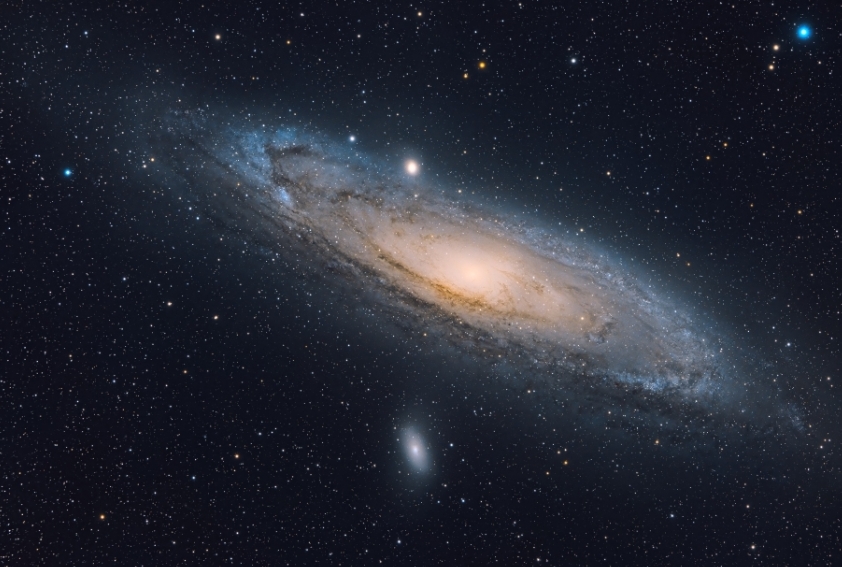
Astronomers watched a giant star swallow its companion for the first time, a stellar merger in the Andromeda galaxy that NASA telescopes tracked from start to finish, NASA said on Nov. 18. The remarkable part is the prediction. A team led from Columbia University flagged the star as odd in February 2023 and published a paper saying it might be starting to merge. In October 2025, it erupted.
How Astronomers Saw the Stellar Merger Coming
The system is called AT 2025abao, nicknamed Bao. The bigger star, “Big Bao,” had about seven times the mass of the sun, 350 times its radius and 18,000 times its brightness, according to NASA. Its companion, “Little Bao,” had about 0.7 times the sun’s mass. Before 2018, the star’s brightness was steady. Then it began to brighten slowly, and the team flagged it. The Zwicky Transient Facility caught the eruption on Oct. 17, 2025. NASA’s Swift observed it in November, and the James Webb Space Telescope looked on Dec. 24.
A calculation from NASA’s dates: the team called the merger about 32 months before it happened. “Stellar mergers are very, very difficult to observe in real time because they are hard to predict,” Viraj Karambelkar, the study’s first author and a NASA Hubble Fellow at Columbia, said in NASA’s release. The study appears in Nature.
Seven Orbits Instead of Thousands
The two stars merged after about seven orbits over roughly seven years. Other known mergers took thousands of orbits, NASA said. Kishalay De, an assistant professor at Columbia, described the event as “almost like a bomb exploding inside a living star.”
Webb’s observation came 47 days after the eruption peaked, the earliest follow-up of an event like this, Karambelkar said. Nadia Blagorodnova, an associate professor at the University of Barcelona, described how quickly it went: “within a week, it peaked.”
What the Andromeda Merger Leaves Behind
Dust still blocks a direct view of what remains, and the system could take years or decades to settle. Sven Buder, an astrophysicist at the Australian National University who was not involved, told ABC News Australia that the work is like “investigating a crime scene, except that the cameras were already rolling.”
Andromeda is about 2.5 million light-years away, which means the light the team recorded left the star about 2.5 million years ago. The project was funded by NASA’s Astrophysics Data Analysis Program. The team plans to keep monitoring Bao and to search for more mergers with the Rubin Observatory and NASA’s Roman Space Telescope.