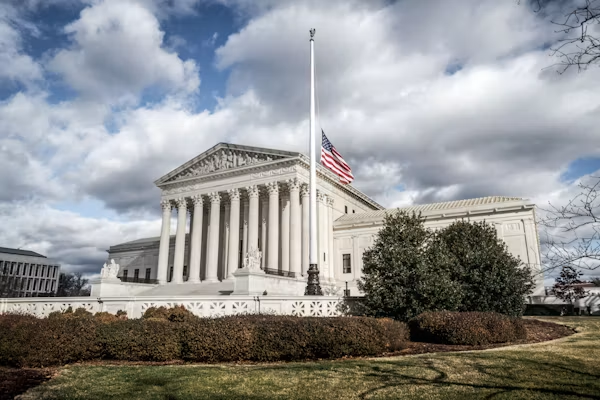
The U.S. Supreme Court on Monday declined to hear William Shelton’s appeal over his firing as a Cleveland housing police officer for posting rap videos, Law360 reported. The order leaves in place a Sixth Circuit ruling that rejected his claim that the firing was racial discrimination.
Shelton, who is Black, asked the justices to rethink the 1973 framework courts use to judge discrimination claims built on circumstantial evidence. The court turned the petition away on Oct. 5, according to Law360, and the case is over.
What the Supreme Court Did in Shelton v. Cuyahoga Metropolitan Housing Authority
The case is docketed as No. 25-1354. The Supreme Court docket shows the Cuyahoga Metropolitan Housing Authority, known as CMHA, waived its right to file a response on June 15. The justices then distributed the petition for their Sept. 28 conference, and the order denying review came one week later.
A waiver does not say anything about the merits. It does mean the housing authority never had to argue its side at the Supreme Court. Shelton’s lawyer, Mark Biggerman of Cleveland, carried the petition alone, and Stephen Funk of the Akron firm Roetzel & Andress represented the housing authority and Gregory Drew, the other named defendant.
Law360 reported in June that Shelton’s petition urged the justices to strike down the burden shifting precedent. His argument was that the Sixth Circuit accepted the housing authority’s explanation, the rap videos, too readily. The precedent is McDonnell Douglas Corp. v. Green, the 1973 decision that has an employee make an initial showing of bias, lets the employer name a legitimate reason and then asks the employee to show that reason is a cover story.
What the Rap Videos at the Center of the Case Showed
Shelton joined the housing authority’s police force in 2016 and also performed as a rapper on public social media accounts, some of them showing him in his CMHA uniform. The Sixth Circuit’s Jan. 14 opinion, written by Judge Helene White, describes the videos supervisors found in September 2020.
One, titled “Head Shot,” shows a mock execution of a homeless person. Another, “The Great Man Challenge,” shows Shelton holding a gun and a fake alcohol bottle in a car. A remix of “WAP” shows him with a knife and threatening language, and other videos carry violent lyrics and derogatory comments about women.
CMHA’s rules barred officers from being “disrespectful or discourteous” to the public and from off-duty conduct that would “diminish the esteem of CMHA,” the opinion says. The housing authority fired Shelton on Jan. 29, 2021, and cited those policies.
Why the Sixth Circuit Ruled Against Shelton On Race Discrimination
Shelton’s discrimination argument had a timing hook. Supervisors learned of the videos on Sept. 18, 2020, according to the opinion, and he filed an internal complaint listing 24 alleged incidents of racial discrimination that same day. The housing authority put him on paid leave on Oct. 7, 2020.
The court said that sequence did not rescue his Title VII claim. It found CMHA had named a legitimate reason, the content of specific videos, and that Shelton offered only a “bare assertion” that the reason was false. The panel also said he produced no evidence that anyone at CMHA knew of the specific videos at issue, though leadership knew generally that he rapped. Judges Karen Nelson Moore and Eric Clay completed the panel and joined the ruling. The housing authority’s own investigation found 23 of the 24 incidents unsubstantiated and said one “may have” occurred, the opinion says.
The Arbitrator Sided With Shelton and the Courts Did Not
Shelton did win once. An arbitrator reinstated him on Nov. 28, 2022, reasoning that CMHA had known he rapped and never warned him his music could violate policy, the opinion says. That was 668 days after the firing.
He sued in federal court in March 2023, more than two years after the termination. That gap matters because the Sixth Circuit held his four First Amendment counts were time-barred under Ohio’s two-year limit. The court counted the clock from the Jan. 29, 2021 firing, so the deadline passed about Jan. 29, 2023, more than a month before Shelton filed.
The Sixth Circuit rejected his argument that the clock should start in March 2022, when he learned CMHA had conducted a legal review of his videos. His equitable tolling argument failed because he did not raise it in the lower court.
The Title VII claim, which the court decided on the merits, turned on a different question than the arbitrator’s: whether CMHA’s stated reason for the firing was real. The panel said the evidence supported it.
What the Denial Means for Other Officers and Artists Who Post Online
A Supreme Court denial is not a ruling on the merits and sets no national rule. It does mean the Sixth Circuit’s opinion, covering Ohio, Michigan, Kentucky and Tennessee, stands as written. In that circuit, a public employer that points to specific off-duty videos has a documented path to defeat a bias claim when the employee cannot show the decision-makers’ knowledge or motive.
Shelton argued in his petition that courts accept employers’ stated reasons too readily, according to Law360’s June report. The denial leaves that question where the Sixth Circuit put it. Image: A photo of the U.S. Supreme Court building from the Architect of the Capitol or the Library of Congress, a federal work in the public domain, with no license fee.