

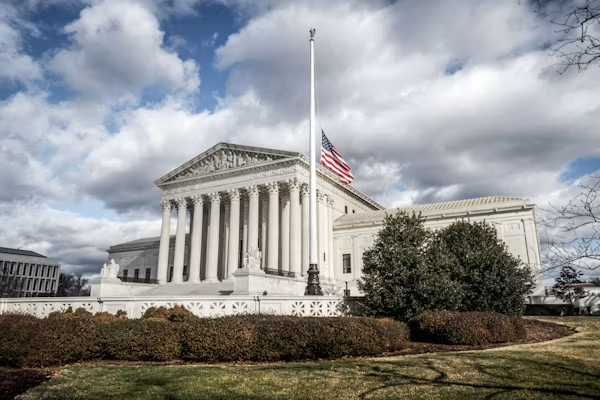
The Supreme Court voted 6-3 on Sept. 25 to let the Trump administration resume using its expanded Systematic Alien Verification for Entitlements database, pausing a lower court order that had blocked the system weeks before the November midterms.
The court’s unsigned majority opinion, issued on its emergency docket, said the challengers’ claims “likely lack merit.” The order lifts an injunction that had halted the expanded version of SAVE, a database first created in 1986 to verify eligibility for public benefits and licenses.
What changed inside the SAVE database
SAVE was not built for elections originally. Congress created the system in 1986 so agencies could check whether applicants for public benefits and professional or driver’s licenses were eligible noncitizens or citizens, a narrower administrative function than the voter-verification role it plays today. The Trump administration overhauled SAVE following a March 2025 executive order that required proof of citizenship for voter registration.
The expanded system folds in natural-born-citizen records and Social Security Administration data, including Social Security numbers, and allows officials to run bulk record searches rather than individual lookups, a change that lets state election offices check large batches of registered voters against federal citizenship and identity records at once instead of looking up one name at a time.
In June 2025, U.S. District Judge Sparkle Sooknanan blocked the expanded system, ruling that the administration had “knowingly trampled on the privacy rights of American citizens in a manner that threatens the sacred right to vote.” The League of Women Voters, the Electronic Privacy Information Center and five individual plaintiffs had sued, arguing the database violated federal law and had already caused citizens to be wrongly flagged or removed from voter rolls based on inaccurate citizenship data, according to reporting from NPR.
The plaintiffs’ core claim is that merging Social Security data with citizenship records at this scale increases the chance a citizen gets misclassified as ineligible due to a data-matching error, such as a name change, a typo in a government record or a mismatched middle name, and then faces the burden of proving citizenship to stay on the rolls.
James Percival, general counsel of the Department of Homeland Security, said American elections are for Americans and that the Trump administration and the department will use every tool at their disposal to secure the country’s elections.
Why the ruling changes less in practice than it does on paper
The decision reads as a sweeping win for the administration, and legally it is: SAVE’s expanded functions, including bulk searches and the merged Social Security data, can resume immediately while the underlying lawsuit continues. But a separate federal law, the National Voter
Registration Act, bars states from conducting systematic purges of voter rolls within 90 days of a federal election. With the Nov. 3 general election now inside that 90-day window, states cannot use SAVE data to run the kind of large-scale roll purges the plaintiffs feared before Election Day, regardless of what the database itself allows. That distinction separates what the ruling permits as a matter of law from what can actually change on the ground this week.
States can still use the database for other verification functions, such as checking individual applicants during the ordinary course of processing new voter registrations, and the 90-day restriction on systematic purges lifts automatically once the window closes after the election. That means the database’s fullest practical effect on voter rolls, including any large-scale removals based on the new bulk-search capability, would not arrive until after Nov. 3 even though the legal authority to use the system exists starting now.
The near-term effect on voter rolls this fall is narrower than the scope of the ruling suggests, according to reporting from CBS News.
Justice Ketanji Brown Jackson dissented, joined by Justices Sonia Sotomayor and Elena Kagan. Jackson said the harm caused by burdening or disenfranchising even a few lawful voters outweighs the nonexistent harm to the government. The dissent’s language reflects a broader concern raised throughout the litigation: that even a small error rate in a system checking tens of millions of voter records could translate into a meaningful number of eligible citizens wrongly flagged, even if the database gets the overwhelming majority of matches right.
The legal fight continues
The League of Women Voters and the Electronic Privacy Information Center said in a joint statement that the decision is profoundly disappointing, as it puts millions of Americans at risk of being unlawfully targeted by the administration’s unreliable voter purge database weeks before the midterm elections, but that the case is not over, according to reporting from NBC News.
The underlying case returns to the lower courts, where Sooknanan’s original ruling on the merits of the database’s legality has not been overturned, only paused. The Supreme Court’s action came through its emergency docket, sometimes called the shadow docket, which allows the justices to rule quickly on requests to pause lower-court orders without full briefing, oral argument or a signed opinion explaining the majority’s full reasoning. A final decision on whether the expanded SAVE system violates federal privacy or voting-rights law is still pending, and the case will continue moving through the lower courts on its normal schedule regardless of the outcome of the November election.
How election officials actually use the database
State and local election offices are not required to use SAVE, but many rely on it as one of several tools to confirm citizenship status when a voter registration is flagged or challenged, alongside state driver’s license and identification records. The expanded version’s bulk-search function changes the scale of that process: instead of an election office submitting individual names for verification as questions arise, officials can now run large batches of the existing voter file against SAVE’s merged citizenship and Social Security data at once.
Supporters of the expansion argue that scale is the point, allowing states to catch ineligible registrations they would otherwise miss one at a time. Critics argue that same scale is what turns an ordinary datamatching error rate, however small, into a large absolute number of citizens affected when applied across an entire state’s voter rolls at once, which is the underlying dispute the lower courts will now continue to sort out.