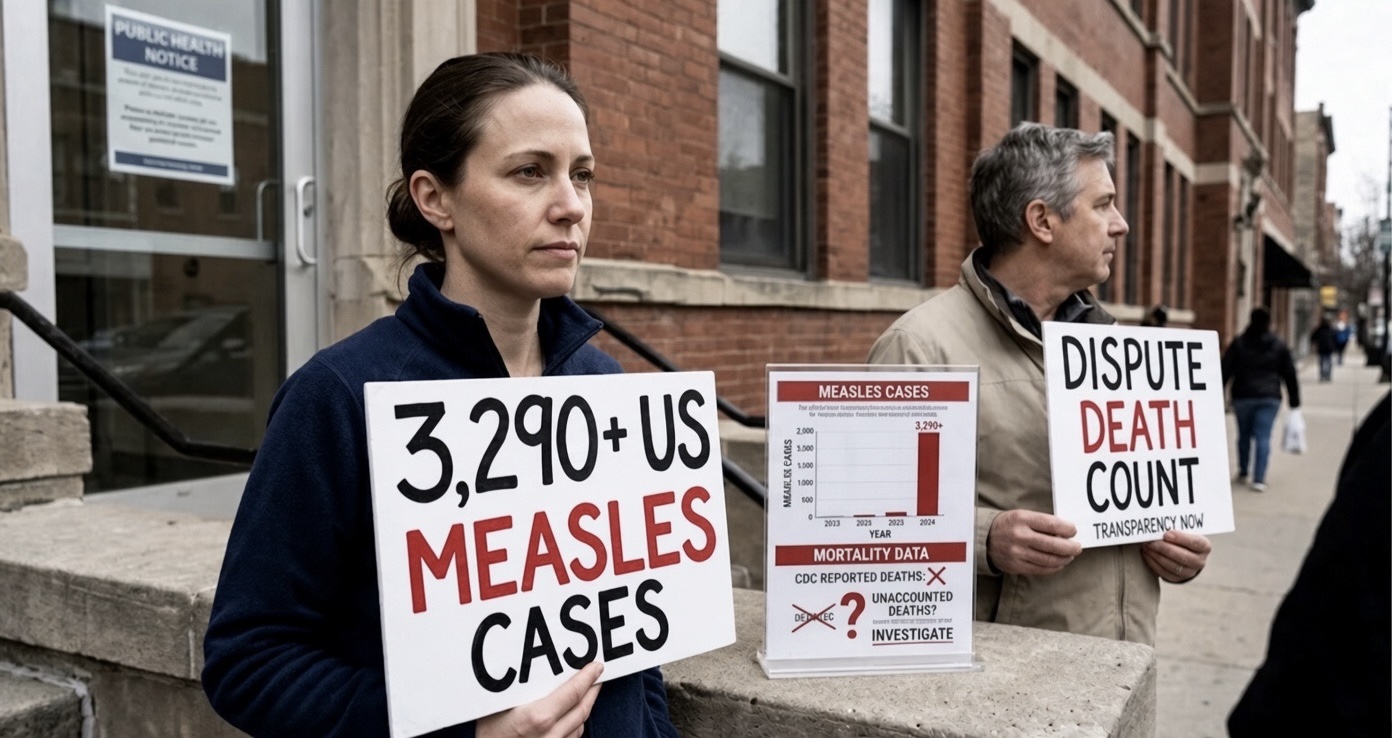
The United States has recorded more than 3,290 confirmed measles cases in 2026, already surpassing the total for all of last year, according to the Centers for Disease Control and Prevention. The outbreak has also produced a public dispute between Pennsylvania health officials and the federal government over how many people have died from the disease this year.
What Happened
The CDC’s measles outbreak page shows 3,294 confirmed cases nationwide as of Sept. 10 — 3,278 among U.S. residents spread across 47 jurisdictions, plus 16 cases among international visitors. That is more than 1,000 cases above the full-year 2025 total, according to an analysis by the Center for Infectious Disease Research and Policy at the University of Minnesota.
Pennsylvania leads the country with 676 cases, followed by South Carolina with 670, Utah with 526, Texas with 192, Virginia with 178 and Wisconsin with 163.
Nationally, 95% of this year’s measles patients were unvaccinated or had unknown vaccination status, according to CDC data; the measles vaccine is 97% effective after two doses. About 8% of patients have required hospitalization nationwide this year, down from 11% in 2025 — though in Pennsylvania specifically, 124 of the state’s 676 patients, or 18%, have been hospitalized.
Measles was declared eliminated in the United States in 2000, meaning the virus no longer circulated continuously within the country and any outbreak had to be traced to a case brought in from abroad. This year’s case count, if it holds, would represent one of the largest annual totals since that elimination milestone, driven largely by clusters in communities with lower vaccination rates, including Mennonite and Amish communities in Texas, Pennsylvania and South Carolina.
The Death Count Dispute
The CDC’s own outbreak page states that the National Center for Health Statistics “does not currently have any death records from 2026 that indicate measles is the underlying cause” — meaning the federal count of measles deaths for the year stands at zero. But Lancaster County, Pennsylvania, Coroner Stephen Diamantoni ruled in late August that a 6-week-old Amish infant died of measles, and Pennsylvania Gov.
Josh Shapiro’s administration has publicly listed two measles-associated deaths in Lancaster County. Neither has been added to the CDC’s national tally.
The infant, who was unvaccinated, had an underlying genetic condition known as Amish lethal microcephaly that made her especially vulnerable to the virus, and she was being treated at the Clinic for Special Children in Leacock Township amid an active measles outbreak in the local Amish community. Diamantoni said he typically sees two to four cases of the genetic condition a year and that “most children survive only four to six months” with it, offering context for why the infant was so vulnerable once infected.
Health and Human Services Secretary Robert F. Kennedy Jr. publicly questioned Pennsylvania’s transparency on the case, saying he could not verify the Lancaster County deaths or obtain further detail from the state. Gov. Shapiro pushed back directly. “I don’t think it serves public health,” Shapiro said, “to get into … conspiracy theories … online.” He defended his health department’s data-sharing practices, saying it has shared information “within legal constraints.”
A second Lancaster County case complicates the picture further: LancasterOnline has reported that the recorded cause of death for a second local measles patient “doesn’t add clarity” to the count dispute, meaning even Pennsylvania’s own two-death figure rests on documentation that outside reporters have found difficult to fully verify.
That leaves three different figures in circulation for the same outbreak — zero from the CDC, two from the state health department, and one confirmed plus one unresolved from the county coroner’s office — none of which this report resolves or averages.
Why It Matters
The dispute is unfolding against a broader backdrop of change in federal vaccine policy. Kennedy dismantled and reconstituted the CDC’s Advisory Committee on Immunization Practices in June 2025 with a membership that outside reporting has described as largely vaccine-skeptic, a change now facing court challenges. In response, outside medical organizations — coordinated through the University of Minnesota’s Vaccine Integrity Project — have begun issuing their own fall vaccine guidance for flu, COVID-19 and RSV independent of the CDC’s advisory panel.
Bruce Gellin of the Vaccine Integrity Project said the goal is ensuring “Americans should have access to the best available scientific evidence and recommendations from the physicians and medical experts” regardless of the federal panel’s makeup. The disagreement over how Pennsylvania’s measles deaths are counted adds a second, concrete example of federal and outside medical authorities reaching different conclusions from the same underlying data.
The outbreak’s geography also matters to how it has spread. Public health officials have traced much of the case growth to close-knit religious communities, including Mennonite and Amish populations in Pennsylvania, Texas and South Carolina, where vaccination rates run below the roughly 95% coverage level public health officials say is needed to prevent sustained community transmission of a virus as contagious as measles.
That pattern helps explain why states like Pennsylvania and South Carolina, rather than the country’s largest metropolitan areas, currently lead the national case count.
What Happens Next
The gap between Pennsylvania’s count of two measles-associated deaths and the CDC’s official count of zero remains unresolved. Fall respiratory illness season is beginning with several major medical societies, including the American Academy of Pediatrics, the American College of Obstetricians and Gynecologists and the American Academy of Family Physicians, issuing independent vaccine guidance rather than waiting on the CDC’s advisory panel, which multiple medical groups describe as being in legal limbo over its restructured membership.