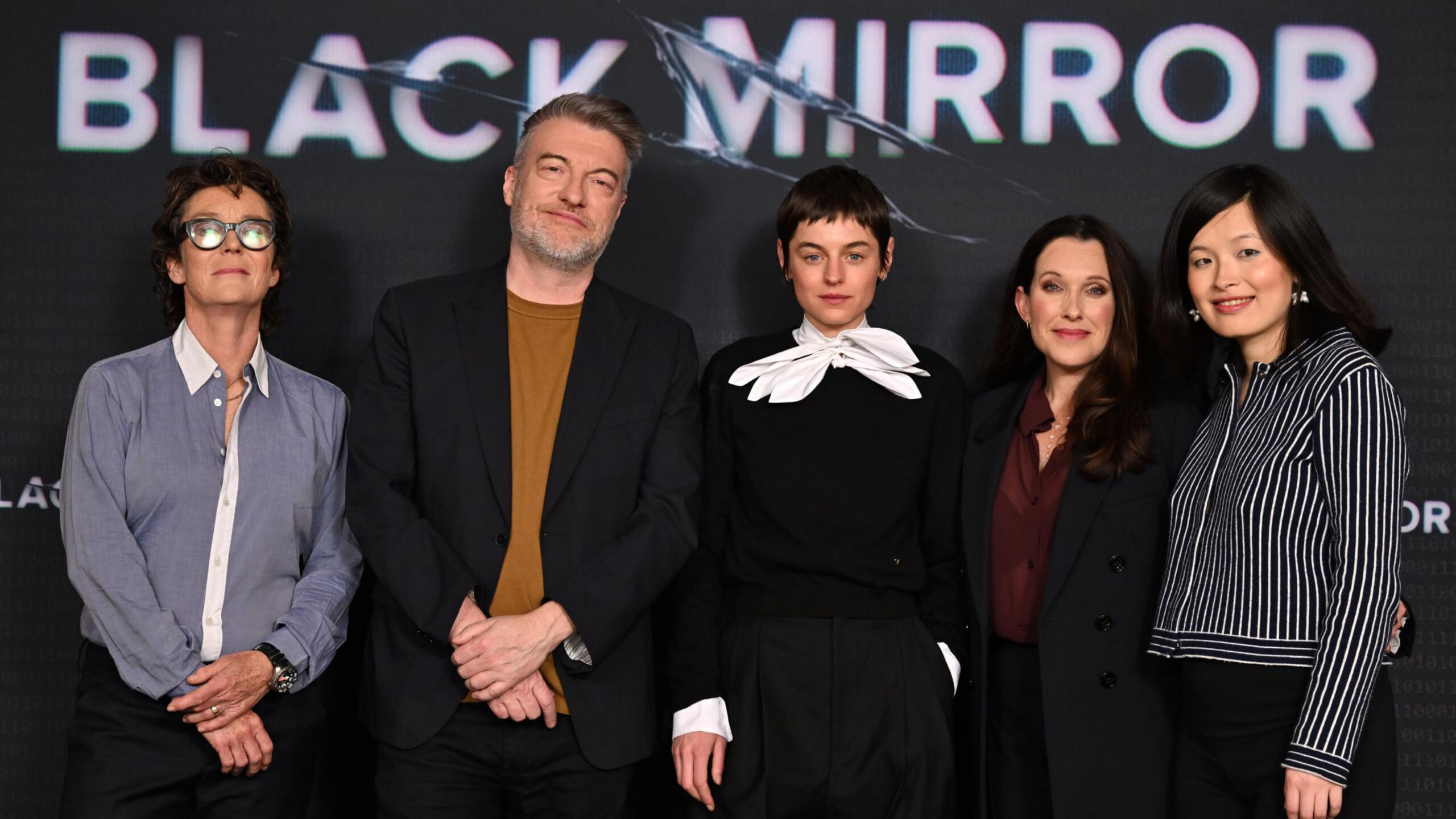
Remember when watching Black Mirror felt like a fun, slightly stressful weekend activity rather than a literal look out the window? Charlie Brooker’s dystopian anthology spent years warning us about the dark, unintended consequences of the gadgets in our pockets. Now, in 2026, the timeline has caught up. The future is here, and it’s a bit of a mixed bag.
While the show nailed our collective screen-time anxiety, it also missed just how mundane, and weirdly exhausting, the actual tech future turned out to be. Here’s what Black Mirror got right about America’s tech reality and where it still misses the mark.
Rating Culture and Digital Fatigue (“Nosedive,” Season 3, Episode 1)
If you’ve opened an app today, you already know Nosedive (Season 3, Episode 1) wasn’t just fiction, it was a blueprint.
No, we don’t have glowing numbers floating over our heads yet, but our social and even economic value is increasingly shaped by digital validation. From workplace reputation systems to community apps and algorithm-driven personal branding, almost everything now carries a silent score.
We’re constantly optimizing how we appear online, chasing engagement, and navigating platforms where a bad digital reputation can quietly follow us into real life. The show didn’t just predict a rating culture, it captured the exhausting feeling of always being “on.”
Digital Grief and AI Companions (“Be Right Back” Season 2, Episode 1)
If you’ve seen Be Right Back (Season 2, Episode 1), you probably remember the eerie chill of Martha talking to an AI replica of her late boyfriend, built entirely from his texts, voice notes, and social media history. At the time, it felt like a distant, slightly morbid sci-fi concept.
Fast forward to today, and AI companions trained on a loved one’s digital footprint are no longer hypothetical. Companies are actively developing and marketing “digital twins” for grief support, allowing people to message or even call versions of those they’ve lost.
The episode captured something unsettlingly accurate: the emotional emptiness that can come from replacing real human presence with a convincing simulation, and we’re now testing that idea in real time.
Viral Justice Culture (“White Bear,” Season 2, Episode 2)
Black Mirror has always understood that the scariest part of technology isn’t the machinery, it’s what happens when you hand it to a crowd. Look no further than White Bear (Season 2, Episode 2), an episode about a woman forced to endure a daily cycle of public torment while bystanders silently film her for entertainment.
Today, that idea hasn’t disappeared, it has simply migrated to our feeds. Public punishment now shows up as viral cancellations, courtroom TikTok trends, and endless online outrage cycles where complex human situations are flattened into content.
The episode’s core themes, collective cruelty, performative justice, and the stripping away of empathy in crowds, feel more relevant with every new trending scandal.
Digital Escape and Eternal Life: (“San Junipero,” Season 3, Episode 4)
It’s not all pure cynicism, though. San Junipero (Season 3, Episode 4) offered a rare glimpse of a hopeful tech future: a digital afterlife where consciousness can be uploaded into a nostalgic, neon-soaked town that exists forever.
While we’re not uploading our minds to the cloud just yet, the premise feels increasingly plausible as virtual spaces, immersive tech, and brain-computer interfaces continue to evolve. In an era shaped by loneliness and digital exhaustion, the idea of a perfected online escape isn’t just sci-fi anymore, it’s becoming an appealing form of coping.
We’re slowly building environments where existing online can feel easier, and sometimes more desirable, than dealing with reality itself.
Digital Likeness and the Battle Over Identity (“Joan Is Awful,” Season 6, Episode 1)
When Joan Is Awful (Season 6, Episode 1) dropped in 2023, it felt like a wild, exaggerated satire of streaming platforms and endless terms-and-conditions nobody reads. The idea that a corporation could instantly turn someone’s ordinary life into a prestige TV show using an AI-generated version of a famous actress felt lightyears away.
Now it doesn’t feel so distant. Conversations around digital likeness, AI clones, and the fine print behind user agreements have moved to the center of the creative industry. Actors, musicians, and everyday people are now openly fighting to protect their voices and faces from being scraped, replicated, and monetized.
The episode captured something uncomfortable: the realization that your identity can be turned into corporate data, and that, at some point, you probably already agreed to it.
The Real Forecast: How Tech Just Magnified Who We Already Were
The show’s greatest strength has always been showing that technology doesn’t fix human nature, it amplifies it. Status anxiety, digital isolation, surveillance capitalism, and the slow erosion of unfiltered connection are all deeply embedded in modern life. It also captured how quickly we normalize invasive tools when they’re packaged as convenience or entertainment.
We don’t need a corporate villain forcing a tracking chip into our skin when we’ll happily buy sleek wearables that monitor our biometrics, sleep, and location just to admire the data on a screen. We don’t need a dystopian government listening in when we willingly place smart speakers in our bedrooms for the convenience of voice-controlled lights.
Black Mirror didn’t really predict a tech revolution, it predicted compliance. As long as the interface is smooth and the experience is effortless, we will continue trading privacy, data, and even parts of our relationships for convenience. Technology didn’t fundamentally change us, it simply scaled what we were already willing to give away.
Now we’re left navigating the quiet exhaustion of a future we helped build.
Where It Sometimes Misses
Black Mirror often portrays people as helpless victims of unstoppable technological forces. In reality, the relationship is more complicated, we’re not just being watched, we’re participating. We livestream our lives, trade privacy for engagement, and choose convenience over depth. The show sometimes underestimates our agency, and the messy, contradictory ways we adopt these tools.
It also tends to focus on individual horror stories rather than the broader system shaping them. The real challenge in 2026 isn’t a single terrifying gadget, it’s an entire ecosystem of incentives designed to keep us engaged, optimized, and online.
The Takeaway
Black Mirror doesn’t offer easy answers, and neither does 2026. We’re more connected than ever, yet somehow more isolated. More informed, yet more anxious. The mirror is still dark, but it’s uncomfortably accurate.
The real question isn’t whether the future it warned about is coming. It’s how much of it we’ve already accepted as normal, and whether we even notice anymore.