The best Black comedy movies do more than make audiences laugh; many have created characters, scenes and sayings that have become part of Black pop culture long after the credits rolled. Across decades, Black filmmakers and performers have used comedy to tell stories about friendship, romance, family, ambition, community and everyday life while challenging Hollywood stereotypes along the way. That staying power is especially visible in Eddie Murphy’s career.
This ranking weighs cultural impact, lasting popularity, critical and audience reception, commercial success where relevant, and each film’s place in Black film history. From cult favorites and romantic comedies to buddy movies, satire and horror comedy, here are 15 of the best.
15. ‘The Blackening’ (2023)
“The Blackening” takes one of horror cinema’s oldest jokes, that the Black character is usually the first to die, and builds an entire comedy around what happens when everyone in the movie is Black. Directed by Tim Story, the film stars Antoinette Robertson, Dewayne Perkins, Grace Byers, Jermaine Fowler, Melvin Gregg, X Mayo, Yvonne Orji, Sinqua Walls and Jay Pharoah.
Co-written by Perkins and Tracy Oliver, the film follows a group of friends whose Juneteenth getaway turns deadly when they are forced into a twisted game by a masked killer. Its strength comes from knowing the conventions it is mocking while allowing its Black characters to be funny, self-aware and different from one another instead of functioning as stereotypes.
The movie has an 87% critics score and 85% audience score on Rotten Tomatoes. It also earned about $17.7 million domestically, according to Box Office Mojo. Its mix of horror, racial satire and ensemble comedy gives this list a distinctly modern entry.
14. ‘Dolemite Is My Name’ (2019)
Eddie Murphy plays entertainer Rudy Ray Moore in “Dolemite Is My Name,” a comedy about the real-life performer who transformed his outrageous Dolemite character into an underground phenomenon. Craig Brewer directed the film, which also stars Wesley Snipes, Da’Vine Joy Randolph, Keegan-Michael Key, Mike Epps and Craig Robinson.
The story follows Moore as he bets on himself and attempts to make a low-budget movie despite lacking traditional Hollywood backing. While the movie is frequently hilarious, it also celebrates independent Black creativity and the determination to build an audience when the mainstream industry is not offering an invitation.
Murphy’s performance helped make the Netflix movie one of the best-reviewed films of his career. Rotten Tomatoes gives “Dolemite Is My Name” a 97% critics score and 91% audience score.
Its acclaim extended into awards season. The film received two Golden Globe nominations, including best motion picture, musical or comedy, and best actor in a musical or comedy for Murphy. That recognition strengthened its place as both a comeback vehicle for Murphy and a celebration of a Black entertainment pioneer whose influence stretched far beyond conventional Hollywood success.
13. ‘Black Dynamite’ (2009)
Few parody movies commit to the joke as completely as “Black Dynamite.” Michael Jai White leads Scott Sanders’ cult comedy alongside Tommy Davidson, Salli Richardson-Whitfield, Arsenio Hall and Kym Whitley.
White plays the impossibly cool title character, a former CIA agent and martial artist whose investigation into his brother’s death grows into an increasingly ridiculous conspiracy. The movie recreates the filmmaking style, dialogue, fashion and exaggerated masculinity associated with 1970s blaxploitation films while deliberately using continuity errors and awkward production choices as part of the joke.
That attention to detail helped “Black Dynamite” develop a devoted following among comedy and genre fans. Rotten Tomatoes gives it an 83% critics score and 85% audience score, reflecting the appeal of a spoof that clearly knows and appreciates the movies it is sending up.
The title’s appeal also extended beyond the movie itself, inspiring an animated series that debuted several years later and further cemented Black Dynamite as a cult character.
12. ‘Uptown Saturday Night’ (1974)
Sidney Poitier was already one of Hollywood’s most important Black stars when he directed and starred in “Uptown Saturday Night.” The comedy pairs him with Bill Cosby and features Harry Belafonte, Flip Wilson and Richard Pryor in a cast packed with major Black talent of the era.
Poitier and Cosby play two friends who discover that a winning lottery ticket was inside a wallet stolen during a nightclub robbery. Their attempt to recover it sends them through an eccentric underworld populated by colorful characters.
The crime comedy offered something especially significant for 1974: a mainstream studio picture built around Black characters simply having an entertaining comic adventure.
Its historical significance received further recognition in 2024, when the Library of Congress selected “Uptown Saturday Night” for the National Film Registry because of its cultural, historic or aesthetic importance.
11. ‘The Nutty Professor’ (1996)
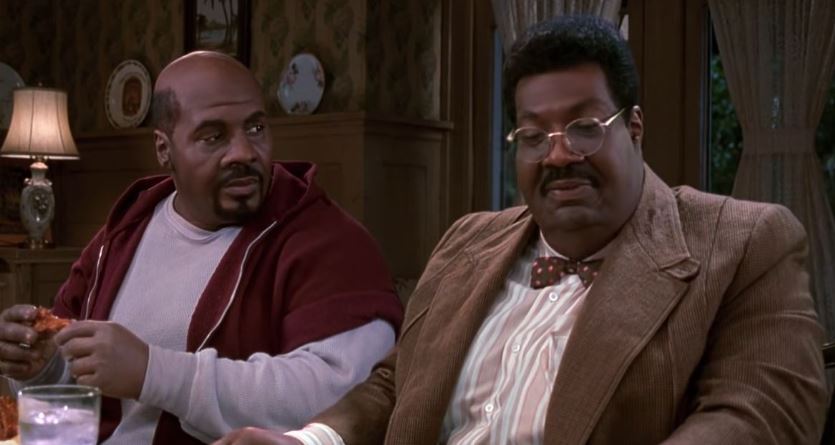
Eddie Murphy’s ability to disappear into multiple characters became the main attraction in “The Nutty Professor.” Tom Shadyac directed the comedy, which also stars Jada Pinkett Smith, James Coburn, Larry Miller and Dave Chappelle.
Murphy stars primarily as Sherman Klump, a kindhearted scientist whose experimental weight-loss formula creates the arrogant alter ego Buddy Love. But Sherman and Buddy are only part of the performance: Murphy also transforms into multiple members of the Klump family, often playing several characters in the same dinner-table scene.
The comedy is deliberately broad, but the technical and performance challenge behind Murphy’s work helped make the movie a major hit. Box Office Mojo lists its domestic gross at approximately $128.9 million and worldwide total at $274 million.
Those transformations also earned major industry recognition. Makeup artists Rick Baker and David LeRoy Anderson won the Academy Award for best makeup for their work on the film. Decades later, the Klump family scenes remain some of the clearest examples of Murphy turning character work, prosthetics and physical comedy into an entire comic spectacle.
10. ‘Boomerang’ (1992)
“Boomerang” gave Eddie Murphy a different kind of leading role while surrounding him with one of the most memorable Black ensembles of any romantic comedy of its era. Reginald Hudlin directed the film, which co-stars Robin Givens, Halle Berry, David Alan Grier, Martin Lawrence and Grace Jones.
Murphy plays advertising executive Marcus Graham, a notorious womanizer whose confidence is tested when his new boss, Jacqueline, played by Givens, treats romance as casually as he does. Berry plays Angela, while Grier, Lawrence, Jones, Eartha Kitt and Chris Rock help fill out the cast.
The film was notable for placing successful Black professionals inside the glossy corporate-romance world that mainstream romantic comedies frequently reserved for white characters. It also found a sizable audience. Box Office Mojo lists approximately $70.1 million in domestic earnings and $131.1 million worldwide.
9. ‘Life’ (1999)
Putting Eddie Murphy and Martin Lawrence together made “Life” an easy sell as a comedy, but the film ultimately had more on its mind than jokes. Ted Demme directed the 1999 movie, which also features Bernie Mac, Obba Babatundé, Anthony Anderson and Clarence Williams III.
Murphy’s Ray and Lawrence’s Claude are wrongly convicted of murder in Mississippi and sentenced to life in prison. Their relationship unfolds across decades as the pair argue, scheme, age and repeatedly dream of freedom. The film balances broad comedy with friendship, racism, lost time and regret in ways that make its emotional ending hit harder than audiences might expect from its two comic leads.
Critics were divided, with “Life” holding a 53% critics score on Rotten Tomatoes. Its considerably stronger 77% audience score reflects the affection it has maintained with viewers, with the chemistry between Murphy and Lawrence remaining its biggest draw.
8. ‘The Best Man’ (1999)
“The Best Man” helped prove that a Black ensemble romantic comedy could be sophisticated, messy, funny and emotionally complicated all at once. Written and directed by Malcolm D. Lee, the film stars Taye Diggs, Nia Long, Morris Chestnut, Sanaa Lathan, Terrence Howard, Regina Hall, Harold Perrineau, Monica Calhoun and Melissa De Sousa.
The story centers on Harper Stewart, a novelist preparing to serve as best man at his friend Lance’s wedding. The problem is that Harper’s new book is based rather closely on the private lives of everyone attending, including a secret that could destroy the wedding.
Instead of relying solely on broad comedy, the film gets much of its humor from friendship, jealousy, attraction and secrets shared among a group of successful Black professionals.
“The Best Man” has an 86% audience score on Rotten Tomatoes. Its enduring popularity later led to the 2013 sequel “The Best Man Holiday” and the Peacock series “The Best Man: The Final Chapters,” extending the characters’ stories more than two decades after the original film.
7. ‘Barbershop’ (2002)
Sometimes the funniest place in a neighborhood is simply where everyone gathers to talk, and “Barbershop” builds an entire comedy around that idea. Tim Story directed the ensemble film starring Ice Cube, Cedric the Entertainer, Eve, Anthony Anderson, Sean Patrick Thomas and Michael Ealy.
Ice Cube plays Calvin Palmer Jr., who inherits his father’s struggling Chicago barbershop and impulsively sells it before realizing what the business means to the people around him. The plot gives the film momentum, but its personality comes from the conversations inside the shop, especially Cedric the Entertainer’s scene-stealing turn as opinionated veteran barber Eddie.
The movie mixes jokes with observations about community, ownership, relationships and generational differences without losing its relaxed hangout atmosphere.
That combination connected with audiences. Box Office Mojo lists a domestic gross of approximately $75.8 million, while Rotten Tomatoes gives it an 82% critics score. Its success ultimately led to sequels and the spinoff “Beauty Shop,” expanding the story into a broader franchise.
6. ‘Girls Trip’ (2017)
Four longtime friends, one wild trip to New Orleans and a breakout performance from Tiffany Haddish helped turn “Girls Trip” into one of the defining Black comedies of the 2010s. Malcolm D. Lee directed the movie, which stars Regina Hall, Queen Latifah, Jada Pinkett Smith and Haddish.
Ryan, Sasha, Lisa and Dina reunite during the Essence Festival, where old resentments surface alongside increasingly outrageous adventures. Despite the wild set pieces, the story keeps its focus on the friendship holding the group together.
Haddish’s fearless performance as Dina became a breakout moment, while Hall, Latifah and Pinkett Smith gave the ensemble enough emotional weight to keep the movie from becoming merely a collection of outrageous jokes. “Girls Trip” earned approximately $115.2 million domestically and $140.6 million worldwide, according to Box Office Mojo. It also holds a 91% critics’ score on Rotten Tomatoes.
The movie reached another milestone through co-writer Tracy Oliver, who became the first Black woman to write a film that grossed more than $100 million at the domestic box office. That achievement adds another layer to the film’s significance beyond its critical and commercial success.
5. ‘Hollywood Shuffle’ (1987)
Robert Townsend knew exactly what he was satirizing when he made “Hollywood Shuffle.” Townsend directed and stars in the comedy alongside Anne-Marie Johnson, Keenen Ivory Wayans, John Witherspoon and Helen Martin.
He plays Bobby Taylor, an aspiring actor trying to succeed in Hollywood while repeatedly encountering stereotypical roles offered to Black performers. Fantasy sequences allow the movie to parody everything from film criticism to detective stories, while Bobby wrestles with how badly he wants success and what he may have to compromise to get it. Hollywood has changed considerably since 1987, but much of the satire remains recognizable, which is part of the film’s lasting power. It also helped establish Townsend and co-writer Wayans as important comedic voices.
The movie’s creation became almost as notable as its subject. Townsend used money from acting jobs and famously relied on credit cards to help finance the independent production rather than waiting for traditional studio backing. The film ultimately grossed more than $5 million, turning his gamble into a striking example of independent Black filmmaking.
Rotten Tomatoes gives “Hollywood Shuffle” an 88% critics score. Its influence reaches beyond the laughs: Townsend used sharp satire to challenge Hollywood stereotypes while demonstrating what Black filmmakers could accomplish outside the traditional studio system.
4. ‘Beverly Hills Cop’ (1984)
Axel Foley helped transform Eddie Murphy from an already famous comedian into one of Hollywood’s biggest movie stars. Martin Brest directed “Beverly Hills Cop,” which also stars Judge Reinhold, John Ashton, Lisa Eilbacher, Ronny Cox and Steven Berkoff.
The movie follows Murphy’s fast-talking Detroit detective to California as he investigates the murder of a childhood friend, repeatedly frustrating the far more restrained Beverly Hills Police Department along the way. The film succeeds because Murphy’s comic personality never feels separated from the action. Axel can talk his way through a hotel lobby, antagonize detectives and chase criminals without the story having to choose between laughs and thrills.
Its commercial impact was enormous. Box Office Mojo lists approximately $234.8 million in domestic earnings and $316.4 million worldwide. It became the highest-grossing domestic release of 1984 when films from that year are ranked by total domestic gross.
The movie also earned an Academy Award nomination for original screenplay. Four decades later, its cultural standing received another boost when the Library of Congress added “Beverly Hills Cop” to the National Film Registry in 2024.
3. ‘House Party’ (1990)
Getting to one unforgettable party is enough to drive the entire plot of “House Party,” but the movie became much more than a simple teen comedy. Written and directed by Reginald Hudlin, it stars Christopher “Kid” Reid, Christopher “Play” Martin, Tisha Campbell, A.J. Johnson, Robin Harris and Martin Lawrence.
After Kid gets into a fight at school, his father grounds him just as Play prepares to throw the party everyone wants to attend. Kid sneaks out anyway, setting off a night filled with dancing, romance, neighborhood trouble and one of the most memorable dance sequences of its era.
“House Party” put Black teenagers, hip-hop and youthful fun at the center of the story without treating Black adolescence primarily through violence or trauma. Its reputation has only grown. The movie holds a 94% critics score on Rotten Tomatoes, and in 2022, the Library of Congress added “House Party” to the National Film Registry, recognizing its cultural, historical or aesthetic significance.
2. ‘Friday’ (1995)
One ordinary day on one neighborhood block was enough to create one of Black comedy’s most enduring movies. F. Gary Gray directed “Friday,” starring Ice Cube, Chris Tucker, Nia Long, John Witherspoon, Regina King and Tommy “Tiny” Lister Jr.
Ice Cube stars as Craig, who has just lost his job, while Tucker plays Smokey, his endlessly talkative friend who has a serious problem involving money he owes drug dealer Big Worm. As the day unfolds, the pair encounter neighbors, family members, romantic distractions and neighborhood bully Deebo.
Written by Ice Cube and DJ Pooh, the movie found comedy in everyday South Central Los Angeles life rather than presenting the neighborhood exclusively through the crime-heavy lens common in many films of the period.
Its popularity far outgrew its modest theatrical beginnings. Box Office Mojo lists approximately $27.5 million in domestic earnings against a reported $3.5 million budget. The film later spawned two sequels and turned Smokey, Deebo and Mr. Jones into instantly recognizable characters.
Its longevity is also reflected in a 91% audience score on Rotten Tomatoes. Few movies on this list demonstrate the difference between initial box-office scale and long-term cultural impact as clearly as “Friday.”
1. ‘Coming to America’ (1988)
Few Black comedies have combined blockbuster success, romance, quotability and unforgettable characters as successfully as “Coming to America.” John Landis directed the film, which stars Eddie Murphy, Arsenio Hall, Shari Headley, James Earl Jones, John Amos and Madge Sinclair.
Murphy plays Prince Akeem, heir to the fictional African kingdom of Zamunda, who rejects an arranged marriage and travels with his friend Semmi, played by Hall, to Queens in search of a woman who will love him rather than his title.
That premise alone would have been enough for a romantic comedy, but Murphy and Hall turned the movie into something far bigger by playing multiple supporting characters, including personalities inside the now-famous barbershop and Murphy’s gloriously enthusiastic singer Randy Watson. Paramount’s official movie page confirms that Murphy and Hall each performed multiple roles.
Commercially, the film was a blockbuster. Box Office Mojo lists approximately $128.2 million domestically and $288.8 million worldwide, placing it among the biggest theatrical releases of 1988. It also earned two Academy Award nominations, for costume design and makeup, adding industry recognition to its commercial success.
More importantly for this ranking, its characters and comic set pieces remained recognizable enough for the story to return more than 30 years later with the 2021 sequel “Coming 2 America.” With Murphy at the center, Hall matching his character work and an ensemble filled with memorable performances, “Coming to America” earns the top spot because few films have matched its combination of cultural staying power, mainstream success and enduring Black comedy appeal.
The Best Black Comedy Movies Were Never Just About the Jokes
What connects these movies is not one style of comedy. “Friday” found humor in an ordinary day on a neighborhood block, “Boomerang” put Black romance and professional success at the center of a glossy studio comedy, “House Party” celebrated Black teenage joy, and “The Blackening” turned decades of horror stereotypes into the punchline.
That range may be the biggest reason the best Black comedy movies continue to matter. They gave Black characters room to be romantic, ridiculous, ambitious, flawed, frightened, successful and simply funny without requiring every story to explain Black life through struggle.
The rankings may always be debatable, especially when movies become tied to different generations and memories. But the staying power of these 15 films suggests that the most memorable Black comedies do something bigger than deliver laughs: they create characters and worlds audiences still want to revisit long after they already know every joke.