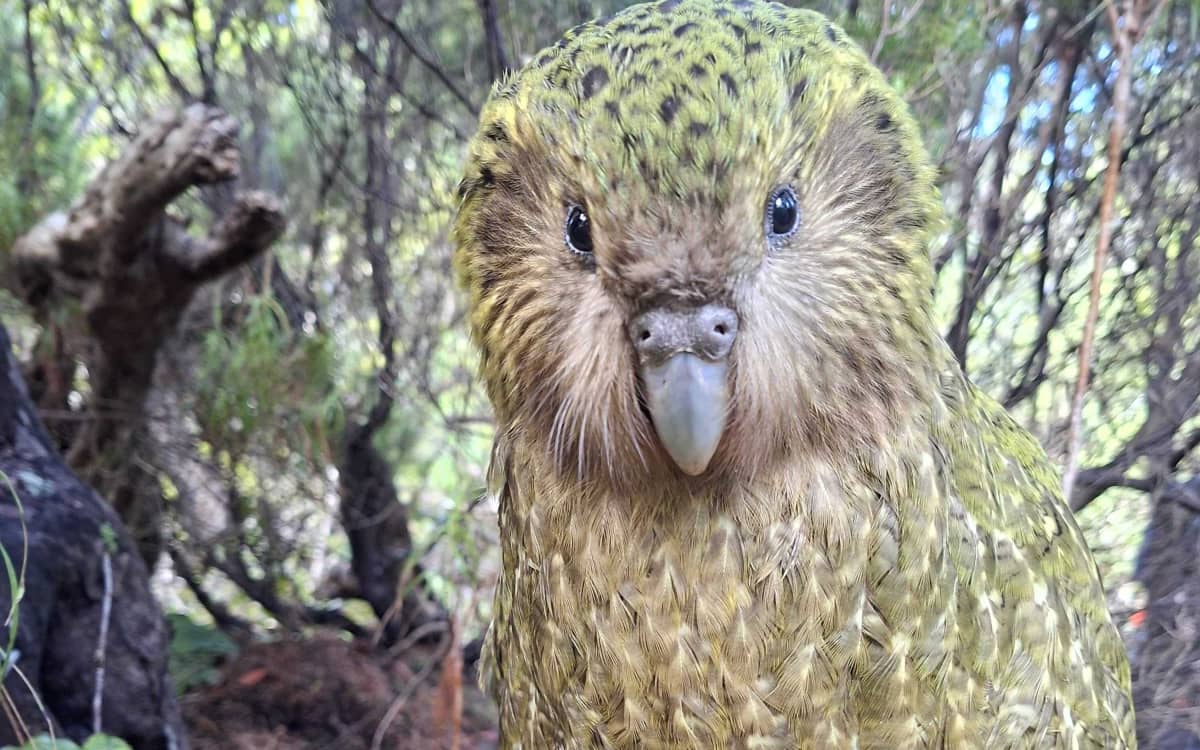
New Zealand’s kākāpō population reached 325 birds on Sept. 1, 2026, after 90 chicks from this year’s breeding season survived to 150 days old and fledged. The Department of Conservation confirmed the total, up from 235 birds before the season.
It is the highest count since the Kākāpō Recovery programme began in 1995 and likely the highest in about 75 years, the department said. The previous single-season record was 73 fledglings in 2019, Mongabay reported.
How the 2026 Season Produced 90 Fledglings
This was the 13th breeding season since the programme started, and it followed a four-year gap. Kākāpō are flightless, nocturnal, critically endangered parrots found only in New Zealand. They breed only in heavy rimu mast years, when the rimu berry harvest is exceptional, and those years arrive every two to four years. The 2026 season followed an exceptional harvest.
RNZ reported season details the government release left out. Seventy-nine nesting females laid 258 eggs, which produced 106 hatchlings. Of the nesting females, 48 raised living chicks, and 32 males fathered offspring. Ten chicks were conceived by artificial insemination.
Three four-year-old females bred for the first time, the youngest females ever to reproduce in the programme, according to RNZ. A male named Tūterangi fathered 10 chicks from six matings. Females named Vori and Tīwhiri each raised four living chicks.
The season was not loss-free. Seven chicks died during the season and four were taken to Dunedin Wildlife Hospital for treatment, Kākāpō Recovery ranger Sarah Manktelow told Live Science. Of the 106 chicks that hatched, 90 reached fledging.
Andrew Digby, science advisor to the programme, said the team deliberately reduced supplementary feeding and hand-rearing this year, stepping back from the intensive management used in past seasons and letting the birds do more on their own, RNZ reported.
“We had a four-year gap between breeding seasons, so it’s fantastic to see the population increase after all that time,” said Deidre Vercoe, operations manager for the Kākāpō Recovery programme, in the department’s announcement. Vercoe said 90 chicks arrived in one season, where the early recovery era took roughly 16 years to produce the same number, RNZ reported.
The Arithmetic Behind 31 Years of Recovery
The calculations in this section are ours, drawn from the figures published by the Department of Conservation and RNZ.
The programme began in 1995 with 51 birds, 20 females and 31 males. Going from 51 birds to 325 over 31 years is more than a sixfold increase.
The 90 chicks that fledged this season equal about 28% of the 325 living kākāpō. More than one in four kākāpō alive today hatched in a single breeding season.
Set that against the hatch-to-fledge numbers. The 258 eggs laid produced 106 hatchlings, or about 41% of eggs. Of those eggs, 90 produced a bird that survived to fledging, or about 35%. Roughly two-thirds of the eggs laid this season did not yield a fledged kākāpō, and the season still set a record.
That arithmetic runs into a physical limit. The existing island populations are at capacity and more predator-free sites are urgently needed, RNZ reported. The programme’s success has produced its next problem.
Island Habitat Is Running Out
Kākāpō live on three predator-free islands: Whenua Hou/Codfish Island, Pukenui/Anchor Island and Te Kākahu-o-Tamatea/Chalky Island, theDepartment of Conservation said. Every bird counted in the 325 lives on one of them.
The recovery group is now weighing how much hands-on management the species still requires. “Our focus is increasingly on determining where intensive intervention is still needed and where we can start to return to more natural levels,” said Tāne Davis, the Te Rūnanga o Ngāi Tahu representative on the Kākāpō Recovery Group, in the department’s release.
Davis has pointed to a larger goal beyond the islands. “One of our future aspirations through Predator Free Rakiura is to return the kākāpō back to its original home,” he told Mongabay in March.
Vercoe has described the programme’s measure of success in similar terms. “We want to create healthy, self-sustaining populations of kākāpō that are thriving, not just surviving,” she told Mongabay.
Funding, Naming and the Next Breeding Season
Meridian Energy partnered with the programme in 2016, when the population stood at 124 birds, according to a joint release from the company and the department. At 325 birds, the population has grown by more than 200 during the decade of that partnership, which has been renewed through June 2029.
“For a decade, we’ve worked together to support this taonga, and we’re proud to continue that commitment through to June 2029,” said Mike Roan, Meridian’s chief executive, in the March release.
Penny Nelson, director-general of the Department of Conservation, said in the same release: “Meridian has backed the programme through a period of strong growth.”
Some of the 2026 chicks will be named between February and March 2027, the department said. Others will stay unnamed, which reflects the shift toward less individually managed breeding.
The next breeding season may come sooner than the last gap suggests. “Our modelling indicates there may be only a two-year gap between breeding seasons this time round,” Vercoe said. That modeling points to 2028 as the next season, though it is a projection rather than a scheduled event. Kākāpō breeding depends on the rimu mast, which Mongabay reported arrives every two to four years.