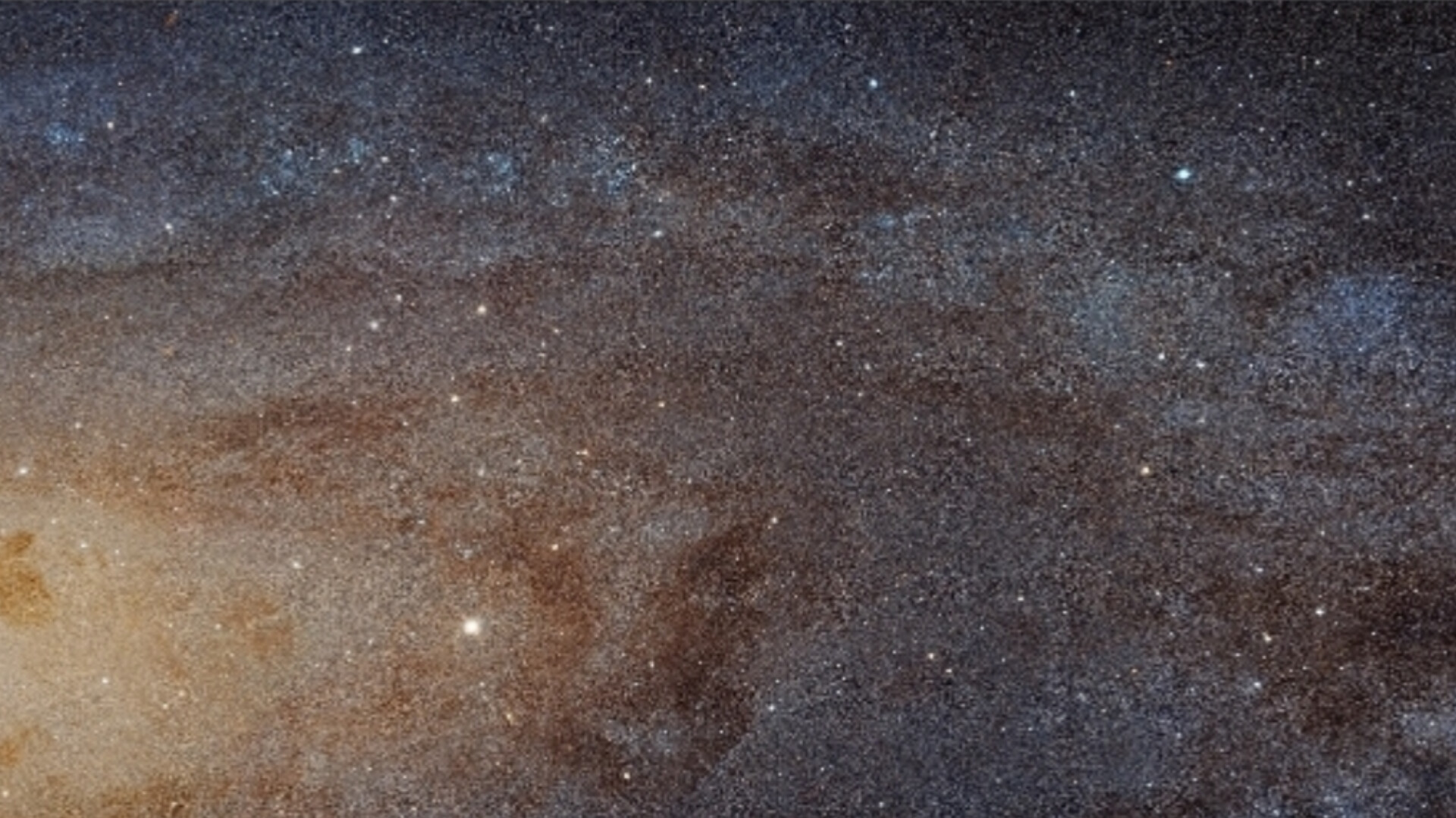
Astronomers watched a star slightly smaller than the sun spiral into a puffy supergiant and merge with it on the edge of the Andromeda galaxy, the first event of its kind caught as it happened, NASA said. The research appeared in Nature on Nov. 18. The bigger result is that it could have been predicted. Old survey data showed the giant star changing more than two years before the eruption, which means the next one might be spotted in advance.
What Happened in the Stellar Merger
The event, AT 2025abao, is nicknamed “Bao.” The giant was about seven times as massive as the sun, 350 times its radius and 18,000 times brighter, NASA said. Its companion had about 0.7 times the sun’s mass. “It was an absolute beast of a star, completely outshining its companion in the data,” said Karel Temmink, a doctoral student at Radboud University who led the simulations.
The small star plowed through the giant’s swollen outer layers, losing orbital energy until it sank inward. Astronomers call this common envelope evolution. It finished after about seven orbits, roughly seven years. A calculation from those figures: about one orbit a year around a star 350 times wider than the sun. “We thought an outburst from a such an extended star would take years,” said Nadia Blagorodnova, an associate professor at the University of Barcelona.
How Telescopes Saw It Coming
The timeline is the story. NASA’s NEOWISE showed the star’s brightness steady before 2018, with variability noticed in February 2023. Other instruments followed in 2024 and 2025. The Zwicky Transient Facility detected the eruption on Oct. 17, 2025, and the Webb telescope observed it on Dec. 24, 2025, 47 days after its peak.
A calculation from the dates: the first sign of trouble came about two years and eight months before the eruption. “Stellar mergers are very, very difficult to observe in real time because they are hard to predict,” said Viraj Karambelkar, a NASA Hubble Fellow at Columbia University and the paper’s first author. Kishalay De, an assistant professor at Columbia, compared the outburst to “a bomb exploding inside a living star.”
Why the Merger Matters
Many stars live in pairs, and mergers like this decide how a large share of those pairs end. Until now, astronomers mostly pieced them together after the fact. NASA said the survivor may be “rejuvenated,” though its final structure remains uncertain.
The fair caution is that this is one event, and every quoted scientist is an author of the work. A pattern will need more cases. More are likely. NASA’s Roman Space Telescope is designed to survey the center of the Milky Way repeatedly and catch short-lived events. “There’s going to be a large influx of similar discoveries just ahead,” Karambelkar said.