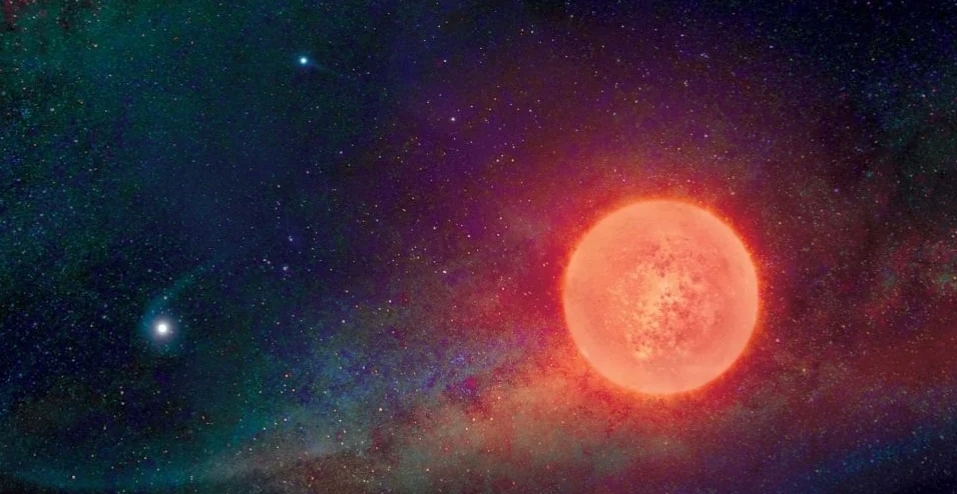
Astronomers have found a triple star system about 28 light-years from Earth made of a red dwarf and two white dwarfs, the remains of dead stars, in an arrangement its own discoverers say should not exist, the Université de Montréal said on Nov. 19. “This system should not exist,” said Patrick Dufour, a professor at the university and a coauthor. The system sits in our cosmic neighborhood, which means the gap in the textbook is close to home.
How the Triple Star System was Found
The team was not looking for it. “We were actually looking for planets,” said Étienne Artigau, a researcher at the university’s Trottier Institute for Research on Exoplanets and the lead author.
Using the SPIRou instrument on the Canada-France-Hawaii Telescope, the researchers saw the red dwarf’s speed swing by nearly 16 kilometers per second, a wobble the release describes as more than a thousand times larger than expected. Something heavy and invisible was pulling on it. The Gemini North telescope then imaged the hidden companion directly.
It was a white dwarf with more than half the sun’s mass, and very faint. “The unusual combination of high mass and very low brightness left only one plausible explanation,” said Charles-Antoine Parent, an undergraduate at Université Laval and a co-author. A second white dwarf orbits the pair from much farther out.
Why the System Should Not Exist
A white dwarf is what remains after a sun-like star swells into a giant and sheds its outer layers. Before it died, the inner white dwarf was a star about 40% more massive than the sun that grew to several hundred times its size, the release said. The red dwarf orbits close enough that it should have been engulfed.
The paper in Astronomy & Astrophysics puts the inner orbit at 4.644 astronomical units, with a period of about 9.8 years. A calculation from that figure: the red dwarf circles closer to its dead companion than Jupiter is to the sun, about 5.2 astronomical units. The authors suggest the red dwarf may have survived a phase in which it orbited inside the dying giant’s outer layers.
The paper calls the system the closest known triple containing multiple white dwarfs and says it has no known analogue within 30 parsecs, about 98 light-years. Its name, Welopō’ai, came from a naming program at the ’Imiloa Astronomy Center in Hawaii.
What Comes Next for the Research
“We have no clean explanation for how it got here,” Dufour said. “That is the question driving our next observations.” The measurements carry a known uncertainty. The paper notes a 4.15% disagreement between two distance measurements from the Gaia space telescope, and using the other value would lower the stars’ masses by about 11.5%.
A calculation from the distance: the light reaching Earth from the system today left it around 1998. The team plans to model how gravity among the three stars shaped their history, and the paper says Gaia’s next data release should settle the distance question.