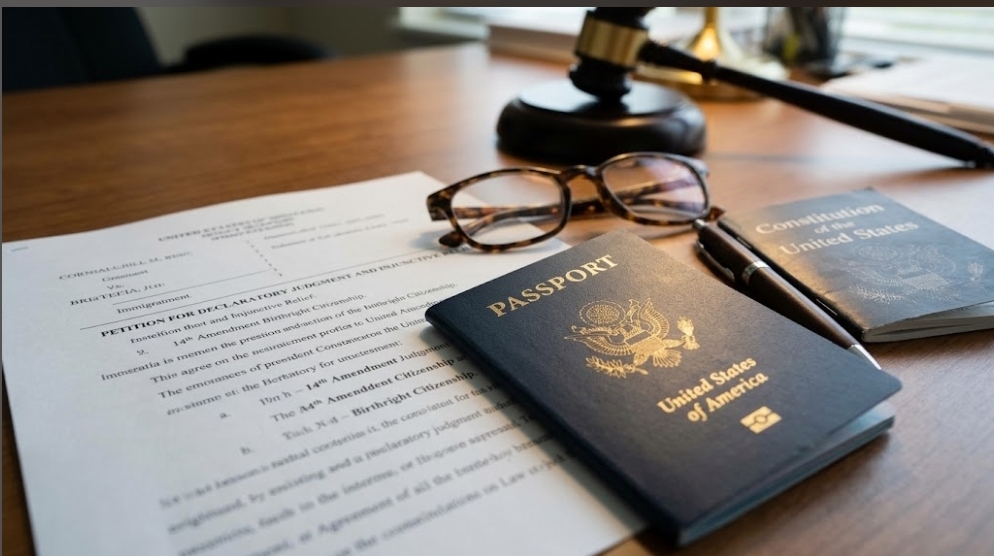
A federal judge in Washington on Nov. 25 blocked President Donald Trump’s second birthright citizenship order, certifying a nationwide class of affected children and ruling that “the President cannot carve out new exceptions to birthright citizenship,” the opinion states.
The administration lost the first round at the Supreme Court and came back 37 days later with a narrower order. The judge treated that as the same question with a smaller footprint, and the ruling reaches every child the order touched from the day it was signed.
What the Second Birthright Citizenship Order Does
Executive Order 14418, “Continuing to Protect the Meaning and Value of American Citizenship,” was signed Aug. 6. It targets children born in the U.S. with no U.S.-citizen parent in four groups: children of a parent designated as an “alien enemy” through terrorist designations, children of certain foreign-government and international-organization employees, children born through birth tourism, commercial surrogacy or fraud, and births in U.S. territories where no statute confers citizenship.
The order frames the effort as protection. “The privilege of United States citizenship remains a priceless and profound gift,” it says. It followed Trump v. Barbara, in which the Supreme Court on June 30 struck down the first order, which would have denied citizenship to children of undocumented immigrants and temporary visitors.
How Judge Cooper Ruled
U.S. District Judge Christopher R. Cooper decided Nathan v. Trump, No. 1:26-cv-03377, in the District of Columbia. He opened with the rule. “Children born in the United States and subject to its jurisdiction are American citizens from birth,” he wrote. He noted the timing: “Barbara’s ink had scarcely dried when the President issued [the] second executive order.”
Cooper found the alien-enemy provision facially unconstitutional and the foreigngovernment-employee provision likely beyond the narrow exceptions the Supreme Court recognized in United States v. Wong Kim Ark in 1898. “EO2’s expansive carveouts scarcely resemble those that Wong Kim Ark recognized,” he wrote. On denying citizenship based on a parent’s status, he was blunt: it “is always unconstitutional no matter how you slice it.”
The government argued the categories fit Wong Kim Ark’s exceptions and that the order reached only births after agencies issued guidance Sept. 4. Cooper rejected that cutoff and set the class to cover every qualifying child born on or after Aug. 6. A calculation from the dates: that is 111 days of births, including about four weeks the agencies’ own guidance left out.
Reaction to the Birthright Citizenship Ruling
The ACLU, the Legal Defense Fund, the Asian Law Caucus and Democracy Defenders Fund represent the plaintiffs. “Third time is not the charm, and the President needs to accept that birthright citizenship is the law of the land,” said Cody Wofsy, deputy director of the ACLU Immigrants’ Rights Project, in the group’s statement.
A White House spokesperson called the decision “just another ruling from an activist judge appointed by Obama” and said the order is “consistent with the holdings and analysis set forth by the Supreme Court,” in a statement to ABC News. The administration can appeal to the U.S. Court of Appeals for the D.C. Circuit, and the injunction stays in force unless a higher court lifts it.