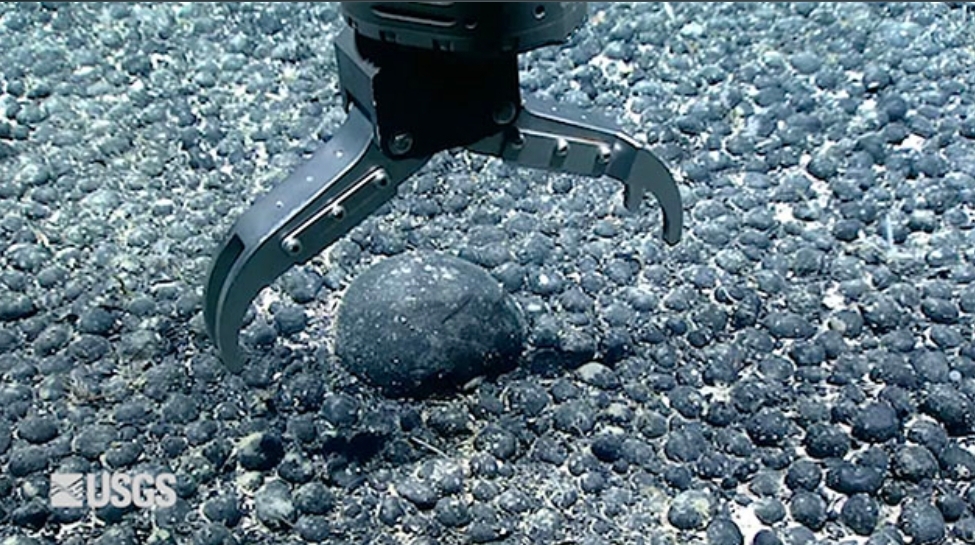
Fist-sized metal nodules on the Pacific seafloor hold animals living inside their cracks, with 4,139 found in 244 nodules, the MARUM center at the University of Bremen said on Nov. 11. The study appears in Scientific Reports. These are the same rocks deep-sea mining companies want to collect for nickel, cobalt and copper. The study turns each nodule from a lump of ore into a home.
What Lives inside the Nodules
The team collected nodules from the Clarion-Clipperton Zone in the central Pacific, 4,000 to 6,000 meters deep, using box corers and diving robots, then took them apart in the lab. The animals are smaller than a millimeter. The nodules held about 17 animals each on average, and one held 245, according to the release.
The communities inside the nodules were significantly different from those in the surrounding mud, and they were genetically similar across sites up to 1,000 kilometers apart. One singlecelled organism, Thurammina sp. 1, appears specifically adapted to life inside nodules.
Dr. Tanja Stratmann, the lead author and a deep-sea ecologist, said the cracks inside the nodules are “large enough to provide home to animals that are smaller than a millimeter in size.” “The crevices in the polymetallic nodules function as small shelters,” said Dr. Coral Diaz-Recio Lorenzo of the Roscoff Biological Research Station.
Why the Deep-Sea Mining Finding Matters
Nodules grow only a few millimeters per million years, according to the release. A mining machine that removes one takes a habitat that will not come back on any human timescale. Prof. Sabine Gollner of the NIOZ Royal Netherlands Institute for Sea Research said commercial mining “may result in an irreversible loss of undescribed and unique biodiversity.”
That is the original angle on the study, and it has an American address. On Aug. 19, NOAA found The Metals Company USA’s application for exploration and commercial recovery in the Clarion- Clipperton Zone, between Hawaii and Mexico, in substantial compliance with the Deep Seabed Hard Mineral Resources Act, the agency said. It is the first application of its kind. The public comment period closed Oct. 19, three weeks before this study came out.
“NOAA is proud to set the global standard for science-based deep sea mining practices,” said NOAA Administrator Neil Jacobs. The fair case for NOAA’s process is that certification would trigger an environmental impact statement, and new science like this is what that review exists to weigh.
What the Nodule Study Cannot Show
The results come from one region and 244 nodules. The researchers do not yet know whether the species that depend on nodules live anywhere else, which decides whether local mining could mean global extinction. That is their next question.
Stratmann is on an expedition to the Clarion-Clipperton Zone now, and follow-up work is funded through the MiningImpact 2 and 3 projects. NOAA’s next step on The Metals Company application is a certification decision, followed by an environmental impact statement if it is approved.