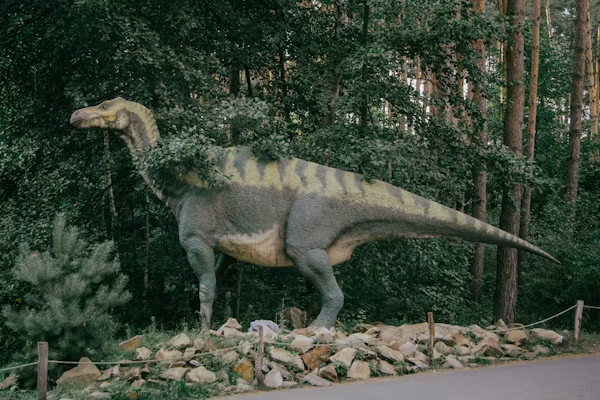
Paleontologists have confirmed the first Diplodocus fossils ever found outside North America, a set of 14 tail vertebrae and several chevrons unearthed at a site in eastern Spain and dated to roughly 150 million years ago.
What Was Found, and Where
The fossils came from the La Tejería site near El Castellar, in Spain’s Teruel province, and belong to an animal researchers estimate stretched roughly 25 meters, or 82 feet, long. The specimen dates to the Late Jurassic period, according to a study published in the Journal of Vertebrate Paleontology and detailed in a Taylor & Francis newsroom release. The fossils are now on public display at the Museo Aragonés de Paleontología in Teruel.
Why Tail Vertebrae Are Enough to Identify a Genus
Fourteen tail vertebrae and several chevrons, the bones that anchor tail muscles and protect blood vessels beneath the tail, might sound like a thin basis for identifying an entire dinosaur genus, but sauropod tails carry some of the most genus-specific skeletal features in the group. Diplodocus in particular is known for a distinctive “whiplash” tail structure, with vertebrae shaped differently than those of related sauropod genera like Apatosaurus or Barosaurus, which gave researchers a reliable anatomical signature to compare against North American reference specimens even without skull or limb material.
That is what allowed Sánchez Fenollosa’s team to confidently assign the Teruel fossils to Diplodocus specifically, rather than simply to the broader sauropod family, despite having only a partial section of the animal’s skeleton.
How a North American Dinosaur Reached Europe
Researchers believe the animal’s ancestors crossed from North America to what is now Europe over a temporary land bridge that existed while the Atlantic Ocean was still forming, a route that would have closed permanently as the ocean widened in the tens of millions of years that followed. Diplodocus had previously been documented only in North America, making this the first physical evidence that the genus, one of the most recognizable long-necked sauropods in popular understanding of dinosaurs, ever existed on a second continent.
The Researchers Behind the Discovery
The find was led by Sergio Sánchez Fenollosa, a doctoral student with the Joint Paleontology
Foundation Teruel-Dinópolis, and Dr. Alberto Cobos, managing director of Fundación Dinópolis. “We are delighted with this discovery,” Sánchez Fenollosa said. “It was an exciting and continuous process of seeing the pieces of the puzzle gradually fall into place.” He added, in comments to Live Science, “This discovery reminds us that even for such iconic dinosaurs, there are still many unanswered questions about their evolutionary history and biogeography.
” Cobos said, “The Diplodocus from El Castellar was approximately 25 meters long, making it another of the giant sauropods of the Spanish Jurassic.”
Why a Century of Fossil Hunting Missed This
Diplodocus has been one of the most extensively studied dinosaur genera since the 1870s, with specimens excavated across the western United States for well over a century, which raises the question of why evidence of a European population took this long to surface. Part of the answer is that the vertebrae found at La Tejería are fragmentary rather than a complete or even partial skeleton, requiring detailed comparative analysis against known North American Diplodocus specimens before researchers could confidently identify them as the same genus rather than a similar but distinct sauropod.
That kind of confirmation depends on having a large enough reference collection of confirmed Diplodocus bones to compare against, a resource that has only become robust enough for this level of certainty in recent decades as more North American specimens were cataloged and digitized.
Teruel’s Place on the Paleontology Map
The discovery adds to Teruel province’s reputation as one of Europe’s richest sources of Jurassic and Cretaceous sauropod fossils, a status built up over decades of excavation work tied to the Fundación Dinópolis research and museum network. The province has previously yielded other giant sauropod specimens, though none previously confirmed as belonging to a genus otherwise known exclusively from North America.
That existing excavation infrastructure, an active research foundation with a dedicated museum and ongoing field programs, is part of why Teruel was positioned to make and confirm a find of this significance rather than a lessdeveloped fossil site elsewhere in Europe.
What This Changes About Dinosaur Migration
Before this discovery, paleontologists’ understanding of Late Jurassic sauropod distribution treated the Atlantic-forming rift between North America and Europe as a more effective, earlier barrier to animal movement than this fossil now suggests it was. Confirmed evidence of a North American genus reaching Europe pushes back the timeline for when that land connection was still passable, or suggests the connection persisted intermittently longer than previously assumed, a detail that matters for reconstructing how other Jurassic species may have moved between the two future continents during the same window.
What Happens Next
Sánchez Fenollosa and Cobos’s team is seeking more complete Diplodocus specimens in the Teruel region to determine which specific species reached Europe and to map the migration route in more detail. The fragmentary nature of the current find means researchers cannot yet say definitively whether the European population represents a known North American Diplodocus species or a previously undocumented one that evolved after the migration.
Further excavation seasons at La Tejería and nearby sites are expected to continue as funding and field schedules allow, with any additional vertebrae or limb material likely to settle the species-level question the current 14 vertebrae cannot answer alone.