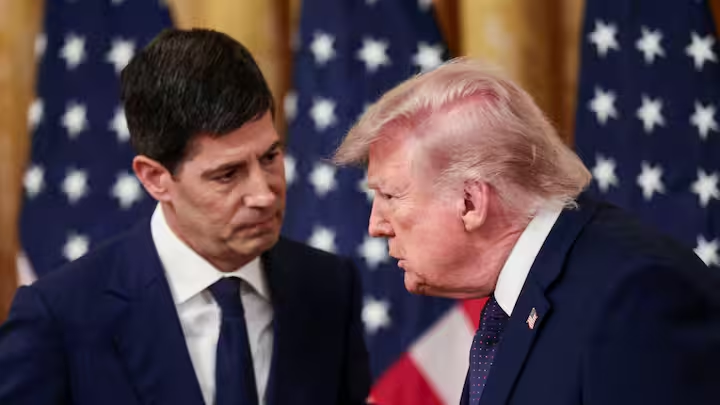
The Federal Reserve raised its benchmark interest rate a quarter point to a range of 3.75% to 4% on Sept. 16, the first increase since July 2023, after Chair Kevin Warsh said “inflation is too high and has been for too long” prompting President Donald Trump to publicly attack Warsh, his own appointee, over the decision.
A Unanimous Vote Trump Didn’t Want
The Federal Open Market Committee voted 12-0 to raise the rate, according to the Federal Reserve’s own press release. Warsh cited inflation readings well above the Fed’s 2% target: personal consumption expenditures inflation ran near 3.6% in August, with core PCE and consumer price index readings near 3.2% and 2.4% respectively, according to his remarks at the post-meeting press conference.
The Fed’s own projections, known as the dot plot, signal one more quarter-point hike is likely before year’s end, with rates expected to hold near 4% into 2027.
Markets fell the same day, with the S&P 500 down 0.5%, the Dow Jones Industrial Average down 1.3% and the Nasdaq down 0.08%, according to Fox Business. Goldman Sachs’ Kay Haigh said the Fed doesn’t “envisage an aggressive tightening cycle,” while Principal Asset Management’s Seema Shah said “the unanimous vote shows that rising energy prices and stubborn inflation have brought even the doves on board.”
Trump vs. His Own Appointee
Trump, who nominated Warsh to the Fed chairmanship, said on social media that interest rates “should be 1%, or less,” and told Warsh he “might as well vote with the board because it’s not going to matter,” calling the FOMC “a bunch of politicians,” according to Yahoo Finance. Warsh declined to discuss any conversation with the president when asked directly, saying, “I’ve got nothing for you on a discussion with the president.”
White House deputy press secretary Kush Desai called the hike a “rather unfortunate decision” that lacked “a particularly compelling economic case.”
Democratic lawmakers used the moment to criticize the administration’s broader economic record rather than the rate decision itself. Rep. Brendan Boyle said the hike shows Trump and congressional Republicans “failed on the economy,” while Sen. Elizabeth Warren argued that the administration’s own policies had prevented the Fed from cutting rates instead.
What a Quarter-Point Hike Means for a Mortgage
By Sept. 20, four days after the Fed’s move, the average 30-year mortgage rate had climbed to 7.04%, up 13 basis points from the prior week, with the 15-year rate at 6.56%, according to mortgage-rate tracking cited by Yahoo Finance. The Mortgage Bankers Association forecasts the 30-year rate averaging 6.6% to 6.7% through the end of the year, while Fannie Mae projects a slightly higher 6.7% to 6.8% range.
On a $400,000, 30-year mortgage, the difference between a 6.6% rate and a 7.04% rate works out to roughly $115 more in monthly payments, a concrete illustration of how a quarter-point Fed move translates into real household costs within days rather than months.
What’s Driving Inflation Back Up
Warsh’s press conference remarks pointed to rising energy prices as a specific driver behind the renewed inflation pressure, on top of already-elevated core prices that have proven slower to fall than the Fed projected earlier in the year. That combination, energy costs pushing headline inflation higher while core inflation stays stubborn rather than declining, is what Principal Asset Management’s Shah referenced in describing the vote as one that brought “even the doves on board,” meaning even the FOMC members who have historically favored lower rates and easier monetary policy concluded the inflation data left them little alternative.
Why a Trump Appointee Voted Against Trump’s Wishes
Warsh’s vote against the White House’s explicit preference is notable because the Fed chair position is a presidential appointment, and Trump has previously pressed for greater influence over the traditionally independent central bank. Warsh’s unanimous vote alongside the rest of the FOMC, despite public pressure from the president who appointed him, signals that at least for this decision, the committee prioritized its reading of inflation data over political pressure.
That dynamic sets up a recurring tension heading into further meetings this year, particularly if the Fed does deliver the additional quarter-point hike its own projections suggest is likely before December.
A Rare Public Rift Between a President and His Own Chair
Presidents have historically avoided directly and personally attacking a sitting Fed chair they themselves appointed, in part because doing so risks undermining confidence in the central bank’s independence, a norm financial markets generally price as a stabilizing feature of U.S. monetary policy. Trump’s direct criticism of Warsh, someone he selected specifically to lead the Fed, breaks from that norm more sharply than his criticism of prior Fed leadership, since Warsh cannot be dismissed as an inherited holdover with no loyalty to the administration.
What Happens Next
The Fed’s own projections point to one additional quarter-point increase before the end of the year, which would push the target range toward 4% to 4.25%. Mortgage rates are expected to stay elevated through the remainder of 2026 under both the Mortgage Bankers Association’s and Fannie Mae’s current forecasts. Whether Trump continues publicly pressuring Warsh ahead of the Fed’s next meeting, and whether that pressure affects the committee’s next vote, remains an open question heading into the final months of the year.
Warsh’s refusal to detail any private conversation with Trump leaves open whether the president’s public criticism translates into private pressure on the rest of the committee before its next scheduled meeting.